
Understanding Why Vehicles Pull
Steering pull - the tendency of a vehicle to drift left or right without driver input - is one of the most commonly reported handling complaints. While it can feel like a single problem, it is actually a symptom with several distinct mechanical causes. Identifying the correct cause matters: chasing the wrong diagnosis wastes money and leaves the real issue unresolved.
The four main categories to investigate are tyre condition and pressure, wheel alignment, brake system drag, and suspension or steering component wear. These categories are not mutually exclusive - a vehicle can have more than one contributing factor simultaneously.
The steps below follow a logical sequence from the most accessible checks to those that require equipment or professional assessment. Work through them in order rather than skipping ahead.
What you will need
Tools You Will Need
Most initial checks require only basic tools you likely already own. More involved tests - particularly brake drag and suspension inspection - require safely raising the vehicle.
Tyre pressure gauge
Accurately measures inflation in each tyre to identify pressure imbalances causing pull.
Floor jack and jack stands
Safely raises the vehicle so you can spin each wheel by hand to check for brake drag.
Torque wrench
Ensures lug nuts are torqued evenly when reinstalling wheels after a swap test.
Start Simple, Work Outward
Diagnostic efficiency improves when you move from the cheapest and easiest checks - tyre pressure - toward more involved inspections. This approach saves time and avoids unnecessary parts replacement. The same logical method applies across many vehicle issues; see our systematic diagnosis guide for a comparable framework applied to no-start conditions.
Step-by-Step Diagnostic Process
When Pull Appears Suddenly
A steering pull that develops abruptly - especially if accompanied by a shudder, noise, or unusual pedal feel - should not be dismissed as a minor nuisance. Sudden pull can indicate a tyre blowout in progress, a brake failure, or a suspension component separation. Reduce speed carefully, pull off the road, and do not drive the vehicle until it has been inspected.
Check and equalize tyre pressure
Start with the simplest and most common cause. Use a quality tyre pressure gauge to check all four tyres - including the spare if you recently rotated. Compare each reading against the manufacturer's recommended pressure printed on the driver's door jamb sticker, not the maximum pressure moulded into the tyre sidewall.
Even a 5-6 PSI difference between the left and right tyres on the same axle can generate a noticeable pull toward the lower-pressure side. Inflate all tyres to spec, then conduct a controlled test drive on a flat, straight road.
Perform a tyre cross-swap test
If pressure is correct but the pull persists, a single defective tyre with internal belt shift or uneven construction could be the culprit. Swap the front left and front right tyres (do not cross axles at this stage) and retest. If the pull switches direction, the tyre you just moved is the cause. If the pull remains the same, the tyres are not the source.
A tyre that pulls regardless of position likely has a radial force variation defect - your tyre shop can measure this with a specialized uniformity machine.
Inspect for brake drag
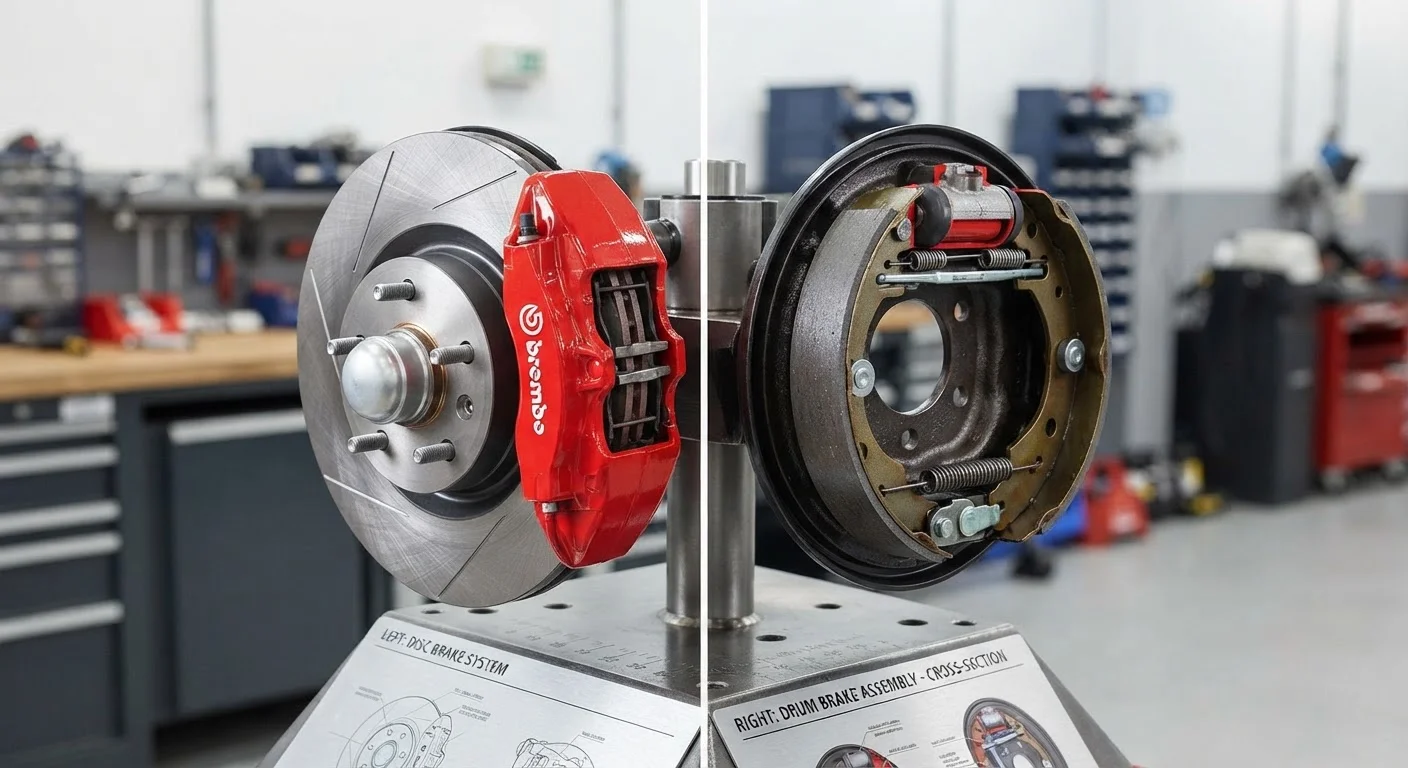
A seized caliper piston or a sticking slide pin can cause one brake to remain partially applied, generating heat and pulling the vehicle toward that corner. With the vehicle safely raised on jack stands and the engine off, attempt to spin each wheel by hand. A wheel that turns noticeably harder than its counterpart on the same axle, or one that is hot to the touch after a moderate drive, suggests brake drag.
Check also for a hose that has collapsed internally - this can trap hydraulic pressure and prevent a caliper from releasing fully.
Evaluate wheel alignment
If tyres and brakes check out, misaligned wheels are the next most likely cause. Camber (the inward or outward tilt of the wheel) and toe (whether wheels point inward or outward relative to the vehicle's centerline) are the two alignment angles most responsible for steering pull. A vehicle pulling toward the side with more positive camber is a common pattern.
Alignment cannot be accurately assessed by eye - it requires a four-wheel alignment machine at a qualified shop. If your vehicle recently hit a significant pothole, curb, or other road hazard, alignment should be checked promptly.
Assess suspension and steering components
Worn or damaged suspension parts - including tie rod ends, ball joints, control arm bushings, and strut mounts - can introduce play and instability that presents as a pull or drift. With the vehicle safely raised, grab each front wheel at the 9 and 3 o'clock positions and try to move it side to side. Then check the 12 and 6 o'clock positions for vertical play. Any detectable looseness warrants closer inspection.
Similarly, a damaged or worn strut on one side can alter ride height and geometry enough to cause a consistent pull. If you find worn components, have a certified technician evaluate and replace them before performing a final alignment.
When to Stop and Seek Professional Help
Several findings in this process indicate the vehicle should not be driven until a qualified mechanic has completed a full inspection:
- Evidence of brake drag, especially if accompanied by heat or a burning smell
- Visible damage to a tyre sidewall, bulge, or separated tread
- Detectable looseness in a ball joint or tie rod end
- Pull that worsened suddenly rather than developing gradually
If the pull is gradual and you've ruled out tyres, brakes, and visible component wear, a professional four-wheel alignment is the appropriate next step. Alignment machines measure angles to fractions of a degree - precision that cannot be approximated by visual inspection alone.
Alignment Does Not Fix Worn Parts
An alignment adjustment on a vehicle with worn ball joints, tie rod ends, or control arm bushings will not hold - and the measurements obtained may be inaccurate. Always repair or replace damaged suspension and steering components before scheduling a wheel alignment. Driving on misaligned or worn suspension accelerates tyre wear and reduces handling predictability.
This article is for informational and educational purposes only. Vehicle safety systems should be inspected and serviced by a qualified mechanic. The diagnostic steps described here are general guidance and may not apply to all vehicle configurations. Always consult your owner's manual and follow appropriate safety precautions when working on or around a vehicle.