How Each System Creates Stopping Force
Both disc and drum brakes are friction-based hydraulic systems: when you press the brake pedal, hydraulic pressure transmits through brake fluid to actuate a friction element against a rotating surface attached to the wheel. The energy of the moving vehicle converts to heat, slowing the wheel.
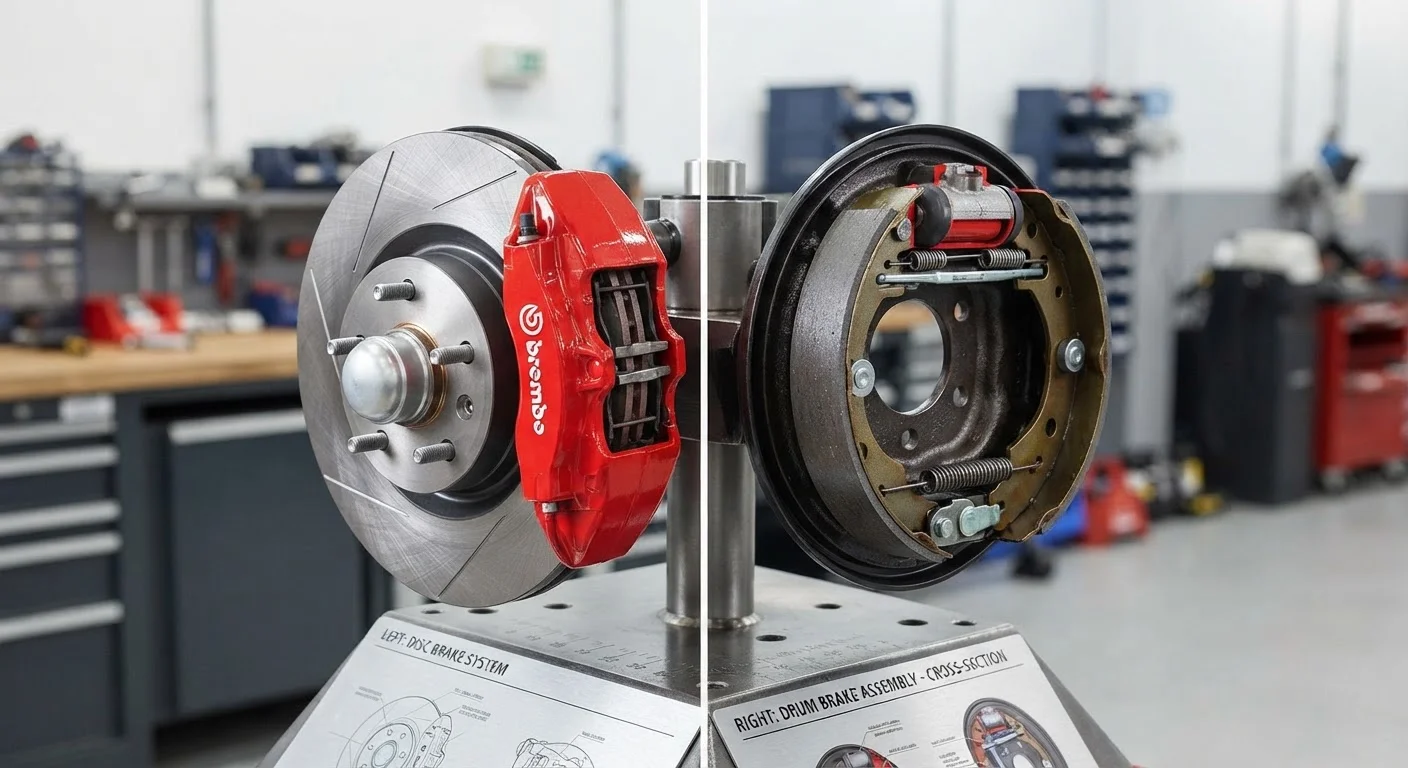
In a disc brake, a flat circular rotor (also called a disc) spins with the wheel. A caliper straddles the rotor and houses one or more pistons that, when pressurized, clamp brake pads against both faces of the rotor. The open design means heat can radiate away from the rotor quickly. Many rotors are vented - cast with internal channels - to accelerate this cooling.
In a drum brake, a hollow metal drum rotates with the wheel. Inside the drum, curved brake shoes lined with friction material are forced outward by a wheel cylinder when hydraulic pressure is applied. The shoes press against the inner surface of the drum, generating the braking force. Because the drum encloses the friction surfaces, heat has fewer escape routes - a meaningful limitation under sustained use.
Understanding how brake fluid transmits hydraulic force is just as important as knowing which friction system your vehicle uses, since degraded fluid affects both designs equally.
Heat Management and Brake Fade
Brake fade occurs when repeated or prolonged braking raises temperatures to the point where friction efficiency drops - the pedal may feel mushy, or stopping distances increase noticeably. Heat management is where disc and drum designs diverge most significantly.
~70%
Braking force handled by front axle
Under typical deceleration, forward weight transfer shifts the majority of braking demand to the front wheels, which is why front disc brakes are standard practice.
2-3x
Faster heat dissipation in vented disc rotors
Vented rotors with internal channels are commonly cited in brake engineering literature as substantially improving cooling compared to solid disc or drum designs.
Disc rotors - especially vented or slotted variants - expose the friction surface directly to airflow, allowing heat to escape efficiently. This makes discs more resistant to fade during downhill driving, towing, or repeated hard stops. Drum brakes trap heat inside the drum casing. As the drum heats up, it can expand slightly, which actually increases the distance the shoes must travel to make contact - a phenomenon called drum expansion - reducing braking effectiveness at elevated temperatures.
For most everyday driving at moderate speeds, drum brakes on rear axles perform adequately. The front axle, which handles the majority of braking force due to weight transfer under deceleration, is almost universally fitted with discs on modern passenger vehicles for precisely this reason.
Where Each Brake Type Is Typically Used
Vehicle manufacturers make brake layout decisions based on engineering requirements, cost, and regulatory standards. Understanding typical placement helps you anticipate what your own vehicle has and what service it may need.
| Criterion | Disc Brakes | Drum Brakes |
|---|---|---|
| Friction element | Brake pads clamp rotor | Brake shoes press drum interior |
| Heat dissipation | Excellent - open rotor design | Limited - enclosed drum traps heat |
| Resistance to fade | High | Moderate; declines with heat |
| Typical vehicle placement | Front axle; all four corners on many vehicles | Rear axle on economy and light-duty vehicles |
| Parking brake integration | Requires separate mechanism or caliper design | Integrated directly into shoe hardware |
| Manufacturing cost | Higher | Lower |
| Visual inspection ease | Easier - pads often visible through wheel | Harder - drum must be removed |
Front disc / rear drum combinations remain common on economy sedans, small crossovers, and light trucks. The front discs handle peak braking demand; the rear drums keep costs down and simplify the parking brake mechanism, which in drum systems is often integrated directly into the shoe hardware. Four-wheel disc setups are standard on most mid-size and larger vehicles, performance cars, and trucks with higher payload ratings.
Drum brakes also appear on trailers, certain commercial vehicles, and some older classic cars - not because they are inferior in every respect, but because they suit specific cost, weight, and integration requirements. If you're interested in how drivetrain layout interacts with braking balance, our article on rear-wheel drive vs. all-wheel drive in performance cars covers related dynamics.
Maintenance, Wear, and Inspection Considerations
Both systems require periodic inspection and component replacement, but the service process differs. Always consult your vehicle's service manual and, if you are uncertain about any brake work, have the system inspected by a qualified mechanic. Brakes are a safety-critical system.
Disc brake service typically involves measuring rotor thickness (rotors have a minimum discard thickness stamped on them), checking for scoring or heat cracking, and measuring brake pad depth. Pads are generally more accessible to inspect visually. Calipers should be checked for piston seizure and fluid leaks.
Drum brake service requires removing the drum to inspect shoe lining thickness, the condition of the wheel cylinder, return springs, and self-adjuster hardware. Because the assembly is enclosed, contamination from a leaking wheel cylinder seal can go unnoticed longer than a leaking disc caliper.
When to Involve a Professional Mechanic
Brake inspection and replacement are tasks where mistakes carry serious safety consequences. If you notice increased stopping distances, a spongy pedal, pulling to one side under braking, or unusual noise, have the system checked by a qualified technician promptly. DIY brake work is possible for experienced hobbyists, but always torque fasteners to specification and verify hydraulic integrity before driving.
Brake fluid condition matters regardless of which system your vehicle uses. Brake fluid absorbs moisture over time, which lowers its boiling point and can introduce air compressibility into the hydraulic circuit - affecting pedal feel and stopping distance in both disc and drum systems. Anti-lock braking systems, explained in our article on how ABS maintains steering control, work in conjunction with whichever friction system your vehicle uses.