Why Riding Context Shapes Legal Access
E-bike regulations in the United States do not follow a single national framework. Access rules are determined by a combination of federal guidelines, state statutes, and agency-level decisions made by land managers such as the National Park Service, U.S. Forest Service, and local municipalities. The result is a layered system where the same e-bike may be fully permitted on a city street, conditionally allowed on a multi-use path, and entirely prohibited on a singletrack trail - all within the same county.
The most practical tool for decoding these rules is the three-class system, which categorizes e-bikes by motor assist type and top assisted speed. If you're unfamiliar with how the classes work, e-bike classification is explained in detail here - understanding those tiers is the essential foundation before interpreting any access rule.
| National regulatory framework | No single federal law; rules vary by state, municipality, and land manager |
| Class 1 road access | Permitted on public roads in nearly all U.S. states |
| Class 3 path restrictions | Excluded from shared-use paths in many cities and counties |
| Trail access trend | Class 1 increasingly allowed where conventional mountain bikes are permitted on federal lands |
| Helmet requirements | Required for Class 3 riders in many states, regardless of age |
| Key verification step | Confirm rules with the specific land managing agency, not just state law |
Public Roads and Bike Lanes
In most U.S. states, all three e-bike classes are treated similarly to conventional bicycles on public roads, provided the rider meets any applicable age requirements and the bike stays within its rated assist speed. Class 3 e-bikes, which assist up to 28 mph, often carry additional state-level requirements: some states mandate helmet use for riders of all ages, minimum age thresholds (commonly 16), and explicit prohibition from certain low-speed vehicle zones.
Bike lanes on public roads generally follow the same state rules as the roadway itself. However, some municipalities layer additional restrictions - a city ordinance may exclude Class 3 bikes from protected bike infrastructure even where state law would otherwise permit them. Always verify local ordinances, not just state statutes.
State Law vs. Local Ordinance
State e-bike statutes establish baseline rules, but municipalities often have authority to impose stricter local requirements. A city may restrict Class 3 bikes from certain infrastructure even when state law would permit them. If you ride in multiple jurisdictions regularly, checking city or county ordinances separately from state law is a practical habit. The new e-bike owner's starting point covers how to approach local law research as part of first-time ownership.
Shared-Use Paths and Greenways
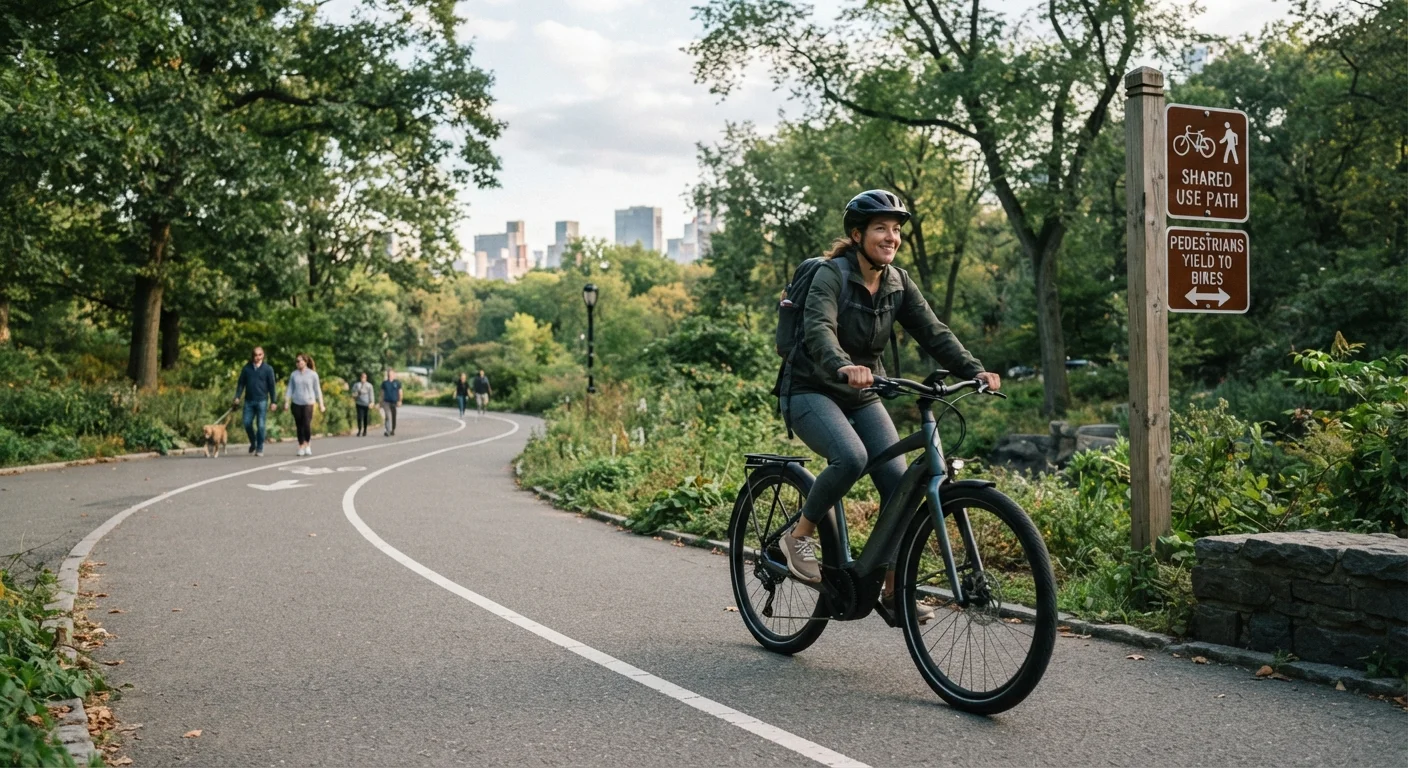
Paved multi-use paths - the kind shared by cyclists, pedestrians, and inline skaters - present some of the most variable access rules of any riding environment. Many jurisdictions default to treating Class 1 and Class 2 e-bikes identically to conventional bicycles on these paths. Class 3 bikes face more restrictions here than anywhere else: because of their higher top assisted speed, they are excluded from shared paths in a growing number of cities and counties.
Some park districts apply blanket bans on any motorized assistance, regardless of class, while others have explicitly updated their codes to mirror the three-class framework. Before riding a greenway or rails-to-trails corridor, check with the managing agency directly - signage is inconsistent and may not reflect the most current rules.
Class 1 e-bike
A pedal-assist e-bike with no throttle, where motor assistance cuts off at 20 mph. Generally the most broadly permitted class across road, path, and trail environments.
Class 2 e-bike
An e-bike with a throttle that can propel the bike without pedaling, with motor assistance limited to 20 mph. The throttle function often triggers additional restrictions on non-motorized trails and paths.
Class 3 e-bike
A pedal-assist e-bike (no throttle) where assistance extends up to 28 mph. Faces the most regulatory restrictions of the three classes, particularly on shared-use paths and natural-surface trails.
Multi-use path
A paved or packed-surface corridor shared by cyclists, pedestrians, and non-motorized users. Access rules for e-bikes on these paths are set locally and vary widely.
Land managing agency
A government body responsible for setting access rules on public lands, such as the U.S. Forest Service, Bureau of Land Management, National Park Service, or a state/county parks department.
Non-motorized designation
A trail or path classification that historically excluded any motorized vehicle. Many agencies are actively reviewing whether Class 1 e-bikes should remain excluded under this designation.
Natural Surface Trails and Public Lands
Trail access for e-bikes on natural surfaces is the most contested and rapidly evolving area of e-bike regulation. Federal land management agencies set rules independently for their jurisdictions, and those rules frequently differ from state and local policies applied to adjacent lands.
As a general pattern that has emerged across many jurisdictions: Class 1 e-bikes (pedal-assist only, no throttle, up to 20 mph) are increasingly permitted on trails where conventional mountain bikes are already allowed, particularly on Bureau of Land Management and U.S. Forest Service lands following updated guidance. Class 2 and Class 3 bikes face stricter scrutiny on natural-surface trails, with many land managers either restricting or outright banning throttle-assisted and higher-speed models from non-motorized trail designations.
State and county parks operate under separate authority and often have more conservative default policies. Private trail networks set their own rules entirely. The practical takeaway: trail access must be confirmed for each specific land unit, not assumed from broader agency policy.
For riders who depend on carrying gear - such as cargo e-bike users - trail access restrictions can compound quickly. Cargo e-bikes introduce additional considerations beyond class alone, including weight and width that some trail systems restrict independently of motor rules.
This article provides general regulatory context for informational purposes. Rules vary significantly by jurisdiction and change frequently. Always verify current access rules with the relevant managing authority before riding in any specific location.