Why Specialty Bike Styles Exist
Most bicycle categories are built around versatility - the ability to handle varied terrain, distances, or rider types. Specialty bikes flip that logic entirely. BMX, dirt jump, and trials bikes are engineered for a single, well-defined purpose, and every design decision flows from that purpose. Compromising on fit between rider and discipline doesn't just reduce performance; it can make a style of riding genuinely harder to learn.
If you're exploring the broader landscape of bike categories, The Bicycle Style Spectrum offers a useful overview of how all major styles relate to one another. For riders navigating terrain that doesn't fit neatly into one box, Picking a Bike Style When You Ride Mixed Terrain addresses those trade-offs directly. What follows breaks down what makes each specialty style genuinely distinct.
BMX Bikes: Built for the Skatepark and the Street
BMX (Bicycle Motocross) bikes are among the most recognizable specialty styles in cycling. Characterized by small 20-inch wheels, a single-speed drivetrain, and a compact, low-slung chromoly or hi-ten steel frame, they are engineered to absorb repeated impacts while remaining light enough for aerial maneuvers.
There are several sub-disciplines within BMX itself: park riding (skateparks and bowls), street riding (urban obstacles and stairs), racing (short-course dirt circuits), and flatland (ground-level trick sequences). Each variant prioritizes slightly different geometry - race BMX frames, for example, are longer and more upright for out-of-the-gate sprint efficiency, while park and street frames are shorter and lower for rotational tricks.
Key characteristics across BMX styles include: 14mm or 3/8-inch axle dropouts for strength, 25/9 or similar fixed gear ratios, gyro or cable detanglers on many freestyle builds, and reinforced hubs designed to handle grinding and impact loads repeatedly without deformation.
BMX frames are engineered for repeated impacts - durability under stress is the defining design principle.
Dirt Jump Bikes: Where BMX Meets Mountain Geometry
Dirt jump (DJ) bikes occupy a deliberate middle ground between BMX and trail mountain bikes. They typically run 26-inch wheels - though 27.5-inch options exist - with a single-speed or occasionally 1x drivetrain, a hardtail frame with a short-travel suspension fork (usually 80-100mm), and wide, flat bars for aerial control.
The longer wheelbase compared to BMX improves stability at higher speeds and on larger jumps, while the suspension fork softens landings on dirt lips and tabletops. DJ bikes are designed specifically for progressive jump lines at bike parks, pump tracks, and dedicated dirt facilities - not for trail riding or commuting.
Because DJ geometry is optimized for jumping and landing, these bikes often feel awkward on sustained climbs or technical singletrack. Riders drawn to this style are typically focused on developing air time, trick vocabulary, and landing technique - a narrower but deeply rewarding skill progression. For comparison of how suspension geometry decisions play out across broader off-road riding, see What Makes a Mountain Bike a Mountain Bike.
The longer wheelbase gives dirt jump bikes speed stability that pure BMX frames can't match on larger features.
Trials Bikes: Precision, Balance, and Zero Momentum
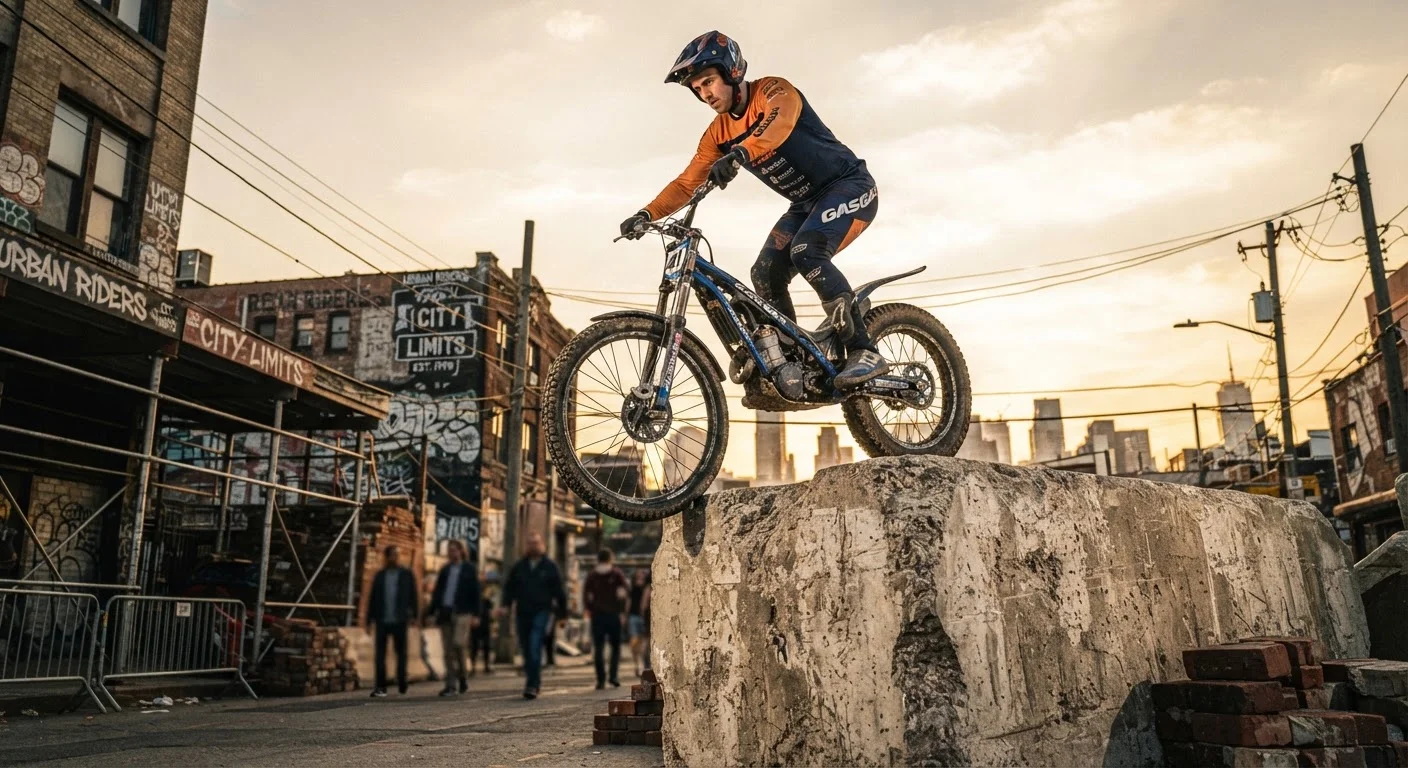
Trials riding is perhaps the most technically demanding cycling discipline - and the one whose bikes look least like conventional bicycles. Trials bikes are defined by what they remove rather than what they add: no saddle (or a vestigial one), no suspension, minimal gearing (often a single rear sprocket), and ultra-slim frames designed entirely around static balance and explosive, precise hops.
There are two main formats: stock trials (26-inch wheels, natural or urban obstacles, more accessible geometry) and mod trials (20-inch wheels, no rear brake required in some competition formats, extremely low bottom bracket). Both require a hydraulic rear brake capable of holding the wheel locked during balance moves - braking precision is non-negotiable in this discipline.
Trials bikes are not transportation. They are not trail bikes. They exist to allow riders to navigate impossible-looking terrain - boulders, walls, pallets, car roofs - through body position, timing, and progressive weight transfer. The learning curve is steep, but the skill transfer to other cycling disciplines, particularly mountain biking, is well-documented among experienced riders.
Trials bikes strip away everything non-essential - the result is a machine built purely for balance and precision.
Frame Materials and Why They Matter in These Categories
In mainstream cycling, frame material debates often center on ride feel and weight savings over long distances. In specialty disciplines, material choices are driven by impact resistance, weld integrity under stress, and repairability.
Chromoly steel (4130 chromoly alloy) dominates BMX and trials for good reason: it is strong, relatively lightweight for steel, weldable by skilled fabricators, and capable of flexing slightly under impact without catastrophic failure. DJ bikes increasingly use aluminum alloy frames for their weight-to-stiffness ratio on jump-focused builds, though chromoly remains common in entry and mid-range segments.
Carbon fiber is rare in these categories. Its failure mode under impact - sudden fracture rather than deformation - makes it poorly suited to disciplines where crashes and hard landings are part of the learning process. Riders evaluating bicycle components for any of these styles should prioritize strength ratings and material specifications over aesthetic appeal.
Chromoly steel's ability to deform rather than fracture makes it the material of choice for high-impact specialty riding.
What These Bikes Are Not Built For
Understanding the limits of specialty bikes is as important as understanding their strengths. BMX bikes are not comfortable for distances beyond short urban segments - the riding position is aggressive, there are no gears, and wheel size limits rolling efficiency. Attempting to use a trials bike as a commuter is impractical; without a saddle or meaningful gearing, sustained pedaling is neither comfortable nor efficient.
Dirt jump bikes come closest to dual-purpose use - some riders pedal them to and from bike parks - but the single-speed drivetrain and jump-specific geometry impose real limitations on road or trail performance. If a rider's routes and goals are genuinely mixed, specialty bikes are the wrong starting point. Cyclocross, gravel, and adventure bikes are among the categories better suited to riders who need adaptability across surface types.
Matching the bike to the actual riding being done - rather than the riding one imagines doing - is the central discipline in any bike selection process.
Specialty bikes perform brilliantly within their discipline and poorly outside of it - that trade-off is intentional.
Choosing the Right Specialty Style
The clearest signal that you've matched the right bike to your discipline is that the bike stops being something you compensate for and becomes an extension of your movement. None of these three styles should be chosen casually or swapped out as a cheaper alternative to another - as choosing a bike based on price alone rarely produces good results in any category, and in specialty disciplines the misfit is immediately apparent.
Try Before You Commit to a Specialty Style
If possible, rent or borrow a discipline-specific bike before purchasing. Many bike parks and urban riding communities facilitate demo days or informal lending. Spending a few hours on a genuine trials or DJ bike reveals quickly whether the discipline's physical demands and skill requirements align with your goals - saving both money and frustration down the line.
Understanding specialty bikes also deepens appreciation for adjacent disciplines. Riders curious about how terrain-specific geometry applies to trail riding may find value in comparing hardtail vs. full-suspension mountain bikes, where similar trade-off logic applies. When you know precisely what you want to ride - and how - the right specialty bike becomes a straightforward, well-supported choice.