
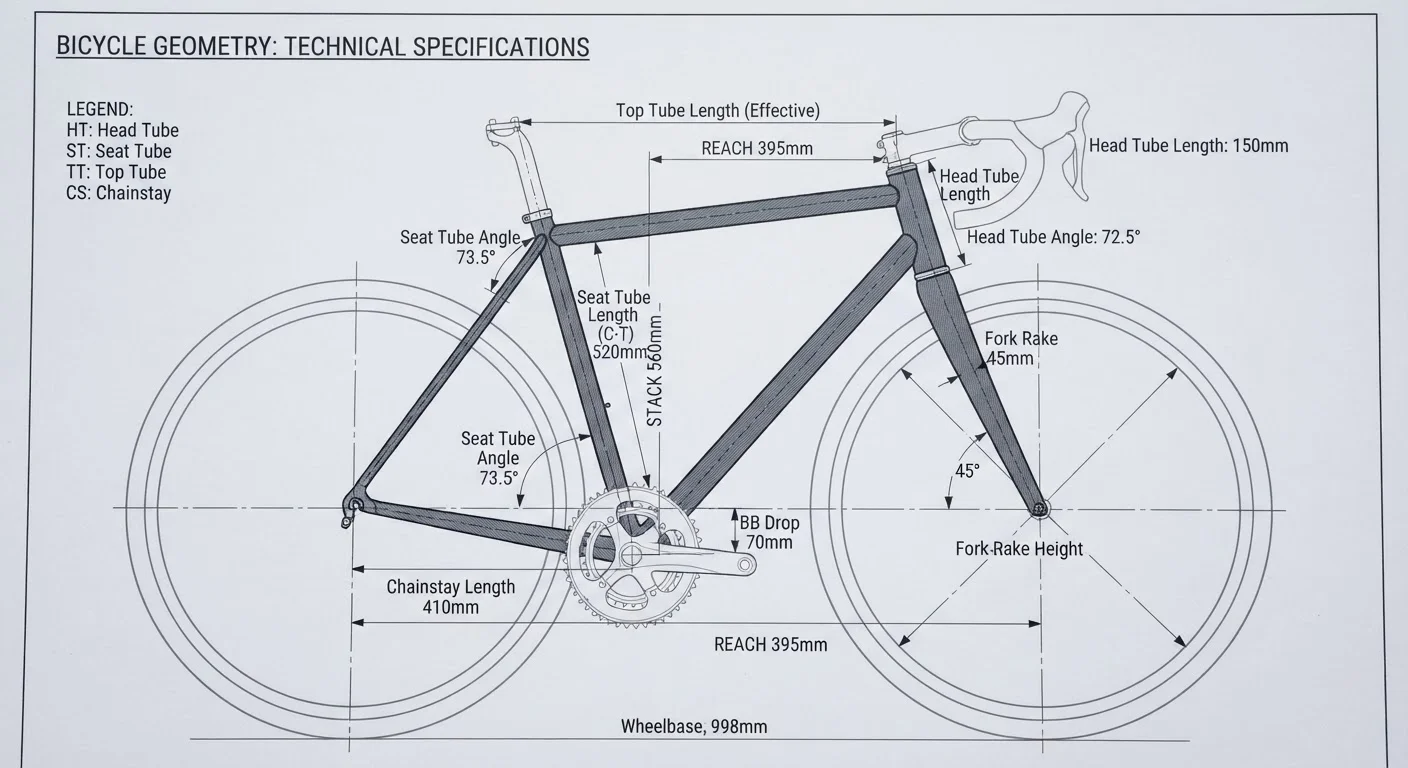
Why Geometry Specs Matter
Every bicycle is defined by a set of geometric measurements that determine how it handles, how it fits, and what kind of riding it suits best. Two bikes with identical components but different geometry can feel like completely different machines. Whether you're comparing a nimble road racer to a stable touring bike, these numbers are the language manufacturers use to encode ride character into metal and carbon fiber.
Understanding geometry doesn't require an engineering degree. The key is knowing which measurements describe rider position, which describe handling behavior, and how they interact. This glossary covers the terms you'll encounter on spec sheets and in geometry charts - organized so you can use them immediately.
| Stack range (road vs. mountain) | ~540-620 mm road; ~580-650 mm trail MTB (Typical published geometry ranges from major frame categories) |
| Head tube angle - road race | 73-74° (Common range across road racing geometry charts) |
| Head tube angle - enduro MTB | 63-65° (Typical slack geometry for aggressive descending) |
| Chainstay length - XC mountain | 425-435 mm (Short stays for agility in cross-country racing frames) |
| Wheelbase - city/touring bikes | 1,020-1,080 mm (Longer wheelbase typical of stable, load-capable designs) |
| Primary fit axes | Stack (vertical) and reach (horizontal) (Industry-standard sizing coordinates used across manufacturers) |
For a deeper look at how individual components interact with the frame, see the Bicycle Anatomy guide and the complete components guide.
Core Geometry Terms Defined
Stack
The vertical distance from the bottom bracket center to the top of the head tube. Stack is the primary number governing how upright or low your riding position will be.
Reach
The horizontal distance from the bottom bracket center to the top of the head tube. Reach determines how stretched-out or compact your body position will feel over the bars.
Head Tube Angle
The angle of the head tube relative to the ground, measured in degrees. Steeper angles produce quicker, more reactive steering; slacker angles slow steering and increase high-speed stability.
Trail
The distance between where the front wheel contacts the ground and where the steering axis projects to the ground. Greater trail generally means more self-centering stability; less trail produces lighter, more twitchy steering.
Chainstay Length
The distance from the bottom bracket center to the rear axle. Shorter chainstays tighten handling and snappy acceleration; longer ones improve stability and cargo capacity.
Wheelbase
The total distance between front and rear axle contact points. Longer wheelbases are inherently more stable at speed; shorter wheelbases maneuver more quickly in tight spaces.
Bottom Bracket Drop
The vertical distance the bottom bracket sits below the axle centerline height. More drop lowers your center of gravity for stability; less drop increases pedal clearance over obstacles.
Seat Tube Angle
The angle of the seat tube relative to horizontal. A steeper seat tube angle shifts your weight forward over the pedals, a geometry choice common on climbing-oriented mountain bikes and time trial frames.
Fork Offset (Rake)
The perpendicular distance between the steering axis and the front axle. Fork offset, combined with head tube angle, determines trail - the two are always evaluated together.
Standover Height
The distance from the ground to the top tube at its midpoint. Adequate standover clearance is a basic safety requirement, especially important on mountain bikes where dismounting quickly is common.
Stack and reach work together as a coordinate system: reach tells you how far forward you'll be stretched, stack tells you how high. A bike with high stack and short reach places you upright and comfortable - typical of city or hybrid bikes. Low stack and long reach puts you in an aggressive, aerodynamic position common on road racing frames.
Head tube angle is one of the most influential single numbers in handling. A steep angle (74-75°) makes steering quick and responsive, suited to criterium racers and XC mountain bikes. A slack angle (63-68°) slows steering and adds stability at speed, which is why enduro and downhill mountain bikes use slack head tubes. Chainstay length directly affects how the bike accelerates and corners - shorter stays snap out of corners more energetically, while longer stays improve load carrying and stability.
Handlebar and stem choices interact directly with reach and stack, letting riders fine-tune position without changing frames. Trail and wheelbase rarely appear on consumer marketing materials but carry real weight when comparing bike styles - see the bicycle style spectrum for how these numbers vary across categories.
Geometry Charts Vary by Manufacturer
Not all brands measure every dimension identically. Some include fork offset in their reach calculation; others do not. When comparing geometry across brands, confirm which reference points each uses before drawing conclusions. A professional bike fit can translate these numbers into actionable size recommendations for your body proportions.
Applying Geometry to Your Bike Choice
Geometry specs become practical tools when you use them comparatively. Rather than memorizing ideal numbers, look at how a bike's measurements differ from a reference point - your current bike, a test ride, or a category benchmark. A longer reach on an otherwise similar frame will require more core engagement. A slacker head angle will demand more deliberate inputs in tight corners but reward you with planted confidence on descents.
If you're still narrowing down which style suits your riding, the pre-purchase checklist structures that decision around terrain, frequency, and fit preferences. Geometry knowledge pairs well with that process - once you know the category that fits your use case, you can use geometry charts to distinguish individual frames within it.
E-bike frames often carry modified geometry to accommodate battery placement and motor weight; the e-bikes section covers how those design constraints influence ride character. Always cross-reference a manufacturer's geometry chart with a professional fit if you're buying a frame sized close to a boundary between sizes.