Why In-Cabin Clutter Is More Than an Annoyance
Most drivers underestimate how much a disorganised cabin affects their focus. Loose items sliding across the dash, cables tangled around the shifter, receipts and charging cords competing for the cupholder - each one generates a small but real cognitive demand. Over a commute or a long haul, that accumulated mental overhead contributes to fatigue in ways that are easy to overlook.
The fix rarely requires a full cabin overhaul. Targeted organisation accessories address specific friction points - the places where disorder actually interrupts your drive. Before adding anything, it helps to audit what's actually causing the chaos. As our guide on accessory overcrowding explains, adding more gear without a plan can create new problems rather than solving existing ones.
The list below covers accessories that solve real, common sources of in-cabin disorder - not novelty gadgets that occupy space without earning it.
Center Console Organisers and Tray Inserts
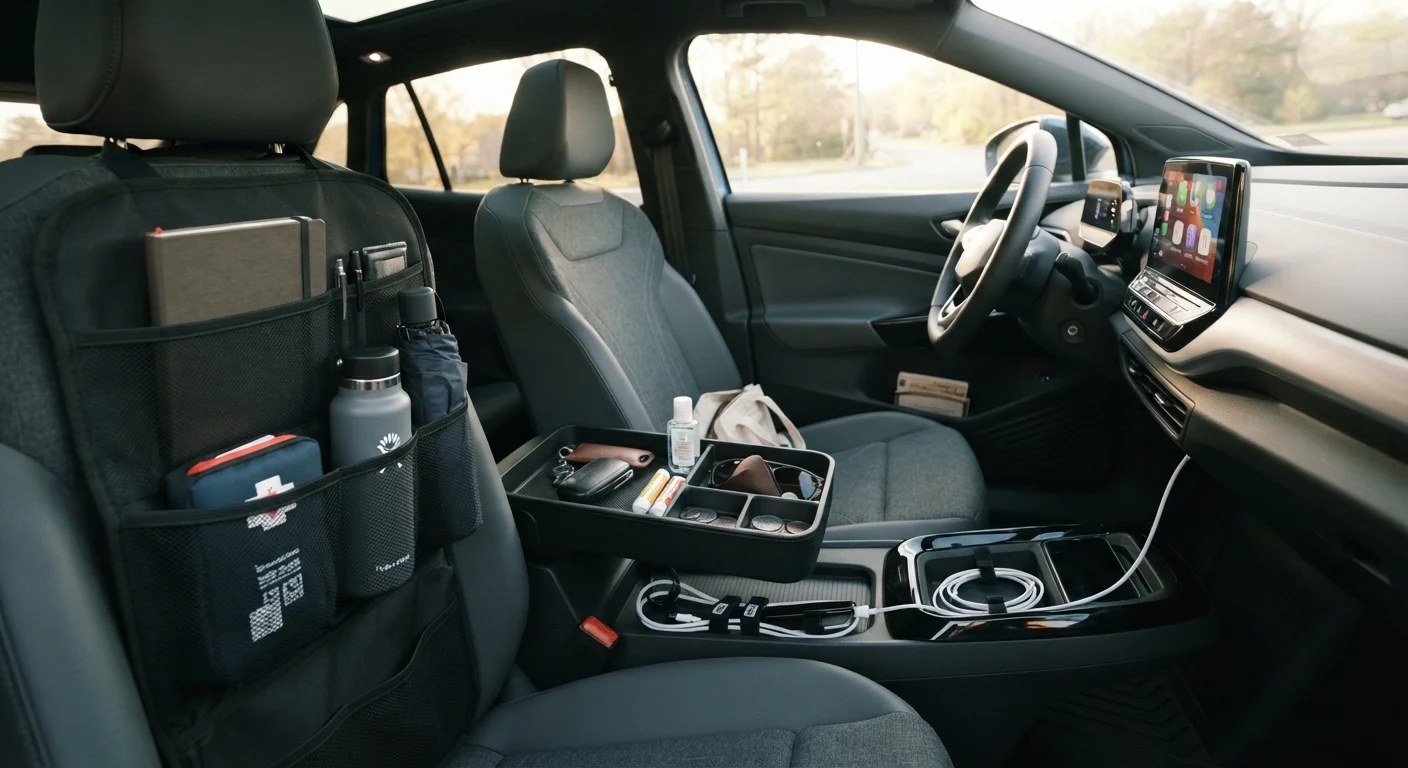
The center console is often the cabin's highest-traffic zone - coins, lip balm, charging cables, sunglasses, and toll receipts all migrate there by default. A molded insert or removable tray divides that space into defined compartments, so each item has an assigned location. When items don't shift during cornering or hard braking, the visual and physical distraction of scrambling for something at a stop light disappears.
Look for inserts that match your specific vehicle's console dimensions rather than universal-fit trays, which often leave gaps where items can still slide.
A molded console insert eliminates the scramble for items that shift during every turn.
Seat-Back Organizers for Rear-Seat Storage
Rear passengers - especially children - tend to generate the most loose-item chaos. Seat-back organisers that hang from the front headrest posts consolidate snacks, tablets, small toys, water bottles, and travel essentials into pockets that stay put during the drive. This keeps the floor clear and reduces the frequency of items rolling under seats and requiring mid-drive retrieval.
Organisers with a rigid backing hold their shape better under load and are easier to access than floppy fabric versions that collapse when full.
Seat-back pockets cut floor clutter and stop rear passengers from handing items forward while driving.
Magnetic or Clip-Mount Phone Holders
A phone without a secure mount is one of the most common sources of driver distraction. Whether it's sliding across the seat, falling into the footwell, or balanced precariously on the dash, an unsecured phone creates repeated temptation to reach or look away. A properly positioned mount - vent-clip, dash-adhesive, or windshield - keeps the device in a fixed location within sightlines without requiring manual repositioning.
Magnetic mounts with a metal plate on the device case allow one-handed placement and removal without looking down. For drivers concerned about ergonomics, our car ergonomics guide covers sightline positioning in more detail.
A secured phone mount eliminates the single most common reach-while-driving temptation.
Cable Management Clips and Anchors
Charging cables are the cabin equivalent of a garden hose left on the floor - functional but perpetually in the way. Adhesive cable clips or routed cable channels along the door sill or dash edge keep cords off the shift lever, out of the cupholder, and away from the driver's arm movement zone. A tethered cable that stays plugged in and ready reduces the fumbling that happens when a device runs low on a drive.
Short, right-angle cables designed for in-car use take up significantly less space than standard cables and are worth considering when fitting a cable management solution.
Routed and clipped cables stay out of the arm movement zone, removing a persistent minor distraction.
Trunk and Cargo Area Organisers
Cargo that shifts in the trunk during braking or cornering isn't just annoying - the sound of sliding items and the knowledge that groceries are tipping over competes with driving focus. Collapsible trunk organisers with non-slip bases hold bags, emergency kits, and reusable shopping totes upright and grouped by purpose. Keeping an emergency kit in a dedicated, fixed compartment also means it's accessible when needed rather than buried under other cargo.
For RV and camper owners, living-space organisation principles translate well to the vehicle tow rig's cargo area, where similar needs for compact, accessible storage apply.
A non-slip trunk organiser stops the slide-and-thud distraction that begins the moment you brake.
Visor Document Organizers and Sun-Side Pockets
Registration, insurance cards, parking passes, and toll receipts are infrequently accessed but often frantically searched for at the worst moments - a toll booth, a traffic stop, a parking garage exit. A slim visor organizer keeps these flat documents in a fixed, findable location. Unlike a glovebox filled with loose paperwork, a visor pocket puts the most-requested documents at immediate reach without requiring a search.
Keeping this organizer limited to genuinely needed documents prevents it from becoming a second junk drawer at eye level.
A visor organizer turns document panic at toll booths and traffic stops into a two-second retrieval.
Building a System That Stays Organised
The accessories above are most effective when treated as a system rather than individual purchases. A trunk organiser that keeps groceries upright does little good if the front seat is still buried in chargers and paperwork. Prioritise the areas that cause the most friction in your specific routine first.
Start With an Audit, Not a Shopping List
Before purchasing any organisation accessory, spend five minutes identifying the three items that cause the most friction in your current cabin. Loose cables, an unsecured phone, and items migrating from the back seat account for the majority of in-drive distractions for most drivers. Solving those specific problems first delivers the largest stress reduction per dollar and square inch of cabin space used.
For drivers who spend extended time on the road, organisation intersects with comfort and ergonomics more broadly. Our interior comfort setup guide covers how accessory placement interacts with seating position and climate control. If long drives are a regular part of your schedule, the road trip comfort checklist pairs well with an organisation audit before departure.
It's also worth noting that clutter is only one source of driver fatigue. Cabin noise contributes independently - and sometimes more significantly - to the mental toll of long journeys. Addressing both gives you the cleanest foundation for a low-stress ride.