Why a Roadside Kit Deserves Serious Attention
Most drivers assume breakdowns happen to other people - until they're standing on the shoulder of a dark highway watching traffic fly past at speed. A roadside emergency doesn't have to be catastrophic to be dangerous; even a flat tire or dead battery puts you and other road users at real risk if you're unprepared.
The items covered here are grounded in practical, real-world scenarios rather than worst-case fear. They're chosen because they address the most common and preventable causes of roadside injury: poor visibility, inability to signal hazard, untreated minor injuries, and mechanical immobility. For a broader look at how safety equipment functions, see our Driver Safety Gear Explained article. Our Safety Equipment Glossary is also a useful reference if any terms below are unfamiliar.
State and Local Requirements Vary
Some U.S. states and Canadian provinces have specific requirements around warning devices, fire extinguishers, or first aid kit contents for commercial vehicles or towed units. If you operate a commercial vehicle, tow a trailer, or frequently drive across borders, review the applicable regulations for those jurisdictions. The items listed here represent broadly useful equipment for private passenger vehicles, not a legal compliance checklist.
The Core Eight Items
Warning Triangles or Road Flares
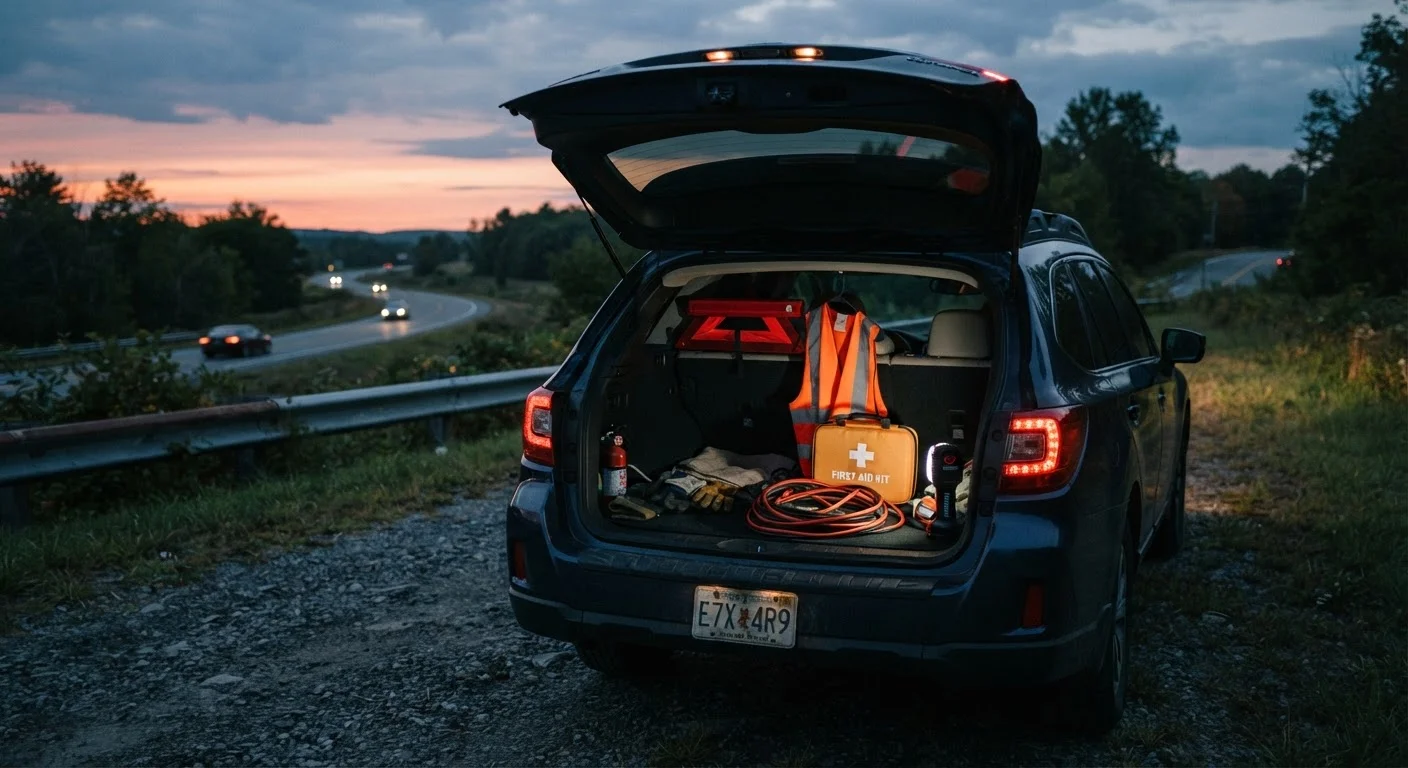
Reflective warning triangles are reusable, weather-resistant, and can be seen from a significant distance when positioned correctly. Place the first immediately behind your vehicle, a second roughly 50 feet back, and a third at 150-300 feet depending on road speed. Road flares offer similar visibility in adverse weather but are single-use and require careful handling due to the open flame. Some drivers carry both. Whatever you choose, deploy them before attempting any repairs.
Deploy warning devices before anything else - visibility is your first line of protection.
Hi-Vis Reflective Vest
A high-visibility vest dramatically increases how detectable you are to approaching drivers, particularly at night or in low-light conditions. Critically, store it inside the passenger cabin - in the door pocket, under a seat, or in the glovebox - so you can put it on before stepping out onto the shoulder. A vest sitting in the trunk is useless if you have to exit an unlit roadway to retrieve it. Look for ANSI/ISEA Class 2 or higher rating for adequate roadway visibility.
Keep your hi-vis vest inside the cabin so you can put it on before exiting the vehicle.
Jump-Start Cables or a Portable Battery Pack
A dead battery is among the most frequent roadside scenarios. Traditional jumper cables require a second vehicle, which means waiting for a willing passer-by. Portable lithium jump-starter packs - now compact enough to fit in a glovebox - allow you to restart most passenger vehicles independently. Whichever option you carry, familiarize yourself with the correct connection sequence before you need it: positive to positive, negative to an unpainted metal ground rather than directly to the dead battery's negative terminal, to reduce spark risk near battery gases.
Portable jump-starter packs let you restart your vehicle without waiting for another driver.
Compact First Aid Kit
A roadside first aid kit doesn't need to rival a paramedic's bag, but it should go meaningfully beyond a handful of adhesive bandages. Prioritize: sterile gauze pads, medical tape, nitrile gloves, an emergency mylar blanket, antiseptic wipes, and over-the-counter pain relief. If anyone in your vehicle has a known medical condition - severe allergies in particular - their prescribed emergency medications belong in the kit as well. The goal is to manage minor injuries and stabilize more serious ones while waiting for emergency services.
Include nitrile gloves and sterile gauze - minor wound management matters most at roadside.
Flashlight or Headlamp with Spare Batteries
Your phone's flashlight is a backup, not a tool. A dedicated LED flashlight or hands-free headlamp leaves both hands available for changing a tire, reading under a hood, or signaling. Headlamps are particularly practical for solo drivers. Store spare batteries separately in a small zip-lock bag; batteries left inside a flashlight for extended periods can corrode and damage the unit. Test your light source at least twice a year.
A headlamp frees both hands - invaluable when changing a tire alone after dark.
Tire Inflation Equipment
A full-size or compact spare tire is only useful if it's properly inflated. Check your spare's pressure every few months - spares are frequently forgotten until they're needed. Complement the spare with a quality lug wrench that fits your vehicle's lug nuts (confirm fitment; universal wrenches sometimes slip), a jack rated for your vehicle's weight, and the jack placement points detailed in your owner's manual. A portable 12V tire inflator adds flexibility for slow leaks that don't require a full swap.
Check your spare tire's inflation pressure regularly - most drivers discover it's flat at the worst moment.
Basic Tool Set and Duct Tape
A small pouch containing adjustable pliers, a flathead and Phillips screwdriver, zip ties, and a roll of duct tape handles an outsized range of minor roadside issues - securing a loose heat shield, temporarily bundling a fraying wire, reattaching a bumper panel clip, or routing a dragging component away from moving parts. This isn't a substitute for professional repair; it's a get-you-to-the-shop kit. Keep the tool selection focused and compact so it actually travels with you.
Zip ties and duct tape alone have resolved countless get-you-home roadside situations.
Water, Non-Perishable Food, and a Charged Power Bank
Waiting for roadside assistance in summer heat or a winter storm is a reality many drivers underestimate. Two to three bottles of water per person, a small supply of calorie-dense snacks, and a fully charged external battery pack are straightforward additions that matter in extended wait scenarios. The power bank keeps your phone functional for calls, navigation, and emergency alerts when your vehicle battery is compromised. Rotate water and food on the same schedule as your annual kit review.
A charged power bank keeps emergency communication available even when your vehicle battery is dead.
One Simple Annual Habit
Set a recurring calendar reminder - your birthday works well - to open your emergency kit and run through each item. Check battery charge levels, verify expiration dates on any medications or food, ensure flares haven't passed their printed shelf life, and confirm your spare tire's pressure. Fifteen minutes once a year keeps the kit genuinely functional when it matters.
Building a Kit That Actually Gets Used
The best emergency kit is one you've organized intentionally - not a jumble of items tossed in a bag years ago. Store your kit in a consistent, accessible location. For SUVs and trucks, a shallow cargo organizer keeps gear from shifting. Sedan drivers often do better with a structured bag that sits upright in the trunk. Check the kit at least once a year: medications expire, batteries drain, and flares have shelf lives.
If you regularly drive with passengers, consider their needs too. Families with young children may want to expand the first aid component. Drivers who spend time on remote roads - or who tow trailers and RVs - should add a tow strap and a more robust water supply. RV and camper owners can find additional preparation context in the RV Living hub. For a closer look at the visibility items in your kit, our guide on reflective gear and high-vis vests explains the performance differences between material types. And if you're curious about what commonly gets left out, When Safety Gear Gets Overlooked is worth reading alongside this list.