
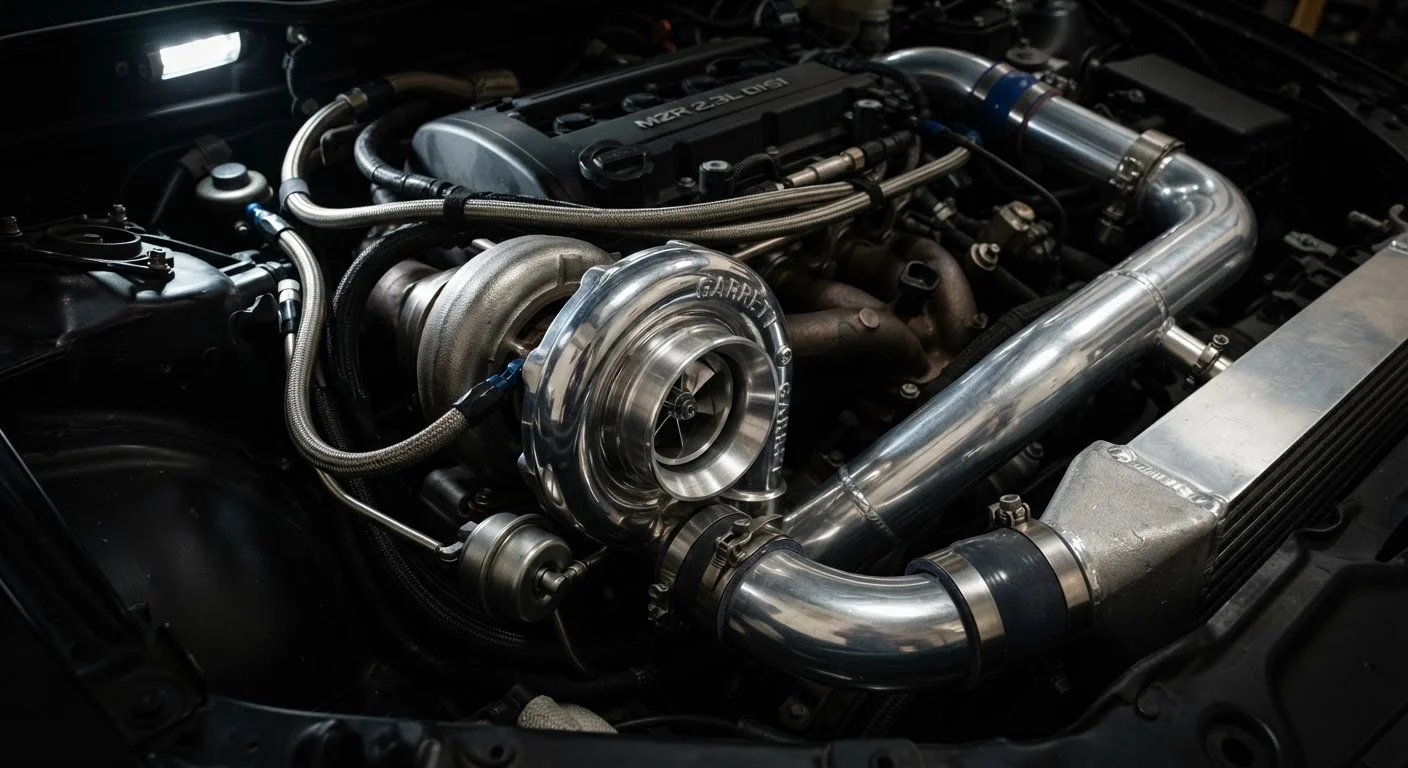
What Is Forced Induction?
A naturally aspirated engine depends entirely on atmospheric pressure to draw an air-fuel mixture into its cylinders. Forced induction breaks that dependency by mechanically compressing intake air before it enters the combustion chamber. More air means more oxygen, which allows more fuel to burn per cycle - the result is significantly greater power output from the same displacement engine.
This principle underpins two dominant technologies: turbochargers and superchargers. Both compress intake air, but they source their driving energy from entirely different places, which shapes everything from throttle feel to installation complexity. If you're newer to the broader performance landscape, the performance cars beginner's guide provides helpful context on how power modifications fit into the larger picture of vehicle performance.
30-50%
Typical power increase from factory-level boost
Industry estimates suggest entry-level forced induction kits can increase naturally aspirated output by 30-50% depending on engine architecture and tune.
100,000+ RPM
Turbocharger shaft speeds under load
Modern turbocharger compressor wheels routinely exceed 100,000 RPM, which is why oil quality and heat management are so critical to longevity.
3-15 PSI
Common street-driven boost pressure range
Most street performance builds target 6-12 PSI of boost; exceeding this on stock internals carries rapidly increasing risk of mechanical failure.
How Turbochargers Work
A turbocharger consists of two turbine wheels mounted on a shared shaft inside a divided housing. Exhaust gases exiting the engine spin the turbine side; that shaft simultaneously spins the compressor side, which draws in and pressurizes fresh intake air. Because turbochargers harvest energy from exhaust flow that would otherwise be wasted, they are thermodynamically efficient and can generate substantial boost without a direct mechanical tax on the crankshaft.
The compressed air exits the compressor hot. Most turbocharged setups route it through an intercooler - a heat exchanger that lowers charge-air temperature before it enters the intake manifold. Cooler, denser air contains more oxygen per unit volume, improving combustion efficiency and reducing knock risk.
The well-known downside is turbo lag: at low RPM, exhaust flow is insufficient to spool the turbine quickly, producing a noticeable delay between throttle input and boost response. Variable-geometry turbos and twin-scroll housings reduce but rarely eliminate this characteristic entirely.
When evaluating a turbo kit, prioritize the quality of the oil feed and drain lines over compressor specifications. Inadequate oil supply is the leading cause of premature turbo failure, not boost level.
Turbine bearings rely entirely on oil film for lubrication at extreme rotational speeds. A restricted or poorly routed drain line allows oil to pool and coke, degrading bearing surfaces rapidly.
Always perform a baseline engine health check - compression and leak-down tests - before committing to a forced induction build. Boosting a tired engine accelerates existing wear rather than masking it.
Forced induction magnifies cylinder pressure, which means any existing sealing weakness or ring wear will fail faster and more expensively under boost than under natural aspiration.
How Superchargers Work
Superchargers are belt-, chain-, or gear-driven directly from the engine's crankshaft. Because they spin in direct proportion to engine speed, boost builds immediately with throttle input - there is no lag. This linear, predictable power delivery is the defining characteristic that makes superchargers popular in street and muscle-car applications.
Three principal designs dominate the aftermarket:
- Roots-type: Two meshing lobes transfer air from inlet to outlet. Boost builds instantly but efficiency decreases at high RPM. Classic muscle-car aesthetic, often visible above the hood line.
- Twin-screw: Counter-rotating helical rotors compress air internally before discharge, making them more thermodynamically efficient than Roots units at higher boost levels.
- Centrifugal: Functions mechanically like a belt-driven turbocharger compressor. Boost rises with RPM, producing a power curve closer to a turbo than a Roots blower - often the most efficient supercharger design at peak RPM.
The trade-off is parasitic drag. A supercharger continuously consumes crankshaft power even when boost isn't needed, which has a modest but measurable effect on part-throttle efficiency.
Key Differences Between Turbos and Superchargers
Understanding the practical distinctions helps clarify which system aligns with a given vehicle use case. For a focused technical comparison of power delivery behavior, see our turbocharger vs. supercharger comparison.
| Factor | Turbocharger | Supercharger |
|---|---|---|
| Power source | Exhaust gas energy | Crankshaft (belt/gear driven) |
| Throttle response | Lag at low RPM | Immediate, linear |
| Peak efficiency | High - recycles exhaust heat | Lower - parasitic crankshaft load |
| Heat output | Significant - intercooler usually required | Moderate - intercooler often fitted on twin-screw |
| Installation complexity | High - exhaust routing, oil feeds, wastegate | Moderate - simpler plumbing, no exhaust work |
| Typical power gains | Potentially very large at high boost | Reliable mid-range gains, predictable curve |
Never Run Boost Without a Proper Tune
Installing a turbo or supercharger kit without a corresponding engine management retune is one of the most reliable ways to destroy an engine quickly. Stock ECU fueling maps are calibrated for naturally aspirated operation; forced induction dramatically alters the air-fuel ratio requirements. Running lean under boost causes detonation, which can damage pistons, rings, and head gaskets within minutes of operation.
Installation Considerations and Supporting Modifications
Neither system is a bolt-on proposition for a standard engine without broader preparation. Cylinder pressure rises sharply under boost, and stock components - pistons, connecting rods, head gaskets, and fuel injectors - are engineered for naturally aspirated loads. Before installation, a thorough mechanical inspection is essential, and many builds require upgraded internals depending on the target boost level.
Critical supporting modifications typically include:
- Engine management retune: Boost changes the air-fuel ratio and ignition timing requirements fundamentally. Running a forced-induction setup without a calibrated tune risks detonation and engine damage.
- Fuel system upgrade: Higher airflow demands more fuel. Larger injectors, an upgraded fuel pump, and potentially a rising-rate fuel pressure regulator may all be necessary.
- Intercooling: Managing charge-air temperature is critical for knock resistance and consistent power.
- Oil and cooling system: Turbochargers in particular require a clean, adequate oil supply and return line. Heat soak is a common failure point on both systems without upgraded cooling.
These builds also sit at the intersection of the performance vehicle ecosystem, where the cumulative effect of modifications must be weighed holistically.
Start Conservative With Boost Targets
When commissioning a tune for a new forced induction setup, resist the temptation to chase maximum numbers immediately. Starting at a lower boost target allows the tuner to assess how the engine responds, identify any mechanical weaknesses, and build a reliable baseline map. Incremental increases over time are far safer than pushing a new build hard from the first dyno pull.
Long-Term Implications for Your Engine
Forced induction increases the thermal and mechanical stress on virtually every component in the combustion cycle. Long-term reliability is achievable, but it demands disciplined maintenance practices that go beyond a stock service schedule.
Oil quality and change intervals are the most consequential variable. Turbos in particular spin at extremely high RPM and are oil-cooled; degraded oil causes bearing wear that can lead to catastrophic failure. Synthetic oil meeting or exceeding the manufacturer's viscosity specification, changed at shortened intervals, is the standard practice in well-maintained boosted builds.
Heat cycling - the repeated expansion and contraction of engine components during use - accelerates gasket and seal wear. Intercooler hoses, intake couplers, and boost pipes should be inspected regularly for cracking or softening. A small boost leak not only reduces performance but can dangerously lean out the air-fuel mixture.
Detonation, or knock, is the primary failure mode to guard against. Even a well-tuned system can encounter knock under conditions the map didn't anticipate - low-octane fuel, extreme ambient heat, or a failing sensor. Knock sensors and a quality engine management system that retards timing safely are important safeguards, not optional extras.
Finally, be aware that adding forced induction to a vehicle not originally designed for it may affect emissions compliance, insurance classification, and in some jurisdictions, vehicle inspection status. Verify applicable regulations before beginning any build.
This article is for informational and educational purposes only. Forced induction modifications involve significant mechanical complexity and risk. Always consult a qualified automotive engineer or professional tuner before modifying your vehicle's engine or fuel system.