How Each System Forces Air Into the Engine
Both turbochargers and superchargers are forms of forced induction - systems that push more air into the combustion chamber than atmospheric pressure alone allows, enabling more fuel to be burned and more power to be produced. That's where the similarity ends. Forced induction fundamentals are worth reviewing before diving into the differences, because the mechanical source of each system's energy is what defines its character.
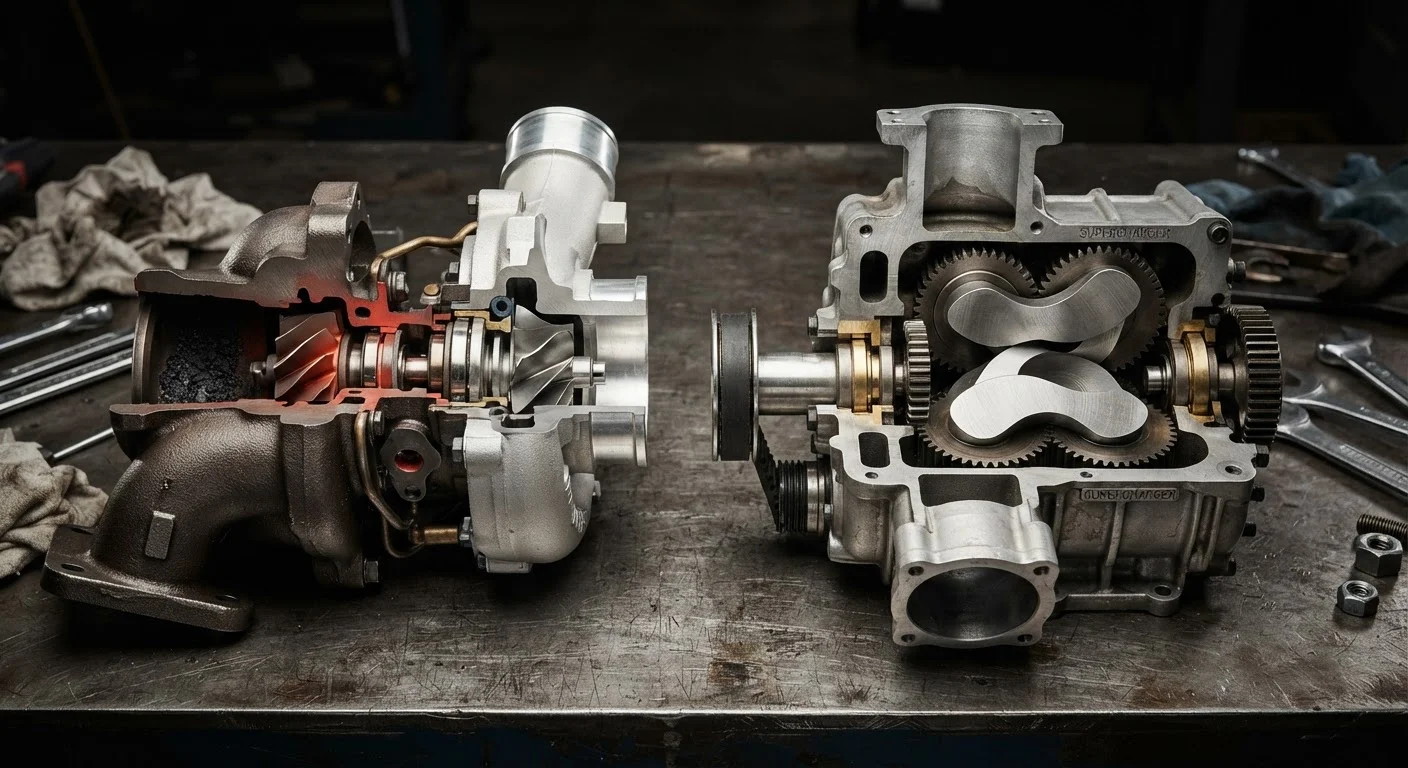
A turbocharger is driven by exhaust gases. Hot, pressurized exhaust spins a turbine wheel, which is connected via a shaft to a compressor wheel on the intake side. The compressor draws in ambient air, pressurizes it, and delivers it to the intake manifold. Because the turbo relies on sufficient exhaust flow to spool up - reach operating speed - there is an inherent delay between throttle input and boost delivery at lower rpm. This is turbo lag.
A supercharger draws its drive energy directly from the engine's crankshaft via a belt, chain, or gear. This mechanical connection means boost is generated as soon as the engine turns - no waiting for exhaust energy to accumulate. The tradeoff is that the supercharger consumes engine power to make engine power, a phenomenon called parasitic drag.
| Criterion | Turbocharger | Supercharger |
|---|---|---|
| Energy source | Exhaust gas flow | Crankshaft (belt/gear driven) |
| Throttle response | Delayed - spool time required | Immediate at any rpm |
| Peak power potential | Very high | High (lower ceiling generally) |
| Thermal efficiency | High - reclaims exhaust energy | Lower - parasitic crankshaft load |
| Heat management | Intercooler typically required | Less critical, some use charge coolers |
| Power curve character | Builds strongly mid-to-high rpm | Broad, linear across rpm range |
| Packaging complexity | Higher - exhaust and intercooler routing | Moderate - sits atop intake manifold |
| Tuning complexity | Higher - variable boost dynamics | Moderate - more predictable output |
Power Delivery: Lag, Linearity, and the RPM Curve
The most tangible difference between the two systems is how power arrives under acceleration. Turbochargers build boost progressively. At low rpm, throttle response can feel similar to a naturally aspirated engine; then, as exhaust flow increases past the turbo's spool threshold, boost rises sharply and power surges. Modern variable-geometry turbines and twin-scroll designs have substantially reduced lag in production and aftermarket setups, but a step-change in power delivery remains characteristic of the platform. Turbocharged versus naturally aspirated power delivery explores this contrast in more depth.
Superchargers behave more like a naturally aspirated engine with a multiplier applied. Throttle input translates directly and immediately to increased boost, which means the power curve is broader and more predictable from idle through redline. Roots-type and twin-screw superchargers deliver boost particularly aggressively at low rpm, while centrifugal superchargers - which resemble a turbo compressor but are belt-driven - behave more like a turbo in that boost builds with engine speed.
30-40%
Typical power increase from forced induction
Industry estimates suggest most bolt-on forced induction setups increase engine output by 30-40% over the naturally aspirated baseline, depending on boost level and supporting modifications.
15-20%
Parasitic loss from a belt-driven supercharger
Engineering assessments of positive-displacement superchargers generally estimate they consume 15-20% of the engine's output just to drive the compressor - before net gains are realized.
~1,500°F
Turbine inlet temperature under load
Exhaust gases entering a turbocharger turbine can reach temperatures around 1,500°F (816°C) under sustained high-load driving, underscoring the heat management demands of turbo systems.
For street driving, supercharger linearity is often described as more intuitive, particularly in traffic or technical roads. For track applications or straight-line performance where the driver can manage engine speed, turbo lag becomes a manageable variable rather than a liability.
Heat, Efficiency, and Supporting Systems
Turbochargers operate in the exhaust stream, meaning the compressor outlet air arrives significantly hotter than ambient. This compressed, heated air is less dense - reducing the effective gain in oxygen delivery - which is why most turbo applications use an intercooler to cool the charge air before it enters the intake manifold. Managing heat soak and maintaining consistent intercooler efficiency are ongoing calibration concerns, particularly in demanding conditions.
Superchargers, being separated from the exhaust path, generate less heat in the intake charge. However, the mechanical energy they consume creates its own thermal load on belts, bearings, and accessory drives. Some positive-displacement supercharger designs also benefit from charge coolers, but the heat management challenge is generally less acute than with turbos.
On efficiency, turbochargers hold an advantage: they harvest energy that the engine would otherwise expel as waste heat. This is one reason turbocharged engines have become the dominant choice in modern performance and economy-oriented applications alike. High-performance engine architecture covers how these thermodynamic considerations fit into broader engine design.
Emissions and Legal Compliance Matter
Forced induction modifications can affect emissions output and may conflict with state smog regulations, particularly in California and other CARB-regulated states. Aftermarket systems intended for street use should carry a CARB Executive Order (EO) number or equivalent approval for your application. Always verify local compliance requirements before installing any forced induction system on a street-registered vehicle.
Both systems place additional stress on engine internals. Increased cylinder pressure demands stronger pistons, connecting rods, and head gaskets. Any forced induction project should be evaluated against the existing engine's strength - particularly on high-mileage or stock-forged platforms. Consult a qualified engine builder before specifying boost levels.
Choosing Based on Your Driving Goals
Neither system is universally superior. Performance upgrades under the hood consistently shows that the most effective modification is one matched to realistic use cases. Consider the following factors:
- Daily driving with spirited weekends: Supercharger setups typically integrate more smoothly into varied real-world conditions where rpm varies constantly.
- High peak output targets: Turbos can achieve higher absolute boost pressures with better thermal efficiency, making them the default for extreme power builds.
- Packaging constraints: Turbocharger systems require routing for exhaust and intercooler plumbing, which can be challenging in tight engine bays. Superchargers often sit directly atop the intake manifold, simplifying packaging - but add height that can affect hood clearance.
- Tuning complexity: Both systems require recalibrated fuel delivery and ignition timing. Turbo systems, with their variable boost behavior, often demand more sophisticated engine management tuning. See how turbocharger boost dynamics work for a closer look at that calibration challenge.
Understanding power delivery differences before committing to either path is essential - both are serious modifications with implications for reliability, emissions compliance, and warranty coverage that vary by state and application.