Built to Protect Without Announcement
Most drivers never consciously interact with the safety systems built into their vehicles - and that's precisely the point. From the moment a significant collision begins, a coordinated sequence of mechanical and electronic responses fires automatically, most of it complete before the driver has processed what's happening.
These aren't optional upgrades or visible features. They're structural and mechanical parts embedded throughout the vehicle, designed to absorb energy, restrain occupants, and manage the forces a crash generates. Understanding how they function - and how they depend on one another - helps you make smarter decisions about maintenance, inspection, and repairs after any impact.
For a broader look at protective equipment across vehicle types, see our Safety hub. This article focuses specifically on the built-in components inside a standard passenger vehicle.
Crumple Zones
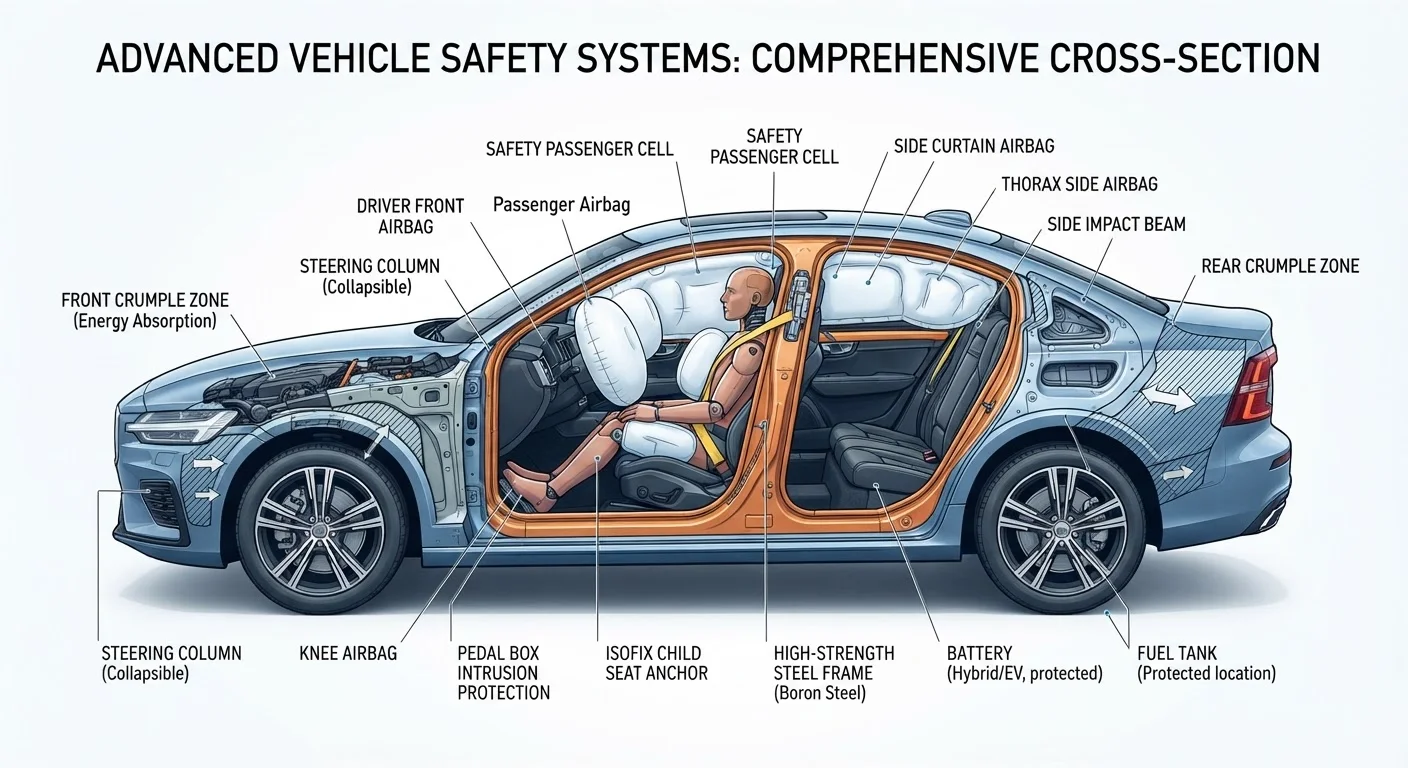
Crumple zones are sections of a vehicle's front and rear structure engineered to deform in a controlled, progressive manner during a collision. Rather than transmitting the full force of an impact directly into the passenger cabin, these zones absorb kinetic energy by collapsing - much like a buffer.
The engineering principle is straightforward: extending the duration of a crash (even by milliseconds) reduces the peak deceleration force experienced by occupants. Front crumple zones are the most prominent, but rear crumple zones and side-impact reinforcement structures follow the same logic. The cabin itself is built as a rigid safety cell surrounded by these sacrificial zones.
Crumple zones extend crash duration by milliseconds, meaningfully reducing peak forces on occupants.
Seatbelt Pretensioners
A seatbelt pretensioner is a pyrotechnic or mechanical device that instantaneously tightens the seatbelt the moment a crash sensor detects a significant impact. It removes slack from the belt within milliseconds, pulling the occupant firmly against the seat back before the body can lurch forward.
Pretensioners work in concert with load limiters - a secondary mechanism that allows controlled, gradual belt release after the initial restraint, reducing chest compression forces. Together, they keep the occupant optimally positioned to benefit from airbag deployment. A pretensioner that has fired must be replaced; it cannot reset or reactivate.
Pretensioners fire in milliseconds, removing belt slack before the occupant's body begins moving forward.
Frontal Airbags
Frontal airbags are stored in the steering wheel hub and dashboard. When crash sensors detect deceleration above a threshold consistent with a significant impact, the airbag control module sends a signal to an inflator containing sodium azide or a similar propellant. The resulting gas inflates the bag in roughly 20-30 milliseconds - and begins deflating almost immediately through vents.
That rapid deflation is intentional: an airbag that stays rigid would itself become an obstacle. The bag is designed to be a cushion in motion, not a static barrier. Frontal airbags are calibrated to work with a belted occupant sitting at a normal seating distance from the wheel.
Frontal airbags inflate and begin deflating in under 30 milliseconds - the entire event is over before most people react.
Side-Curtain and Thorax Airbags
Side-curtain airbags deploy from the roofline to cover the side windows, protecting occupants' heads from side-impact intrusion and glass. Thorax (or side torso) airbags, typically housed in seat bolsters, protect the chest and abdomen during a lateral collision.
Unlike frontal airbags, curtain airbags in some vehicles are designed to remain inflated longer - particularly in rollover scenarios - to provide sustained head protection throughout a roll event. The sensors that trigger these bags are separate from frontal-impact sensors and are tuned to detect lateral acceleration patterns specific to side crashes.
Side-curtain airbags may stay inflated through a rollover to provide sustained head protection.
Anti-Lock Braking System (ABS)
The ABS prevents wheel lockup under heavy braking by modulating brake pressure at each wheel individually. When a wheel begins to lock, the ABS module reduces pressure to that wheel, allows brief rotation, then reapplies pressure - cycling many times per second.
The practical benefit is directional stability: locked wheels lose lateral grip entirely, making steering inputs ineffective. ABS maintains enough rolling contact for the driver to steer around obstacles while braking hard. It does not necessarily shorten stopping distance on all surfaces, but it preserves steering control - a critical difference in collision avoidance.
ABS preserves steering control during emergency braking - a crucial capability for collision avoidance.
Electronic Stability Control (ESC)
ESC monitors wheel speed, steering angle, and lateral acceleration to detect when a vehicle is departing its intended path - such as during oversteer or understeer. When it identifies a loss of control, ESC selectively applies braking to individual wheels and may reduce engine torque to help bring the vehicle back in line.
ESC operates transparently in normal driving but intervenes during sudden maneuvers, slippery conditions, or overcorrection. It has been required on all new passenger vehicles sold in the US since the 2012 model year. Research from the National Highway Traffic Safety Administration (NHTSA) has linked ESC to significant reductions in single-vehicle crashes, particularly rollovers.
ESC has been linked by NHTSA research to significant reductions in single-vehicle crashes and rollovers.
Headrests and Active Head Restraints
Headrests - more accurately called head restraints - limit rearward head movement during a rear-end collision, reducing the risk of whiplash-type cervical spine injuries. A properly positioned head restraint should sit level with the top of the occupant's head, with the rear surface close to (but not necessarily touching) the back of the head.
Many modern vehicles feature active head restraints, which mechanically or electrically move forward and upward upon rear impact, closing the gap between the occupant's head and the restraint more quickly. The distinction matters: a passive headrest that is adjusted too low provides substantially less protection. Check your owner's manual for correct positioning instructions.
A head restraint set too low provides far less whiplash protection - correct adjustment is critical.
Why These Systems Must Be Treated as a Unit
Each component described above contributes to a carefully engineered energy-management chain. Remove, damage, or improperly repair any one link, and the entire system's performance can be compromised. For example, an airbag that deploys without a functioning pretensioner to hold the occupant in position can itself cause injury rather than prevent it.
Schedule a Post-Collision Safety Inspection
Even if airbags did not deploy, a collision can deform structural components, trigger pyrotechnic pretensioners, or compromise sensor calibration. Have a qualified technician inspect the vehicle's safety systems after any significant impact. Never assume that a lack of visible damage means all systems are intact and functional.
After any collision - even one that appears minor - have the vehicle inspected by a qualified technician. Sensors, pyrotechnic devices, and structural elements may have triggered or deformed in ways that aren't visible. Many of these components are single-use and will not function again without replacement.
For those interested in additional occupant protection beyond factory equipment, in-car safety equipment for track day participants covers supplemental systems such as roll cages and HANS devices used in motorsport contexts.
This article provides general educational information about vehicle safety systems. It is not a substitute for professional inspection, certified repair work, or manufacturer service documentation. Always consult a qualified mechanic for diagnosis and repair after a collision.