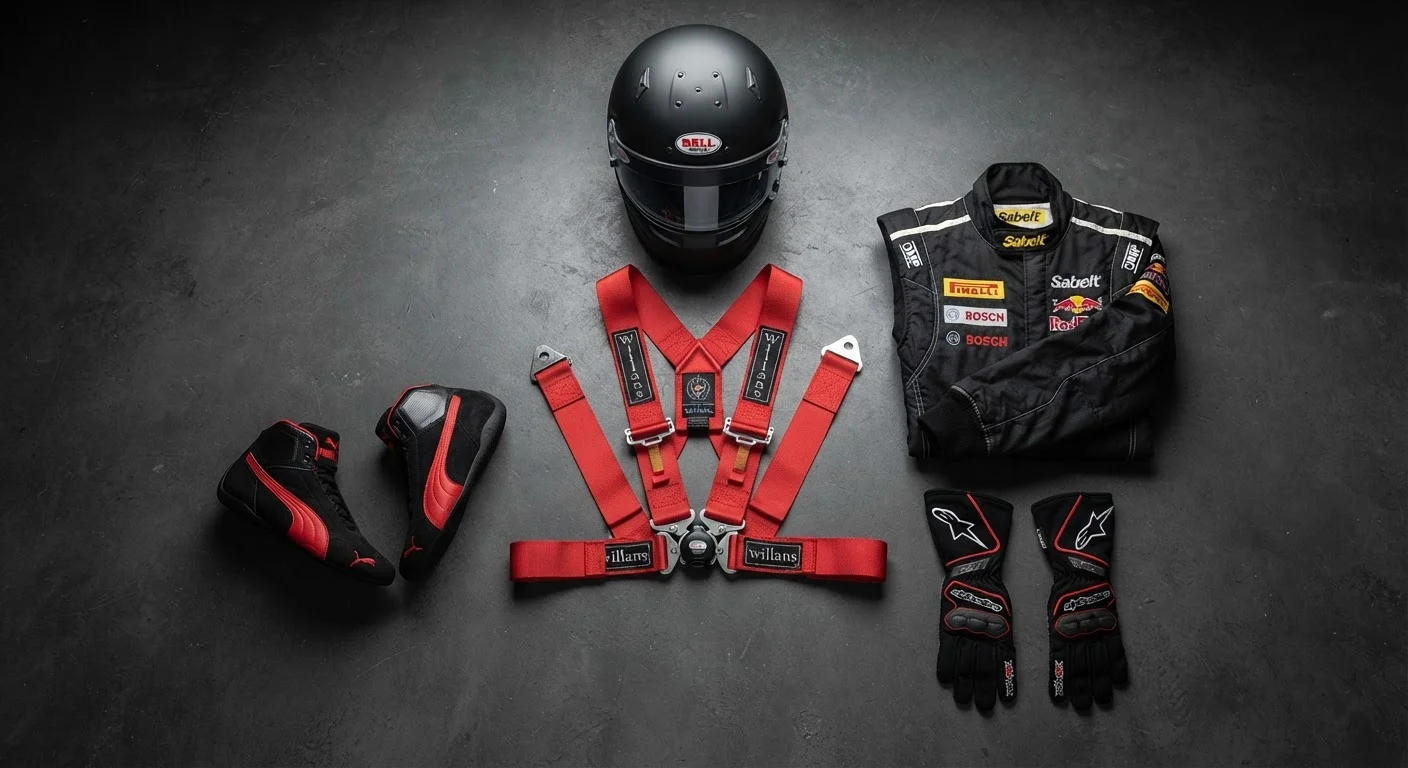
Why In-Car Safety Equipment Is Different at the Track
Track days operate in a fundamentally different risk environment than public road driving. Higher speeds, harder braking, and close proximity to barriers and other vehicles mean that stock safety systems - designed around road collision scenarios - may not provide adequate protection. Most track day organizers mandate specific equipment minimums, and those minimums escalate with faster run groups or dedicated competition events.
Understanding the purpose behind each piece of equipment helps drivers make informed decisions rather than simply checking compliance boxes. For a broader look at how individual safety items function, see our driver safety gear explainer. This guide focuses specifically on in-car hardware - the structural, restraint, and fire safety systems installed in the vehicle itself.
Street vs. Track Safety Modifications Don't Always Mix
Some modifications that improve track safety actively reduce road safety. A full roll cage, for example, introduces rigid structures at head height that increase injury risk in low-speed road incidents where a rollover is not occurring. Multi-point harnesses used without a proper racing seat can be dangerous on public roads. Drivers should understand these tradeoffs before running a dual-purpose vehicle.
Roll Cages and Roll Bars: Structural Protection Explained
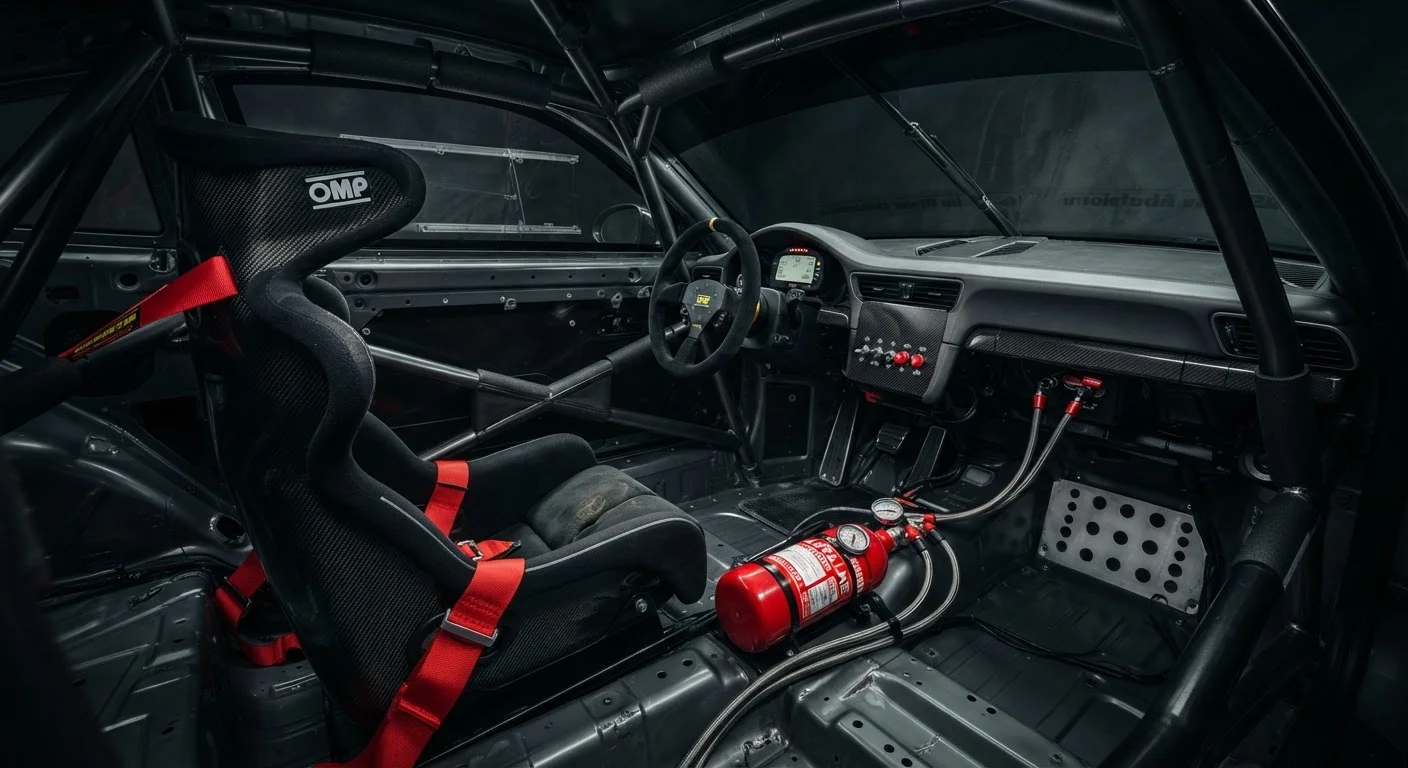
A roll bar is a single hoop structure behind the driver; a full roll cage extends that protection with additional tubes connecting to the vehicle's floor, firewall, and door apertures. Both serve to maintain survivable cabin space if the vehicle inverts or contacts a barrier. For novice track day participants, most organizers require little more than the factory B-pillar structure, but dedicated time-attack or stage rally regulations typically mandate a certified cage.
Cage design is highly specific to the vehicle chassis and the regulations of the sanctioning body involved. Poorly designed or incorrectly installed cages can transfer impact energy in ways that increase rather than reduce injury risk. Installation should always be performed by a fabricator experienced with motorsport cage construction and familiar with the relevant rulebook. The SFI Foundation and FIA publish detailed cage specifications; drivers should confirm which standard applies to their event.
Never Install a Cage Without Professional Fabrication
An incorrectly designed or improperly welded roll cage can be more dangerous than no cage at all by transferring crash energy directly to the occupant or compromising the factory crumple zone strategy. Cage fabrication must be performed by a qualified motorsport fabricator using the correct material specifications and tube diameter for the sanctioning body's rulebook. Self-installation based on online guides alone is not an acceptable substitute.
Multi-Point Harnesses and Seat Systems
Stock three-point seatbelts allow significant forward body movement during deceleration. In a high-speed incident, that movement can result in head contact with the steering wheel or dashboard. Multi-point harnesses - typically four-, five-, or six-point configurations - restrain the torso, shoulders, and pelvis far more aggressively, keeping the driver firmly planted in the seat.
A harness must be paired with an appropriate racing seat. Using a multi-point harness with a factory seat is widely considered unsafe because factory seats are not engineered for the load vectors produced by a four- or five-point system; sub-strap routing in particular can create harmful abdominal loading in a frontal crash. FIA-homologated racing seats have defined shell stiffness and harness pass-through geometry to address this.
When fitting a harness in a car that still has factory seats as an interim step, use a single-point lap belt rather than a sub-strap until a proper racing seat is installed - this avoids dangerous abdominal load paths.
The geometry of a factory seat pan directs sub-strap forces toward soft tissue rather than the pelvis, a risk that is well-documented in motorsport safety literature.
Photograph every certification label and expiry date on your safety equipment at the start of each season and store the images in cloud storage - this gives you instant proof of compliance at any event.
Labels can fade or detach over time, and event officials may deny track access without legible certification markings regardless of actual equipment quality.
Harness expiry dates matter. SFI 16.1-rated belts carry a two-year service life from manufacture date; FIA 8853 harnesses expire five years from manufacture. Using out-of-date hardware may void your track day insurance coverage and, more critically, the webbing's energy absorption properties degrade over time.
HANS Devices and Neck Restraint Systems
The Head and Neck Support (HANS) device - and equivalent systems from other manufacturers - is a collar-and-tether system that limits how far the head can move forward relative to the torso during a frontal impact. This reduces the risk of basilar skull fractures, a historically common motorsport fatality. The device anchors to the helmet via flexible tethers and rests on the driver's shoulders, secured under the harness straps.
HANS devices are rated by SFI 38.1 and FIA 8858 standards; always verify which certification your event requires. Fit matters: devices are sized and angled to match the driver's build and seating position. Our dedicated article on neck restraint principles and practical considerations covers selection and fit in greater depth.
5 yrs
FIA harness homologation period from manufacture
FIA 8853 specifies that harnesses must be replaced or recertified within five years of the stated manufacture date, regardless of apparent condition.
2 yrs
SFI 16.1 harness maximum service life
The SFI Foundation specifies a two-year service life from manufacture date for belts certified to SFI 16.1, a common requirement at US track events.
~40°
HANS device angle range for reclined seating
HANS devices are available in multiple angle configurations (typically 10°, 20°, and 30-40°) to match different seat recline angles and maintain correct tether geometry.
Fire Suppression Systems and Extinguishers
Track-prepared vehicles, particularly those with modified fuel systems or dry-break filler caps, carry a higher fire risk than stock cars. A plumbed fire suppression system delivers extinguishing agent - typically AFFF foam or Novec 1230 gas - through fixed nozzles aimed at the engine bay and cockpit simultaneously, allowing the driver to activate suppression without locating a hand-held unit. Hand-held extinguishers mounted inside the cabin remain acceptable for many novice track day events and are a meaningful improvement over no provision at all.
Placement of any extinguisher should allow operation by a restrained driver with one hand. For more on fire extinguishers as part of a broader vehicle emergency kit, see common safety gaps that leave drivers exposed. Check agent type compatibility with your specific vehicle materials, and confirm that any plumbed system meets the weight and mounting requirements of your roll structure.
Inspect Every Component Before Each Event
Walk through each piece of safety hardware before trailering to the track: check harness webbing for fraying or UV degradation, verify fire extinguisher pressure indicators, and confirm all cage mounting bolts are torqued to spec. A pre-event checklist takes under ten minutes and catches issues that scrutineering may not.
Understanding Certification Standards
Two main standards bodies govern most motorsport safety equipment sold in North America: the SFI Foundation, which issues North American-oriented specifications, and the FIA, which publishes international homologation standards used globally. Neither is universally superior - the applicable standard depends entirely on which sanctioning body or track organization governs your event.
Certification markings appear on labels sewn into harnesses, stamped on cage tabs, or printed on helmet liners. A safety equipment glossary can help decode the acronyms encountered on certification tags. Cross-checking the manufacture date on those labels before each season is a straightforward habit that prevents compliance surprises at the gate. When in doubt about which standard applies, contact the event organizer directly - the responsibility for equipment compliance rests with the driver.
This article is for informational and educational purposes only. Always consult your event organizer's specific rulebook and, for structural modifications, a qualified motorsport fabricator. Safety equipment installation and inspection should be performed or verified by qualified professionals.