How a Catalytic Converter Works
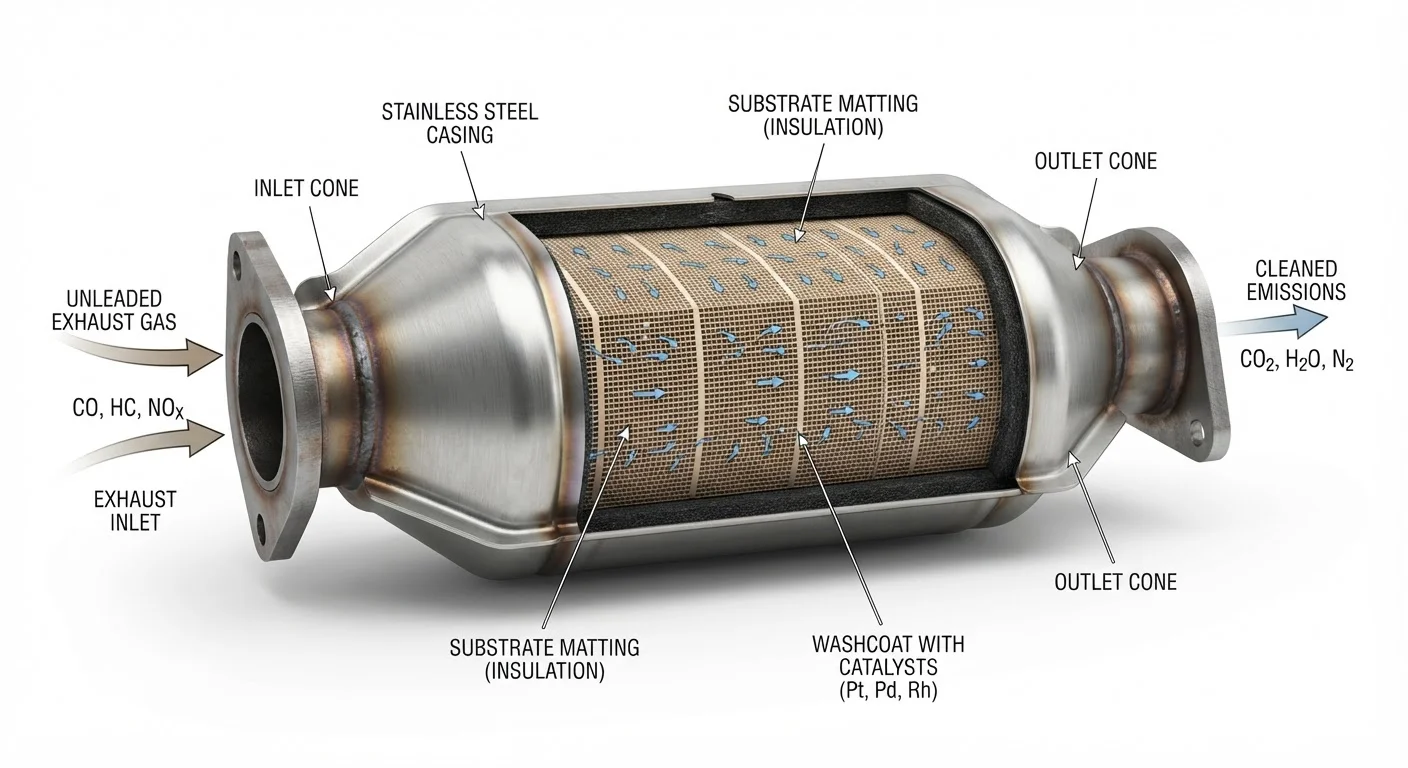
Inside every catalytic converter is a ceramic or metallic honeycomb substrate - a structure with thousands of tiny parallel channels that dramatically increase the surface area available for chemical reactions. This substrate is coated with a wash coat containing precious metals: primarily platinum, palladium, and rhodium. These metals act as catalysts, meaning they facilitate chemical reactions without being consumed in the process.
As hot exhaust gases flow through the converter, two types of reactions occur simultaneously:
- Reduction reactions - Rhodium helps break down nitrogen oxides (NOx) into harmless nitrogen (N₂) and oxygen (O₂).
- Oxidation reactions - Platinum and palladium convert carbon monoxide (CO) and unburned hydrocarbons (HC) into carbon dioxide (CO₂) and water vapor (H₂O).
This dual-action process is why modern units are called three-way catalytic converters - they address three distinct classes of pollutants in a single pass.
Keep Your Engine Healthy to Protect the Converter
A catalytic converter's lifespan is directly tied to how well the engine upstream is maintained. Address oil consumption, coolant leaks, and misfires promptly - these are the most common causes of premature converter contamination and failure. Routine tune-ups are one of the most cost-effective ways to protect this component.
Why Operating Temperature Matters
Catalytic converters only function effectively once they reach what engineers call light-off temperature - typically around 400°F to 600°F (205°C to 315°C). Below this threshold, the precious metal catalysts are not reactive enough to trigger the necessary chemical conversions. This is why cold-start emissions are disproportionately high in vehicles: for the first few minutes of operation, the converter is essentially inactive.
Modern engine management systems address this partly by running a slightly richer fuel mixture at startup, which generates additional exhaust heat to bring the converter up to temperature faster. Some manufacturers also position the converter closer to the engine - often referred to as a close-coupled design - to reduce the time to light-off.
Cold Starts and Short Trips
Vehicles that predominantly make short trips may experience faster catalytic converter wear because the unit never fully reaches optimal operating temperature. This leads to incomplete chemical reactions and gradual buildup of byproducts on the substrate. Occasional longer drives allow the converter to fully heat up and effectively burn off accumulated deposits.
Sustained high heat is also a risk. Misfires that send large amounts of unburned fuel into the exhaust can cause the converter to overheat and melt its internal substrate - a condition that results in complete failure and typically requires full replacement.
Emissions Regulations and Legal Obligations
The catalytic converter became standard equipment on U.S. passenger vehicles following the Clean Air Act amendments and EPA regulations introduced in the early 1970s. Today, both federal and state laws strictly govern catalytic converter use. Removing or deliberately bypassing a functioning converter - a practice sometimes called "decat" - is a federal violation under the Clean Air Act and carries substantial fines.
For performance-oriented readers, this has practical implications. Aftermarket exhaust modifications - including high-flow catalysts - must meet EPA standards or, in stricter states, California Air Resources Board (CARB) certification to remain street-legal. You can learn more about how these modifications interact with vehicle performance in our guide to exhaust upgrades.
~90%
Reduction in key pollutants from catalytic conversion
EPA documentation indicates modern three-way catalytic converters can reduce hydrocarbons, carbon monoxide, and NOx by up to 90% compared to untreated exhaust.
1975
Year catalytic converters became standard in U.S. vehicles
Federal emissions standards required catalytic converters on new passenger vehicles sold in the United States beginning with the 1975 model year.
400°F+
Minimum temperature for effective catalytic conversion
Industry engineering references consistently cite approximately 400°F (205°C) as the light-off threshold below which catalyst reactions are negligible.
Diagnosing and Maintaining Your Catalytic Converter
A catalytic converter has no moving parts and generally requires no scheduled maintenance. Its longevity, however, is closely tied to overall engine health. The most common causes of premature failure include:
- Engine oil or coolant entering the combustion chamber and contaminating the substrate
- Persistent engine misfires sending unburned fuel into the exhaust stream
- Physical damage from road debris striking the undercarriage
- Use of fuel additives not compatible with catalytic systems
When a converter fails, it typically triggers a diagnostic trouble code (DTC) - often a P0420 or P0430 - which illuminates the check engine light. A mechanic will use an OBD-II scanner along with exhaust gas analysis to confirm whether the converter itself has failed or whether the root cause is an upstream issue like a faulty oxygen sensor.
Understanding how one exhaust system component interacts with others is part of a broader mechanical picture. Enthusiasts interested in how engine tuning decisions affect emissions-related systems will also find value in our breakdown of engine tuning myths.
This article is intended for general educational purposes. Exhaust system repairs involve hot components and potentially hazardous gases - always consult a qualified mechanic before performing any work on your vehicle's emissions system.