What the Law Actually Requires
The U.S. Coast Guard (USCG) establishes minimum federal equipment standards for recreational vessels operating on navigable waters. State agencies may layer additional requirements on top of those federal minimums, so what's required on a lake in one state may differ slightly from what's required offshore in another. That said, the federal baseline is consistent nationwide and applies to nearly all recreational boats.
The four primary categories of federally required safety equipment are: personal flotation devices (PFDs), visual distress signals, fire extinguishers, and sound-producing devices. Certain vessels also require navigation lights, a marine sanitation device, and a copy of federal regulations - but the first four categories cover what most boaters think of as core safety gear.
| PFD requirement | One USCG-approved wearable PFD per person aboard (U.S. Coast Guard federal regulations) |
| Throwable device requirement | Required on vessels 16 feet and longer (U.S. Coast Guard federal regulations) |
| Fire extinguisher class | B-class (flammable liquids); quantity depends on vessel length (USCG Title 33 CFR Part 175) |
| Flare expiration | 42 months from manufacture date (USCG pyrotechnic signal standards) |
| Child PFD wear requirement | Children under 13 must wear PFD while vessel is underway (federal minimum) (U.S. Coast Guard; state rules may be stricter) |
| Sound device requirement | All vessels must be capable of producing a sound signal (Navigation Rules, Inland and International) |
Understanding these requirements isn't just about avoiding a citation. Each item addresses a specific, statistically documented hazard. Drowning, fire, and vessel collisions account for the majority of recreational boating fatalities each year, according to USCG boating accident statistics. The required gear directly corresponds to those risks.
Personal Flotation Devices: Types, Fit, and Counts
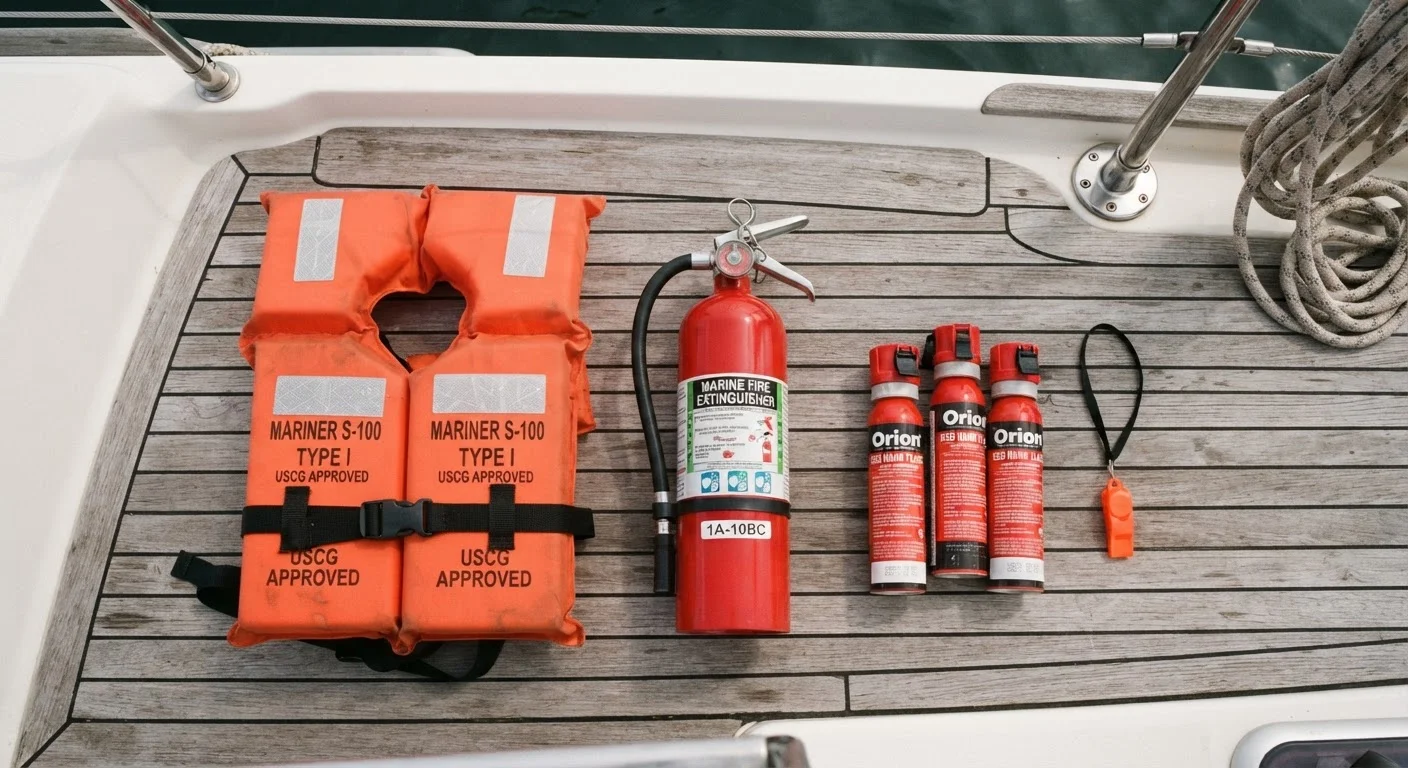
Federal law requires at least one USCG-approved wearable PFD for every person aboard a recreational vessel. On boats 16 feet and longer, you must also carry at least one Type IV throwable device - a ring buoy or cushion that can be thrown to a person in the water.
PFD (Personal Flotation Device)
A USCG-approved buoyancy aid designed to keep a person afloat. PFDs are categorized into five types based on buoyancy level and intended use environment.
Type IV Throwable Device
A ring buoy, buoyant cushion, or horseshoe buoy designed to be thrown to a person already in the water. It is not intended to be worn.
B-I / B-II Fire Extinguisher
USCG-designated ratings for marine fire extinguishers classified for flammable liquid fires. B-II units have a larger agent capacity than B-I units.
Visual Distress Signal (VDS)
Any pyrotechnic or non-pyrotechnic device used to signal distress to rescuers. Examples include handheld flares, aerial flares, and electric distress lights.
Navigable Waters
Waters of the United States subject to federal jurisdiction, including coastal waters, the Great Lakes, territorial seas, and connected inland waterways used in interstate commerce.
PFDs are classified into five types based on buoyancy and intended use. Types I, II, and III are wearable; Type IV is throwable; Type V covers special-use devices such as inflatable suspender-style PFDs, which are approved only when worn. Inflatable PFDs require the wearer to manually or automatically activate them, making fit and maintenance particularly important.
Children under 13 must wear a properly fitted, USCG-approved PFD whenever a vessel is underway on federally controlled waters, unless they are below deck or in an enclosed cabin. Several states have stricter age requirements. A PFD that doesn't fit correctly provides substantially reduced protection - always size PFDs to the wearer's weight and chest measurement, not just age. For more on common misconceptions around life jacket use, see boating myths that can put you at risk.
Fire Extinguishers: Classification and Placement
Portable fire extinguishers are required on boats with enclosed engine compartments, enclosed living spaces, or permanently installed fuel tanks. The USCG designates required extinguishers by a B-class rating (flammable liquids), with specific quantity requirements tied to vessel length.
- Under 26 feet: At minimum, one B-I extinguisher is required (unless a fixed suppression system is installed in the engine compartment).
- 26 to 40 feet: Two B-I units, or one B-II unit.
- 40 to 65 feet: Three B-I units, or one B-II and one B-I unit.
B-I extinguishers contain at least 2 lbs of dry chemical or 4 lbs of carbon dioxide. B-II units are larger. Extinguishers must be in serviceable condition - check the gauge, verify the pin and tamper seal are intact, and inspect for corrosion or physical damage at the start of each season. Extinguishers with discharged gauges or visible damage must be replaced or professionally recharged before the vessel is operated.
Mount extinguishers in accessible, clearly marked locations. An extinguisher locked under gear in a forward berth is effectively useless in a cockpit fire.
Visual Distress Signals and Sound-Producing Devices
Vessels operating on coastal waters, the Great Lakes, territorial seas, and waters connected to those bodies that are more than two miles wide are required to carry visual distress signals (VDS). Vessels used only on inland waters not subject to those rules are generally exempt, but many operators carry signals regardless as a best practice.
Acceptable VDS options include pyrotechnic devices (handheld or aerial flares), non-pyrotechnic alternatives (electric distress lights, orange distress flags), or a combination. Pyrotechnic devices carry an expiration date - typically 42 months from manufacture - and expired flares do not count toward the legal requirement, though it is advisable to keep them aboard as backups.
Pyrotechnic Flares: Storage and Disposal
Expired flares cannot be thrown overboard - they are classified as hazardous waste. Many Coast Guard Auxiliary stations and some marinas host periodic flare disposal events. Check with your local boating authority or USCG Auxiliary flotilla for scheduled collection dates in your area. Storing expired flares separately from current ones helps prevent confusion during an actual emergency.
Sound-producing devices are required for all vessels to comply with the Inland and International Navigation Rules. Vessels under 39.4 feet must be able to produce an efficient sound signal; vessels 39.4 feet and longer must carry a whistle and a bell. An air horn, handheld canister horn, or installed electric horn satisfies the whistle requirement. These signals are used to communicate intentions and warn of vessel presence in reduced visibility - not just in emergencies.
For a broader look at built-in safety systems beyond required gear, the watercraft safety features guide covers kill switches, navigation lights, and float plans in detail.