Why Boating Myths Are More Dangerous Than They Seem
Recreational boating carries genuine risks that misinformation can quietly amplify. Unlike some domains where a misconception leads to minor inconvenience, false beliefs on the water can translate directly into life-threatening situations. Many boating myths persist precisely because they feel plausible - they reflect a misread of personal experience or a misunderstanding of how the marine environment actually works.
This article addresses the most consequential myths new and casual boaters tend to hold, grounded in U.S. Coast Guard data and established marine safety principles. If you're heading out on the water for the first time, starting with accurate information is the single most effective safety investment you can make.
Myth
Life jackets are only necessary in an emergency - you can grab one if things go wrong.
Fact
Most drowning victims in recreational boating accidents were not wearing a life jacket at the time of the incident, leaving no time to retrieve one.
The idea that a life jacket can be grabbed reactively assumes that the person remains conscious, calm, and mobile after an incident. Capsizing, falls overboard, and collisions can be instantaneous and disorienting. U.S. Coast Guard recreational boating accident data consistently shows that the vast majority of drowning victims were not wearing a personal flotation device (PFD) at the time of the accident.
Federal regulations require that a wearable, Coast Guard-approved PFD be on board for every person, but wearing one dramatically increases survival odds - particularly in cold water, where loss of muscle control can occur within minutes. For more on required safety equipment, see what safety gear boaters are required to carry.
Myth
Alcohol affects you the same way on the water as it does on land.
Fact
Environmental factors on the water - sun, wind, wave motion, noise, and vibration - accelerate alcohol's impairing effects, making boaters more impaired at lower blood alcohol concentrations.
The U.S. Coast Guard recognizes this compounding effect as a documented factor in boating fatalities. The physical stressors of being on open water - constant motion, reflected sunlight, heat, and engine noise - accelerate fatigue and intensify alcohol's impact on balance, coordination, reaction time, and judgment. A person who feels minimally affected after two drinks on land may be significantly impaired on the water.
Beyond impairment, operating a vessel with a blood alcohol concentration (BAC) of 0.08% or higher is a federal offense and is illegal in all 50 states. Penalties can include fines, license suspension, and criminal charges.
[important_callout]Myth
If the weather looks calm when you leave the dock, you'll be fine out there.
Fact
Marine weather can deteriorate rapidly and without obvious warning, particularly on open water and large inland lakes.
Calm conditions at departure offer no guarantee of what you'll encounter even an hour later. Afternoon thunderstorms develop quickly in many parts of the U.S., particularly during summer, and conditions on open water can escalate from moderate chop to dangerous seas faster than many new boaters expect. Checking forecasts is not a one-time pre-departure step - it's an ongoing practice throughout any outing.
Reading the weather before you leave the dock covers how to assess marine forecasts, recognize warning signs on the water, and make informed go/no-go decisions.
Myth
Experience on the water means you don't need formal boating education.
Fact
Formal boater education courses cover navigation rules, legal requirements, emergency procedures, and hazard recognition that informal experience rarely teaches comprehensively.
Years of casual boating can build certain practical skills while leaving significant knowledge gaps. Navigation rules (governed by the U.S. Inland Rules and COLREGS), proper anchoring technique, float plan practices, and emergency signaling procedures are rarely intuited from time on the water alone. Many experienced boaters are surprised by what they learn in a structured course.
Most states do not require adults to complete boater education, but the knowledge gap it addresses is real and consequential. The case for taking a boater education course explains what these programs actually cover and why they matter beyond fulfilling a legal requirement.
Myth
Bigger boats are always safer than smaller ones.
Fact
Vessel safety depends on design, condition, proper loading, operator competence, and appropriate use - not size alone.
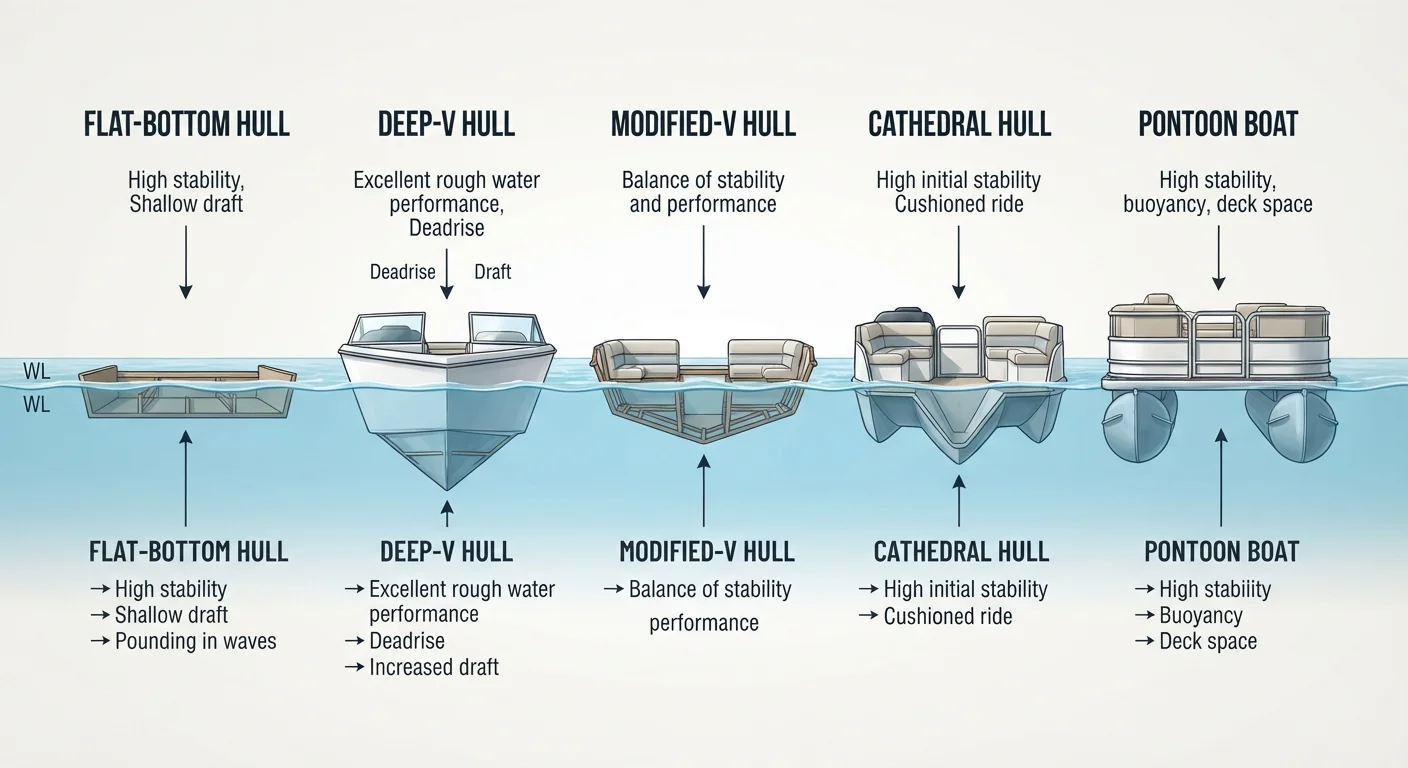
A well-maintained small boat operated within its rated capacity in appropriate conditions can be far safer than a large vessel that is poorly maintained, overloaded, or operated by an inexperienced skipper in weather beyond its design intent. Hull design plays a critical role in how a vessel handles in various sea states. Common misconceptions about boat hull shapes explores how hull geometry actually affects stability and performance - and why assumptions about size and safety often miss the point.
Understanding what type of boat suits your intended use is a foundational step. The new boater's map to boat categories provides a clear overview of vessel types and their intended environments.
Building Habits That Reflect Reality
Correcting a myth is only useful if it changes behavior. The safety practices that matter most - wearing your PFD, filing a float plan, checking weather continuously, staying sober at the helm, and respecting capacity limits - are all grounded in how the water actually behaves, not how it's often assumed to.
Never Exceed Your Vessel's Capacity Rating
Overloading a boat beyond its posted weight or passenger capacity rating significantly increases the risk of swamping, capsizing, or loss of control. These ratings are calculated based on hull design and buoyancy - they are not arbitrary. See what boat capacity ratings actually mean for a detailed breakdown of how these numbers are determined.
Modern watercraft come equipped with a range of safety systems beyond the life jacket. Understanding those features - from kill switches to navigation lights - helps boaters use their vessel as designed. Similarly, understanding how maritime navigation rules work is foundational knowledge that experience alone rarely delivers reliably.
~75%
Fatal boating accident victims not wearing a PFD
According to U.S. Coast Guard recreational boating statistics, approximately three-quarters of boating fatalities involve victims who were not wearing a life jacket.
#1
Leading cause of boating fatalities
Drowning consistently ranks as the top cause of death in recreational boating accidents, according to U.S. Coast Guard annual reports.
~23%
Accidents where alcohol was a contributing factor
The U.S. Coast Guard identifies alcohol use as a contributing factor in roughly one in five recreational boating deaths in recent reporting years.
Every boater, regardless of experience level, benefits from periodically re-examining what they believe to be true. The stakes on the water make accuracy a practical necessity, not just an intellectual exercise.