Why Built-In Safety Features Matter
Life jackets get most of the attention in boating safety conversations - and they deserve it. But a well-equipped watercraft carries a second layer of protection built directly into the vessel itself. These integrated systems work before, during, and after an emergency, often buying critical time when seconds count.
Understanding which features do what helps you evaluate any boat more intelligently, whether you're reading a spec sheet or walking a dock. For a broader vocabulary of vessel terms, the Watercraft Features Glossary is a useful companion reference. This guide focuses specifically on the safety systems that protect people and vessels on the water.
Engine Cut-Off Switch (ECOS)
A device - tethered or wireless - that shuts down the engine automatically if the operator leaves the helm, preventing a runaway vessel.
Bilge
The lowest interior section of a boat's hull where water collects. A bilge pump removes this water to maintain buoyancy and stability.
EPIRB
Emergency Position Indicating Radio Beacon - a device that transmits a distress signal via satellite to help rescuers locate a vessel in an emergency.
VHF Marine Radio
A radio operating on marine VHF frequencies, used for vessel-to-vessel and vessel-to-Coast Guard communication. Channel 16 is the standard distress and calling frequency.
AIS
Automatic Identification System - a transponder technology that broadcasts a vessel's position, speed, and heading to other AIS-equipped vessels and shore stations.
Float Plan
A written record of a trip's details left with a trusted contact onshore, enabling authorities to act quickly if the vessel is overdue.
Engine Cut-Off Systems
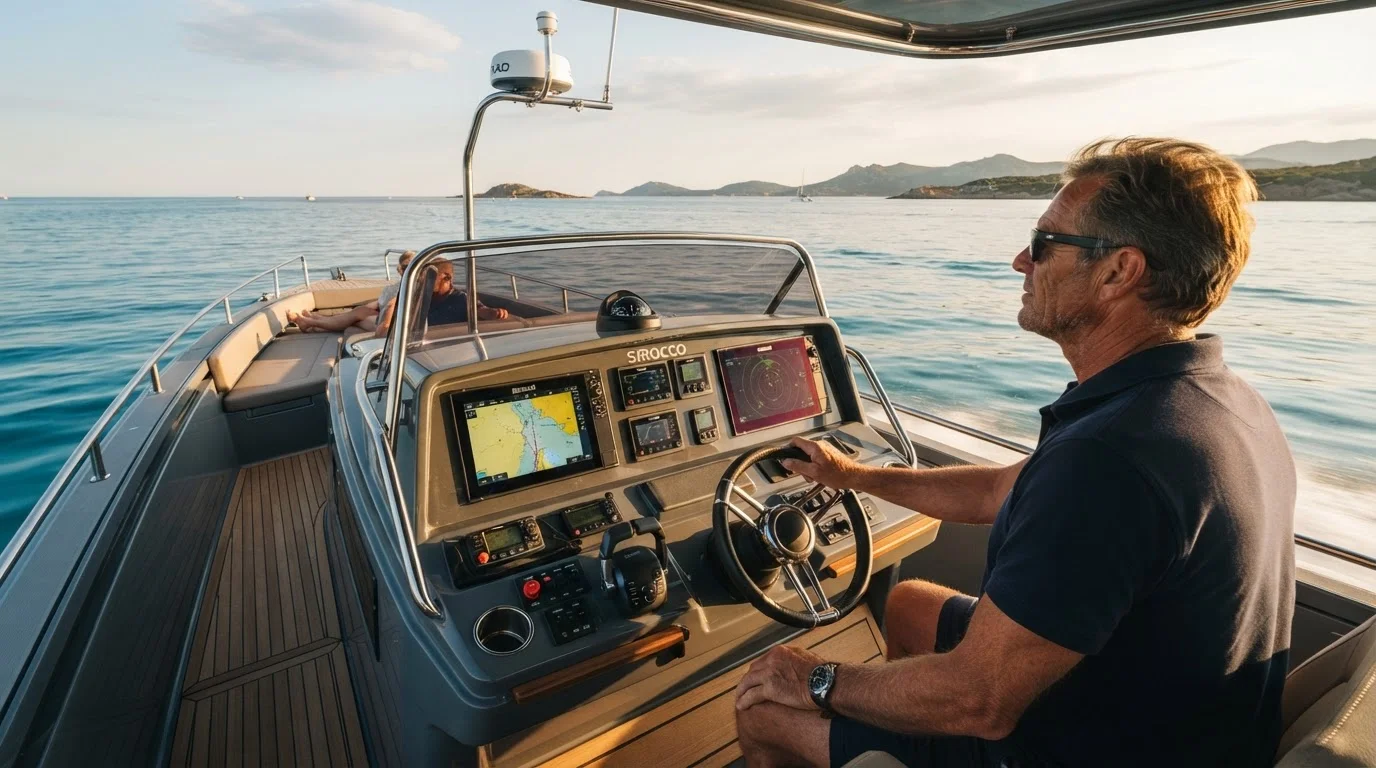
An engine cut-off switch (ECOS) - commonly called a kill switch - is a tethered or wireless device that stops the engine immediately if the operator is separated from the helm. When the lanyard detaches from the operator's wrist or life jacket, the circuit breaks and the engine shuts down.
The U.S. Coast Guard requires ECOS use on most motorboats under 26 feet when the motor is running above idle speed. Wireless ECOS systems, now increasingly common, use proximity-sensing technology to achieve the same result without a physical tether. Both designs address the same hazard: a vessel continuing at speed with no one in control.
Check Your Kill Switch Before Every Departure
Test the ECOS lanyard or wireless sensor before leaving the dock on every outing. Attach the tether to your wrist or life jacket as soon as you're underway above idle speed. This habit takes seconds and is one of the most direct injury-prevention actions an operator can take.
Beyond the switch itself, throttle controls, steering systems, and emergency engine shutoffs at the helm all contribute to operational safety. When evaluating any motorboat, confirm that all engine controls are ergonomically accessible from the primary operating position.
Navigation Lights and Signaling Equipment
Navigation lights communicate a vessel's position, heading, and status to other boats in low-visibility or nighttime conditions. Federal regulations specify which lights are required based on vessel type, length, and mode of operation (anchored, underway, sailing, or motoring). Common configurations include a red port light, green starboard light, and white stern or masthead light.
Signal devices - including sound-producing equipment like horns and whistles - are also federally required and governed by U.S. Coast Guard Navigation Rules. Visual distress signals (VDS), such as flares, are mandatory on coastal waters for most recreational boats. For a full breakdown of required safety gear, see the complete safety gear reference.
Expired or Missing Flares Are a Legal and Safety Risk
Visual distress signals have expiration dates printed on the casing - typically three years from manufacture. Expired flares do not meet federal carriage requirements, even if they appear functional. Carry the correct number of unexpired flares for your cruising area and stow them where all aboard can access them quickly.
Bilge Pumps and Fire Suppression
The bilge is the lowest interior section of the hull. Water - from rain, spray, or minor seepage - naturally collects there. An automatic bilge pump, triggered by a float switch, removes that water before it becomes a stability or sinking hazard. Manual bilge pumps provide a backup option if the automatic system fails or is overwhelmed.
Engine compartment fire suppression systems - typically using clean-agent chemicals - are factory-installed on many inboard and sterndrive boats. These systems can discharge automatically when heat sensors detect a fire, or manually via a cockpit control. They are particularly relevant because engine-compartment fires can develop faster than a portable extinguisher can be retrieved and aimed.
Portable fire extinguishers remain a legal requirement on virtually all motorized recreational boats, regardless of whether a fixed system is present. Check that any extinguisher aboard is Coast Guard-approved for marine use and within its service date. For more on overlooked but practical vessel systems, first-time shoppers frequently miss bilge access details until they're dealing with a real problem.
Float Plans and Electronic Safety Aids
A float plan costs nothing and requires no hardware. Before departure, record your vessel description, departure location, intended route, passenger names, and expected return time - then leave that information with a trusted contact onshore. If you're overdue, they can alert the U.S. Coast Guard with actionable details rather than a vague report of a missing boat.
Electronic safety aids extend your reach in emergencies. A VHF marine radio allows communication with the Coast Guard and other vessels on Channel 16, the international distress and calling frequency. An EPIRB (Emergency Position Indicating Radio Beacon) or a PLB (Personal Locator Beacon) transmits a distress signal via satellite when activated, enabling search-and-rescue teams to locate a vessel even far offshore. AIS (Automatic Identification System) transponders broadcast your vessel's position and speed to other AIS-equipped boats, reducing collision risk in busy channels.
New boaters sometimes underestimate how quickly conditions can change on the water. For a grounded perspective on common misconceptions, boating myths that can put you at risk is worth reading before your first season. Safety features - built-in and behavioral - work best together. See the complete watercraft features guide for context on how safety systems fit within the broader set of vessel attributes.
U.S. Coast Guard Boating Safety Resource Center
The official federal resource for boating regulations, required safety equipment lists, and float plan templates. Useful for verifying what your vessel class is required to carry.
BoatUS Foundation Safe Boating Courses
State-approved online boating safety courses covering navigation rules, safety equipment use, and emergency procedures - relevant for new and returning boaters alike.