Why Hull Shape Myths Are So Persistent
Boaters develop strong intuitions about hull behavior - often from a single vessel type they've spent years aboard. Those intuitions harden into rules that get passed down at marinas, fishing clubs, and boat shows. The problem is that hull performance is deeply contextual: a design that excels in one environment can be actively wrong for another.
Understanding hull behavior requires separating initial stability (resistance to rolling at rest) from dynamic stability (behavior underway in varied sea states), and recognizing that deadrise angle, beam, displacement, and load distribution all interact. No single variable tells the full story. For a foundational overview, hull types and their handling characteristics is a useful starting point.
Myth
Flat-bottom hulls are unstable and unsafe - only V-hulls provide reliable stability on the water.
Fact
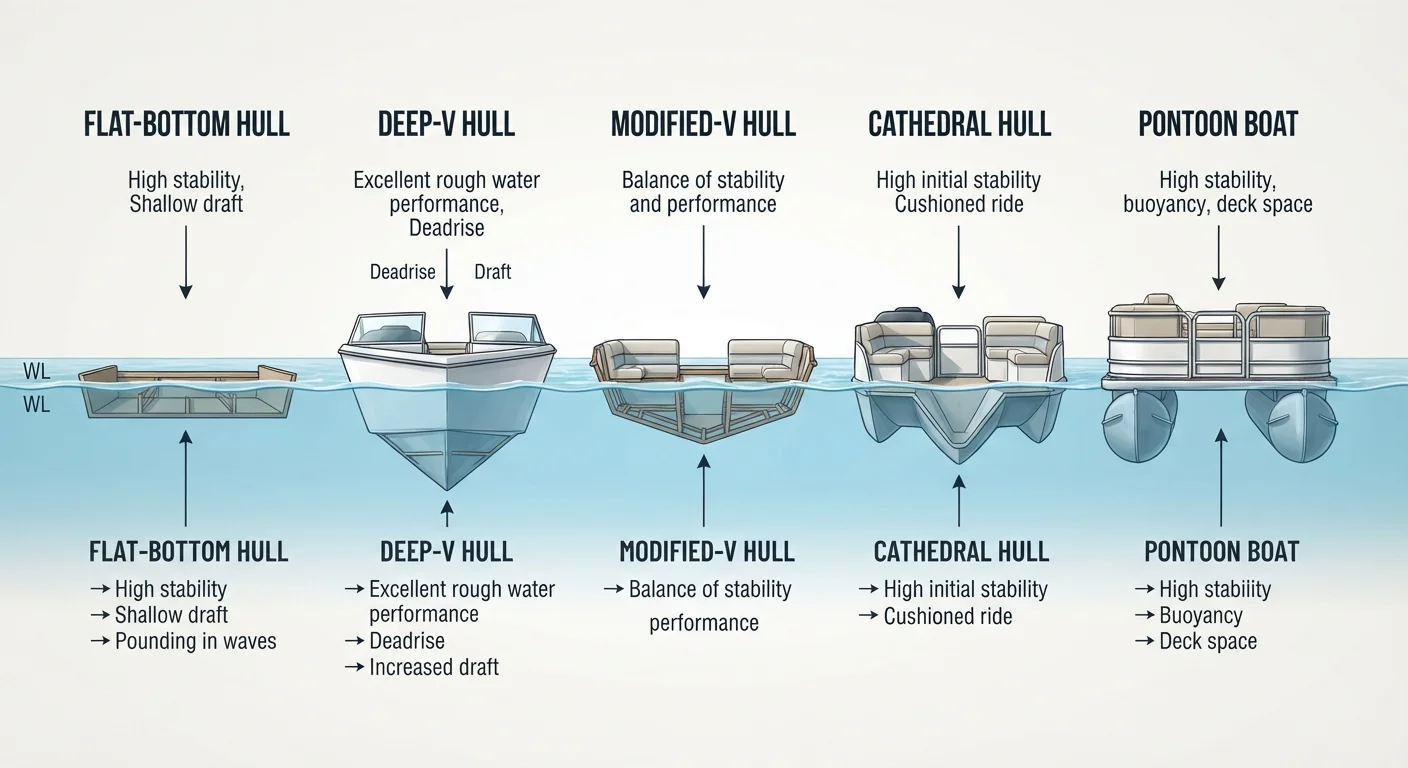
Flat-bottom hulls offer excellent initial stability in calm, protected water and are deliberately chosen for applications like jon boats, skiffs, and river craft.
Initial stability - the resistance to small tilting forces - is actually higher in flat-bottom designs than in deep-V hulls. The wide, flat planning surface creates a large waterplane area that resists rocking at rest and at low speeds. That's precisely why flat-bottom boats dominate shallow-water fishing, duck hunting marshes, and calm inland lakes.
Where flat-bottom hulls lose ground is in secondary stability and rough-water behavior. Once the hull starts to tip past a threshold, recovery is abrupt. In chop or waves, the flat surface pounds hard against the water surface rather than slicing through it. The design is optimized for specific environments - not inherently dangerous, but context-dependent.
Myth
A deep-V hull is the right choice for any boater who wants a smooth ride regardless of conditions.
Fact
Deep-V hulls excel in rough open water but trade off initial stability, shallow-water access, and fuel economy - making them poorly suited for many common boating environments.
The acute deadrise angle of a deep-V hull (typically 18-24 degrees at the transom) allows the bow to split waves cleanly, reducing pounding in heavy seas. This makes the design genuinely superior for offshore fishing, Great Lakes crossings, and exposed coastal cruising.
But those same geometry characteristics mean the hull sits deeper, rocks more noticeably at idle, and requires more power to reach planning speed. For a boater who primarily fishes protected bays, lakes, or rivers, a deep-V adds cost and fuel burn without delivering meaningful benefit. Dead rise angle is a spectrum, and the right number depends entirely on where you boat.
Myth
Pontoon boats are only suitable for calm lakes - they can't handle real wave action.
Fact
Modern pontoon designs with tri-toon configurations and performance tubes are capable of handling moderate open-water conditions with appropriate seamanship.
Traditional twin-tube pontoons are indeed best suited to protected water. The flat deck sits low relative to the tube height, and the broad beam can catch beam seas awkwardly in chop. That reputation has calcified into a blanket assumption that all pontoons are fragile lake boats.
Tri-toon designs - which add a center tube - significantly increase buoyancy, reduce bow rise, and improve planing behavior. Some models are engineered with lifting strakes (ridges on the tube undersides) that redirect water flow to improve handling in moderate wave conditions. They're not offshore vessels, but dismissing the entire category as calm-water-only overlooks genuine engineering advances in the segment.
Myth
A wider beam always means a more stable boat.
Fact
Beam width contributes to stability, but hull shape, weight distribution, and center of gravity interact in ways that can make a wide-beam boat less stable than a narrower one under certain conditions.
Beam - the maximum width of a hull - does increase the waterplane area and tends to improve initial stability. But a wide, shallow hull with a high center of gravity (common when heavy gear or passengers are stacked on an open deck) can develop a surprisingly sharp roll threshold.
The relationship between beam and stability is one reason naval architects track metacentric height (GM) - a measurement of the distance between a vessel's center of gravity and its metacenter, which predicts righting moment. A tall, wide boat loaded unevenly can have a lower effective GM than a narrower, lower-profile hull loaded properly. Hull geometry is a system, not a single variable.
Myth
Monohulls are inherently more seaworthy than catamarans in rough water.
Fact
Catamarans offer distinct stability and safety advantages in many open-water conditions, though each design involves trade-offs rather than one being universally superior.
The assumption that monohulls are the "real" seagoing hull and catamarans are novelties gets the engineering backwards in several respects. Twin-hull designs have extremely wide beam, which delivers exceptional initial and secondary stability - they are far more resistant to capsize from wave action in typical conditions than a comparably sized monohull.
Where catamarans face genuine risk is in breaking seas or extreme conditions, where a steep wave can pitch-pole the vessel (flip it end-over-end) if the bows bury. Understanding these specific failure modes is essential context. For a fuller treatment of the structural differences, see monohull vs. catamaran trade-offs.
What the Engineering Actually Says
Every hull shape represents a deliberate set of trade-offs made by designers working within physics constraints. Flat-bottom boats aren't mistakes - they're optimized tools. Deep-V hulls aren't universally superior - they're specialized instruments. The engineering doesn't support blanket rankings.
Stability Ratings Don't Tell the Whole Story
A boat's static stability - how it sits at rest - differs significantly from its dynamic stability underway. A hull that feels rock-solid at the dock can behave unpredictably when load shifts, speed increases, or beam seas develop. Always account for conditions, passenger distribution, and cargo when evaluating whether a hull is appropriate for a trip.
Hull behavior also changes with load. A moderate-V runabout that handles predictably with two adults and light gear can behave very differently when fully loaded with passengers, fuel, and equipment. Weight placed high or toward the stern shifts the center of gravity and can dramatically alter how the hull responds to wave action. Buyers evaluating hulls should test them under realistic load conditions, not just at the dock.
Hull Choice Is a Safety Decision
Matching hull design to your intended water conditions isn't just about comfort or performance - it directly affects safety. Operating a flat-bottom skiff in exposed, choppy offshore water or taking a deep-V freshwater bass boat into steep ocean chop can create genuinely dangerous situations. Understand what your hull is engineered for before leaving the dock.
For readers interested in how these same principles apply beyond hull shape, common myths about horsepower and boat speed covers related misconceptions about propulsion and performance. And if broader boating safety assumptions concern you, boating myths that create real risk addresses misconceptions with direct safety implications.
18-24°
Typical deep-V transom deadrise range
Marine design references commonly cite this deadrise window as the threshold for rough-water offshore performance in recreational powerboats.
~30%
Fuel efficiency penalty at planning speeds
Deeper-V hull designs generally require meaningfully more power to reach and maintain planing speed compared to moderate-V or flat-bottom equivalents of similar displacement.