What Defines an SUV
The term SUV describes a broad category of passenger vehicles that combine a relatively tall ride height, a cargo-accessible interior layout, and - in many cases - enhanced all-terrain or all-weather capability. Despite the name, the modern SUV market is dominated by vehicles built more for comfort and versatility than sporting off-road use.
A key distinction worth making early: the words SUV and crossover are often used interchangeably by manufacturers and media, but they technically describe different engineering approaches. A traditional SUV rides on a truck-derived body-on-frame chassis, while a crossover uses a car-derived unibody platform. That architectural difference shapes ride quality, fuel economy, towing limits, and off-road capability in meaningful ways.
For readers weighing whether an SUV is the right choice at all, our comparison of sedans and SUVs explores where each body style genuinely excels.
Crossover ≠ SUV in Every Meaningful Way
Using 'crossover' and 'SUV' interchangeably can lead to genuine mismatches between a buyer's expectations and the vehicle's actual capability. A unibody crossover marketed as an SUV may have a tow rating of 1,500 lbs and minimal ground clearance - very different from a body-on-frame SUV rated for 8,000 lbs. Always check the specifications sheet, not just the segment label.
SUV Segments and Body Styles Explained
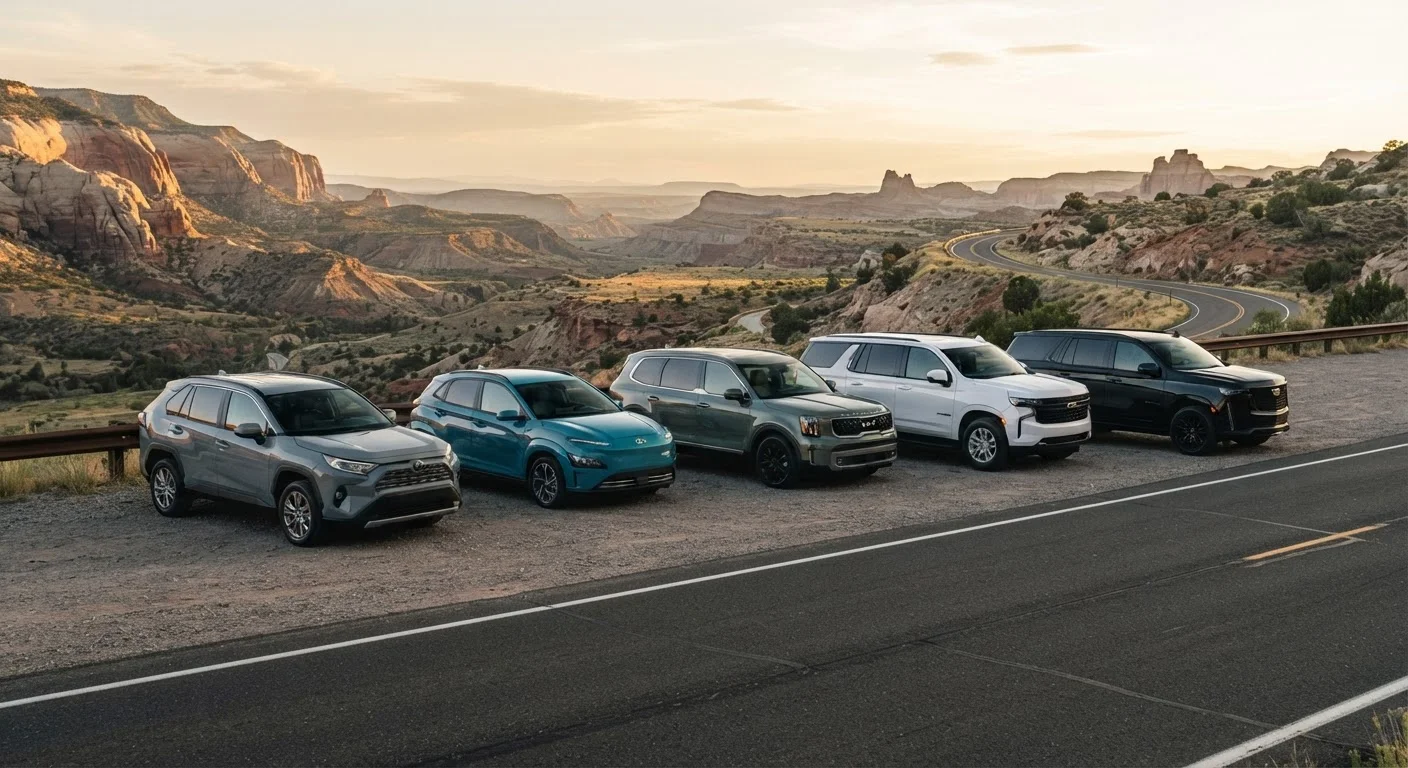
The SUV market is typically divided into size-based segments, each suited to different priorities:
- Subcompact SUV - smallest footprint, easiest to park, typically seats four to five. Fuel economy is a strength; cargo volume and towing are limited.
- Compact SUV - the highest-volume segment in the U.S. Balances passenger space, fuel economy, and price. Most are front-wheel-drive based with optional AWD.
- Mid-size SUV - two rows with more rear legroom and cargo room. Often available with optional third-row seating.
- Full-size SUV - body-on-frame construction is common here; genuine three-row seating and towing ratings above 7,000 lbs are typical strengths.
- Mid-size luxury SUV - blends premium interiors and advanced driver-assistance tech with the practicality of the mid-size segment.
- Full-size luxury SUV - the pinnacle of SUV refinement, often commanding six-figure prices and featuring air suspension, massaging seats, and advanced infotainment.
Coupe-style SUVs (sometimes called crossover coupes) add a sloped roofline for aesthetics at the cost of rear headroom and cargo volume - worth knowing if maximum practicality is a priority.
~50%
U.S. new vehicle sales that are SUVs or crossovers
SUVs and crossovers have consistently accounted for roughly half of all new vehicle sales in the United States in recent model years, according to industry sales tracking data.
17+ feet
Typical length of a full-size body-on-frame SUV
Full-size three-row SUVs on body-on-frame platforms commonly exceed 204 inches (17 feet) in overall length, a meaningful consideration for garage fit and urban parking.
8,000+ lbs
Maximum tow rating for full-size body-on-frame SUVs
Some full-size body-on-frame SUVs are rated by manufacturers to tow over 8,000 lbs when properly equipped, compared to 2,000-3,500 lbs for most compact crossovers.
Platform Architecture: Unibody vs. Body-on-Frame
Understanding platform architecture helps you predict real-world behavior before a test drive. A unibody (monocoque) design integrates the body and frame into a single welded structure. This approach reduces weight, lowers the center of gravity slightly, and generally produces a quieter, more car-like ride. The vast majority of compact, mid-size, and luxury crossovers use unibody construction.
Body-on-frame construction mounts a separate body onto a distinct steel ladder frame. This design is more tolerant of chassis flex during off-road use, supports higher payload and towing ratings, and tends to be more repairable after hard use. Full-size SUVs like those sharing platforms with light-duty pickup trucks retain this architecture.
Before comparing tow ratings between models, verify that the published figure reflects a fully equipped vehicle - not the lightest possible configuration. Tow ratings can vary by hundreds of pounds depending on cab style, engine, and axle ratio.
Manufacturers are required to test tow ratings with specific configurations; a different engine or drivetrain option on the same nameplate can carry a substantially different rating.
When evaluating AWD systems for winter use, look for systems with a rear locking differential or torque-vectoring capability rather than assuming any AWD badge provides equivalent cold-weather traction.
Basic AWD systems that only engage the rear axle reactively after wheel slip is detected may respond too slowly in sudden low-traction situations, particularly on ice.
Neither approach is objectively superior - the right choice depends on how you intend to use the vehicle. If your primary use is school runs and highway commuting, a unibody crossover will likely feel more refined. If you regularly tow a boat or trailer exceeding 5,000 lbs, a body-on-frame platform may be the more appropriate foundation. Compare the trucks and vans category for work-focused alternatives that share this architecture.
Drivetrain and All-Wheel Drive Fundamentals
Drivetrain configuration is one of the most misunderstood aspects of SUV shopping. Four common configurations exist:
- Front-Wheel Drive (FWD)
- Power delivered to the front axle only. Lowest cost, best fuel economy, adequate for most on-road conditions.
- All-Wheel Drive (AWD)
- Power distributed to all four wheels, typically managed electronically and automatically. Improves traction on wet, snowy, or lightly uneven surfaces. Adds cost and reduces fuel economy modestly.
- Part-Time 4WD
- Driver-selectable system found on body-on-frame SUVs. Must be disengaged on dry pavement to avoid drivetrain binding.
- Full-Time 4WD
- A center differential allows all four wheels to turn at different speeds, making it usable on any surface. Common on serious off-road oriented vehicles.
AWD systems also vary by sophistication. A basic open-differential AWD system provides far less off-road traction than a system with torque vectoring and locking rear differential. If winter driving or trail use is a genuine need, investigate the specific AWD system - not just the label.
AWD Is Not a Substitute for Winter Tires
All-wheel drive improves acceleration traction but does not meaningfully reduce stopping distances on snow or ice. Braking performance is governed by tire compound and tread pattern, not drivetrain configuration. In climates with regular winter conditions, appropriate winter tires provide a larger safety benefit than AWD alone.
Safety Ratings and Active Technology
Two independent organizations publish the crash-test data most relevant to U.S. buyers: the National Highway Traffic Safety Administration (NHTSA) and the Insurance Institute for Highway Safety (IIHS). Each uses different test methodologies, so a vehicle can perform differently across the two rating systems. Consulting both provides a more complete picture.
Beyond passive crash protection, most modern SUVs offer a suite of active safety technologies - often grouped under names like "driver assistance package" or "safety suite." Common systems include:
- Automatic Emergency Braking (AEB) - detects imminent collisions and applies braking if the driver does not respond.
- Lane-Keeping Assist - provides steering input or alerts when the vehicle drifts from its lane unintentionally.
- Blind-Spot Monitoring - alerts the driver to vehicles in adjacent lanes not visible in mirrors.
- Adaptive Cruise Control - maintains a set following distance from the vehicle ahead.
When evaluating a specific model, check whether these systems are standard across all trim levels or restricted to higher-priced trims. Our guide to reading an SUV window sticker explains how safety packages are typically itemized on the Monroney label.
Running Costs and Ownership Considerations
Sticker price captures only a fraction of what an SUV will ultimately cost. Key ongoing expenses include:
- Fuel - larger engines, heavier vehicles, and AWD systems reduce fuel economy. A difference of 5 MPG across 15,000 annual miles represents a meaningful annual fuel cost gap.
- Insurance - rates vary by vehicle category, engine size, repair cost, and safety record. Full-size and luxury SUVs typically carry higher premiums.
- Depreciation - some segments and brands retain resale value better than others. Depreciation is often the largest single ownership cost over a five-year period.
- Scheduled maintenance - service intervals, parts costs, and dealer network density all affect the real-world cost of upkeep.
- Tires - larger diameter, performance-oriented, or all-terrain tires can cost significantly more per set than standard passenger car tires.
For shoppers considering a sedan as an alternative, total cost of ownership comparisons frequently favor the sedan on fuel and insurance, while the SUV offers advantages in cargo volume and towing.
Request a Five-Year Ownership Cost Estimate
Before committing to a specific model, ask the dealership or use an independent automotive data resource to model five-year ownership costs - including depreciation, fuel, insurance, and scheduled maintenance. This single exercise frequently changes which vehicle represents the stronger value, and often surfaces differences that sticker price comparisons conceal.
Matching an SUV to Your Lifestyle
The most common mistake SUV shoppers make is buying for capability they will rarely use. A practical framework for narrowing your choice:
- Define your towing and payload needs precisely. If you tow, identify the loaded weight of your trailer or boat - not an estimate. Match the SUV's rated capacity with at least a 10-15% margin.
- Count your passengers regularly. A third row sounds appealing but adds length and cost. If you rarely carry more than five adults, a two-row mid-size often serves better.
- Quantify your cargo use. Measure the largest items you routinely carry. Cargo volume figures in cubic feet don't always translate intuitively - measure your gear against the vehicle's load floor dimensions.
- Be honest about off-road use. Most SUV owners never leave pavement. AWD and ground clearance add cost; reserve them for genuine need.
- Factor in parking and garage dimensions. A full-size SUV can exceed 17 feet in length and may not fit standard garage bays or urban parking structures.
No single SUV is the right answer for every household. Use the segment breakdowns and architectural distinctions in this guide as a filter - then narrow to specific models that meet your verified requirements, and allow real-world test drives and ownership cost research to make the final determination.
This article is intended as general educational information about vehicle categories and features. Specifications, pricing, and availability vary by model year and region. Always verify current data with manufacturer sources or a qualified automotive professional before making a purchase decision.
“The best SUV is the one that fits the life you actually live - not the adventurous weekend you imagine having twice a year.”
— Cars & Trucks Editorial Team, Automotive editorial analysts