Why the Monroney Label Exists and What It Covers
The Monroney label - formally the Automobile Information Disclosure Act sticker - has been a federal requirement on new vehicles since 1958. Its purpose is straightforward: give every buyer access to the same standardized information regardless of which dealership they visit or how much they already know about the car business. For SUV shoppers in particular, the label is especially useful because SUVs span an enormous range of configurations, drivetrains, and price points, making standardized disclosure more valuable than in simpler vehicle categories.
The label is organized into distinct sections: pricing (base MSRP, options, and destination charge), EPA fuel economy estimates, NHTSA safety ratings, and a list of standard and optional equipment. Understanding what each section means - and equally, what it omits - is the foundation of confident SUV shopping. If you're also evaluating sedans, reading a sedan spec sheet follows a parallel logic, though the relevant figures differ.
What you will need
Tools and Resources to Have Ready
You don't need specialized equipment to read a Monroney label, but a few reference resources sharpen your analysis considerably. Having fueleconomy.gov open on your phone while standing in a dealership lets you immediately benchmark an SUV's MPG against its segment peers. The NHTSA portal lets you drill past the sticker's summary stars into individual test results.
Manufacturer Build-and-Price Tool
Generates a digital version of the Monroney label for any trim and option combination before visiting a dealership.
fueleconomy.gov
Cross-reference EPA fuel economy estimates and compare them across similar SUV models side by side.
NHTSA Safety Ratings Portal (nhtsa.gov)
Look up full crash-test details beyond the summary stars shown on the window sticker.
For a broader framework on how the window sticker fits into the overall SUV evaluation process, our complete SUV guide covers platform architecture, segment definitions, and technology factors that the Monroney label alone doesn't address.
Step-by-Step: Decoding Each Section of the Sticker
Work through the label systematically - top to bottom - rather than jumping to the total price. Each section provides context that makes the numbers in subsequent sections more meaningful. The steps below walk through every major block in the order it appears on a standard Monroney label.
Locate and confirm the label is genuine
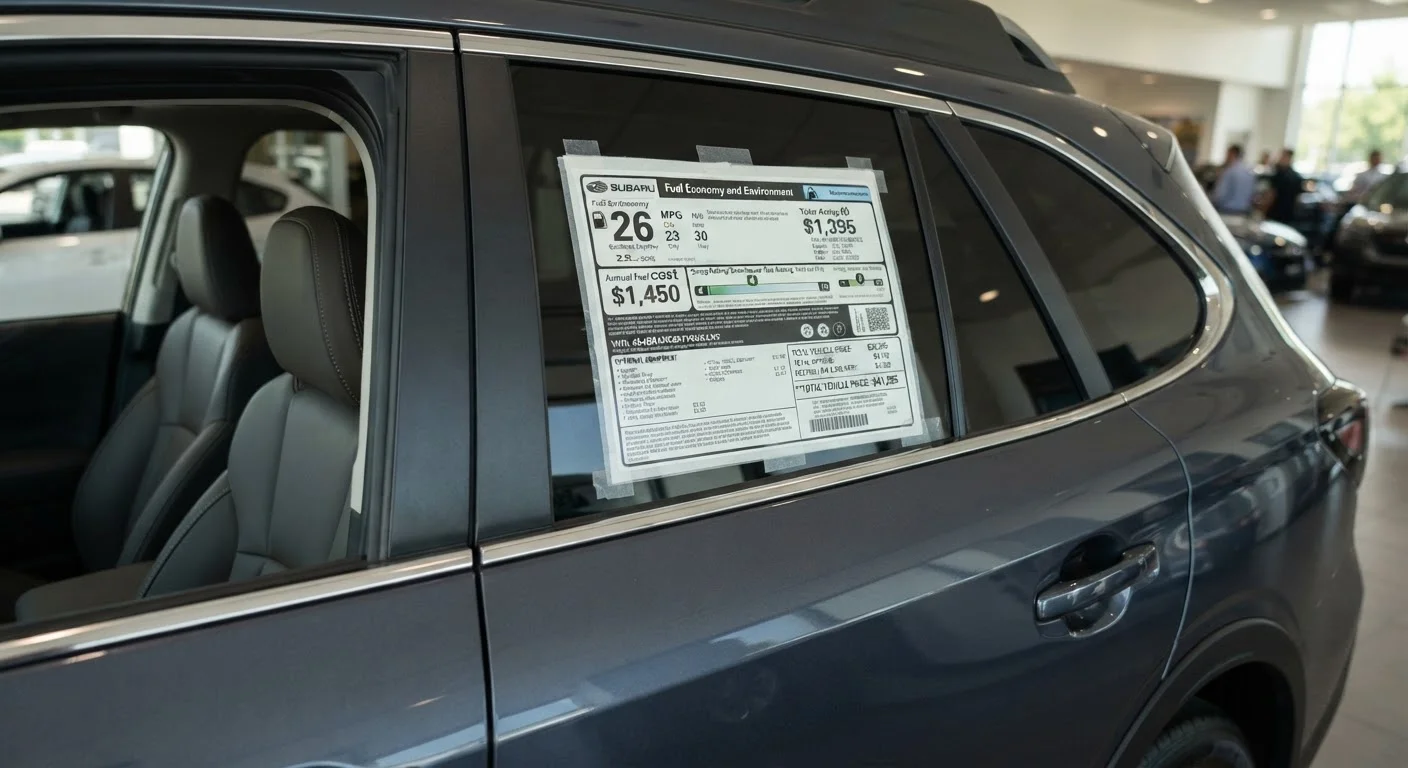
The Monroney label - named for the 1958 federal legislation that made it mandatory - must be affixed to the side window of every new passenger vehicle sold in the United States. It cannot legally be removed before the buyer takes delivery. Look for it on the rear passenger-side window or the front driver-side window. On a digital build-and-price tool, it appears as a printable PDF. Confirm the label matches the actual vehicle by cross-checking the VIN printed at the top of the label against the VIN on the dashboard and door jamb.
Parse the pricing section
The pricing block lists several distinct figures that are often misread as a single number:
- Base MSRP: The manufacturer's suggested retail price for the specific trim level (e.g., Sport, Limited, Platinum) with no optional equipment.
- Optional packages and accessories: Each add-on is itemized with its own price. Packages bundle multiple features - compare the bundled price against à-la-carte alternatives.
- Destination and delivery charge: A fixed fee covering transport from factory to dealership. This figure is non-negotiable and identical for every buyer regardless of geography.
- Total MSRP: The sum of base price, options, and destination. This is the figure dealers typically anchor negotiations to.
Note that taxes, title, registration fees, and dealer documentation fees are not included on the Monroney label. Those appear later in the purchase contract.
Interpret the fuel economy section
The large central section of the label displays EPA-estimated fuel economy in miles per gallon (MPG) for city, highway, and combined driving cycles. For plug-in hybrids and EVs, look for MPGe (miles per gallon equivalent) and, separately, an electric range estimate.
Key points to understand:
- The EPA's city and highway test cycles are conducted in a lab under controlled conditions. Real-world results typically vary due to terrain, climate, payload, and driving style.
- The label also shows an estimated annual fuel cost based on assumed mileage and a national average fuel price - treat this as a directional figure, not a guarantee.
- The comparison bar at the bottom shows where this vehicle ranks against others in its class, giving useful context.
Cross-reference figures at our complete SUV guide to understand how powertrain type (turbocharged four-cylinder, hybrid, V6) affects real-world efficiency for your likely use case.
Read the safety ratings block
The Monroney label includes an NHTSA Overall Vehicle Score displayed as stars (1-5). Below it, individual ratings appear for frontal crash, side crash, and rollover resistance. A five-star overall score is the top rating.
Important caveats:
- NHTSA and IIHS use different test methodologies. An SUV can score well on one program and less well on the other. IIHS ratings are not printed on the Monroney label - look them up separately at iihs.org.
- If the vehicle was not yet rated at time of production, the label may show "Not Rated" - check NHTSA's website for updates.
- Standard safety technology (automatic emergency braking, lane-keep assist) is listed in the standard equipment section and affects real-world safety independent of crash-test scores.
Review standard and optional equipment lists
Below the pricing and ratings sections, the Monroney label itemizes what comes standard on the trim and what was added via options. Scan this carefully:
- Confirm that features central to your decision - a panoramic roof, a towing package, a third-row seat - appear as either standard or as a checked option with its price.
- Identify any options you would not use. These are candidates for negotiation or a reason to consider a different trim configuration.
- The trim name is printed clearly at the top. Different trims of the same nameplate can have substantially different standard equipment, which is why comparing total MSRPs across trims is essential.
For off-road-focused SUVs, cross-check suspension and skid plate listings against real capability metrics. Our guide on ground clearance and approach angles explains which specs to validate beyond what the sticker shows.
Note what the sticker does not cover
The Monroney label is comprehensive but deliberately limited to federally mandated disclosures. Several cost and capability factors are absent:
- Dealer markup or discount: The sticker shows MSRP - the actual transaction price is set by negotiation.
- Financing terms and interest: Loan rates, lease residuals, and money factors are in the finance office, not on the label.
- Long-term ownership costs: Insurance premiums, maintenance intervals, tyre sizes, and depreciation curves do not appear. See seven SUV ownership costs for a thorough breakdown of what to budget beyond the sticker.
- Real-world towing and payload limits: The sticker may note a maximum tow rating, but achieving it depends on trim, hitch type, and how the vehicle is configured.
Compare Stickers Across Trims Before Visiting
Most manufacturers publish Monroney-style labels through their online build-and-price tools. Pull labels for two or three trim levels before stepping into a dealership - you'll arrive with concrete numbers and a clearer sense of which options packages offer genuine value for your priorities.
Putting the Numbers in Context
A window sticker becomes genuinely useful only when the figures are compared across at least two or three SUVs in the same segment. An isolated MSRP tells you little; a side-by-side comparison of total MSRPs, combined MPG estimates, and safety scores tells you considerably more. Keep in mind that sticker data reflects a single point in time - fuel prices, incentive programs, and available configurations change - so treat the label as a decision-support document rather than a final accounting of what you'll pay.
For SUVs with off-road marketing claims, the sticker's standard equipment list is only a starting point. Verify suspension travel, skid plate coverage, and locking differential availability through the manufacturer's spec sheet or dedicated off-road spec resources. Trucks present a similar issue - what the window sticker doesn't tell you about truck capability explores how advertised tow ratings diverge from real-world limits.
MSRP Is a Suggestion, Not a Fixed Price
The "suggested" in MSRP is legally meaningful. Dealers may sell above or below MSRP depending on market demand, inventory levels, and negotiation. The Monroney label does not obligate any transaction price. Always confirm the out-the-door price - which includes taxes, title, registration, and any dealer fees - in writing before signing.
Once you understand the sticker, the next layer of analysis is post-purchase cost. The Monroney covers acquisition price; it says nothing about what an SUV costs to own for five years. Seven SUV ownership costs that catch first-time buyers off guard covers the running expenses that often surprise new owners.