The Deployment Sequence: From Impact to Inflation
The process that takes an airbag from dormant cushion to deployed protection unfolds in three distinct stages, all within a timeframe measured in milliseconds. Understanding each stage clarifies why airbags behave the way they do - and why they don't deploy in every collision.
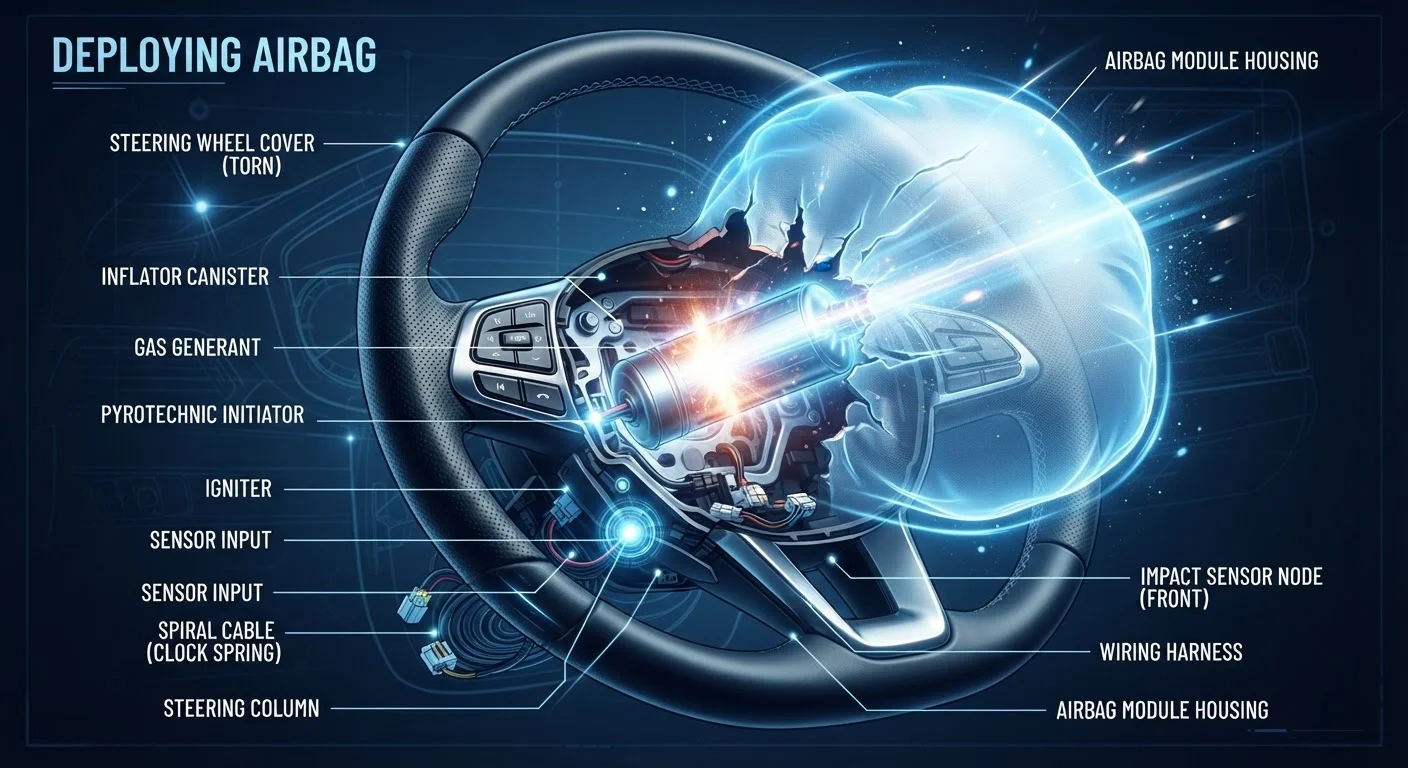
Stage 1 - Sensing: Accelerometers mounted at strategic points around the vehicle continuously measure deceleration forces. When a collision occurs, these sensors generate electrical signals that travel to the airbag control module (ACM), sometimes called the SRS module. Most systems require agreement from multiple sensors before authorizing deployment, which prevents false activation from potholes or minor parking lot contacts.
Stage 2 - Inflation: Once the ACM confirms a qualifying event, it sends an electrical current to the inflator - a sealed canister containing a solid propellant. The resulting chemical reaction produces a large volume of nitrogen gas in roughly 20 to 30 milliseconds, filling the fabric bag. The fabric itself is typically coated with a powdery lubricant (often mistaken for smoke) that aids the rapid unfolding process.
Stage 3 - Deflation: Engineered vent holes allow gas to escape as the occupant contacts the bag, dissipating kinetic energy progressively rather than abruptly. A fully inflated bag that stayed rigid would itself cause injury - controlled deflation is essential to the system's protective function.
This complete sequence is detailed further in our overview of collision safety components that operate in concert during a crash.
~30-50 ms
Time for front airbag full inflation
NHTSA engineering documentation describes front airbag inflation occurring within approximately 30 to 50 milliseconds of a qualifying crash event.
10+
Airbag locations in many modern vehicles
Premium and mid-range vehicles now routinely include front, side-curtain, thorax, knee, and center airbags across multiple seating rows.
~15-20 mph
Typical minimum speed for front airbag deployment
Front airbags are generally calibrated to deploy in frontal impacts roughly equivalent to a rigid-barrier collision above 15 to 20 mph, though thresholds vary by vehicle design.
Sensor Types and What They Detect
Modern SRS systems use several sensor types working in coordination. Front-impact accelerometers are typically located in the vehicle's crumple zones and inside the ACM itself. Side-impact sensors - which must react even faster than frontal sensors due to reduced crumple space - are often mounted in the B-pillars or door structures. Rollover sensors use gyroscopic or tilt-detection technology to identify rotation events that might warrant curtain or side-bag deployment.
Pressure sensors are also increasingly common in door cavities; when a side impact compresses the door panel, the pressure spike provides near-instantaneous trigger information that pure accelerometers might lag on by critical milliseconds.
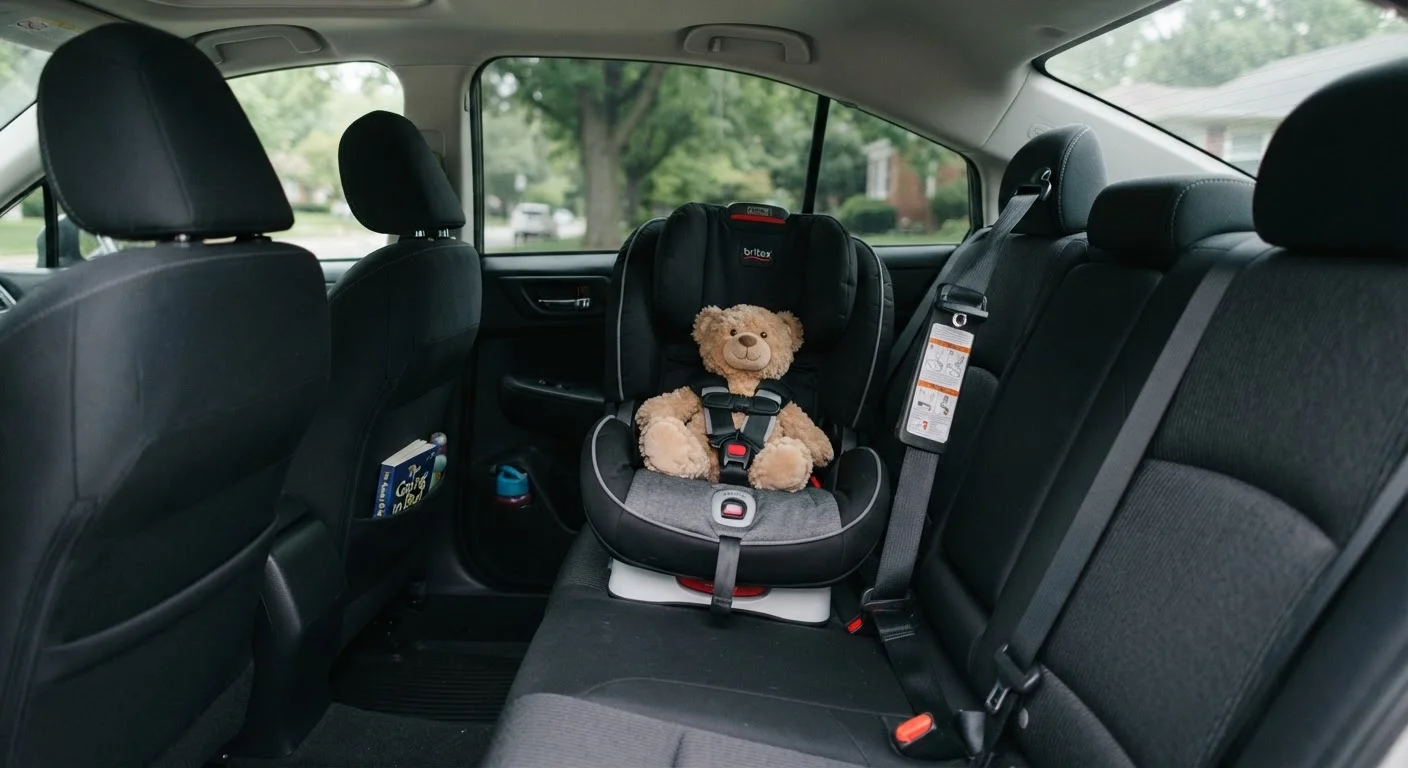
Occupant detection systems add another layer: weight-sensing seat mats and sometimes infrared or ultrasonic sensors determine whether the front passenger seat is occupied, and by an adult or a child-sized presence. This data influences whether the passenger airbag deploys at full force, deploys at reduced force, or is suppressed entirely - a critical consideration discussed in detail in our guide on child passenger safety fundamentals.
SRS Warning Light: Don't Ignore It
An illuminated SRS or airbag warning light on your instrument cluster indicates the control module has detected a fault in the system. A fault condition may mean one or more airbags will not deploy as intended in a collision, or conversely, could deploy unexpectedly. Have the system diagnosed by a qualified technician promptly - this is not a warning light that should be deferred.
Factors That Affect Airbag Performance
Even a perfectly functioning airbag system can underperform if external conditions undermine its design assumptions. Several variables are worth understanding:
- Seating position: Airbags are calibrated assuming occupants are seated upright, a reasonable distance from the bag housing. Sitting too close to a steering wheel airbag - sometimes called being "out of position" - dramatically increases injury risk from the deployment force itself.
- Seatbelt use: Because airbags are supplemental, an unbelted occupant slides forward before the bag is fully inflated, contacting it at far greater velocity. The SRS works as an integrated system; the seatbelt pre-positions the occupant so the bag can absorb energy at the right moment.
- Vehicle damage history: Previous collisions - even ones that did not deploy airbags - can stress or misalign sensors. Crash sensors that are damaged or improperly calibrated after a repair may not respond correctly in a subsequent event.
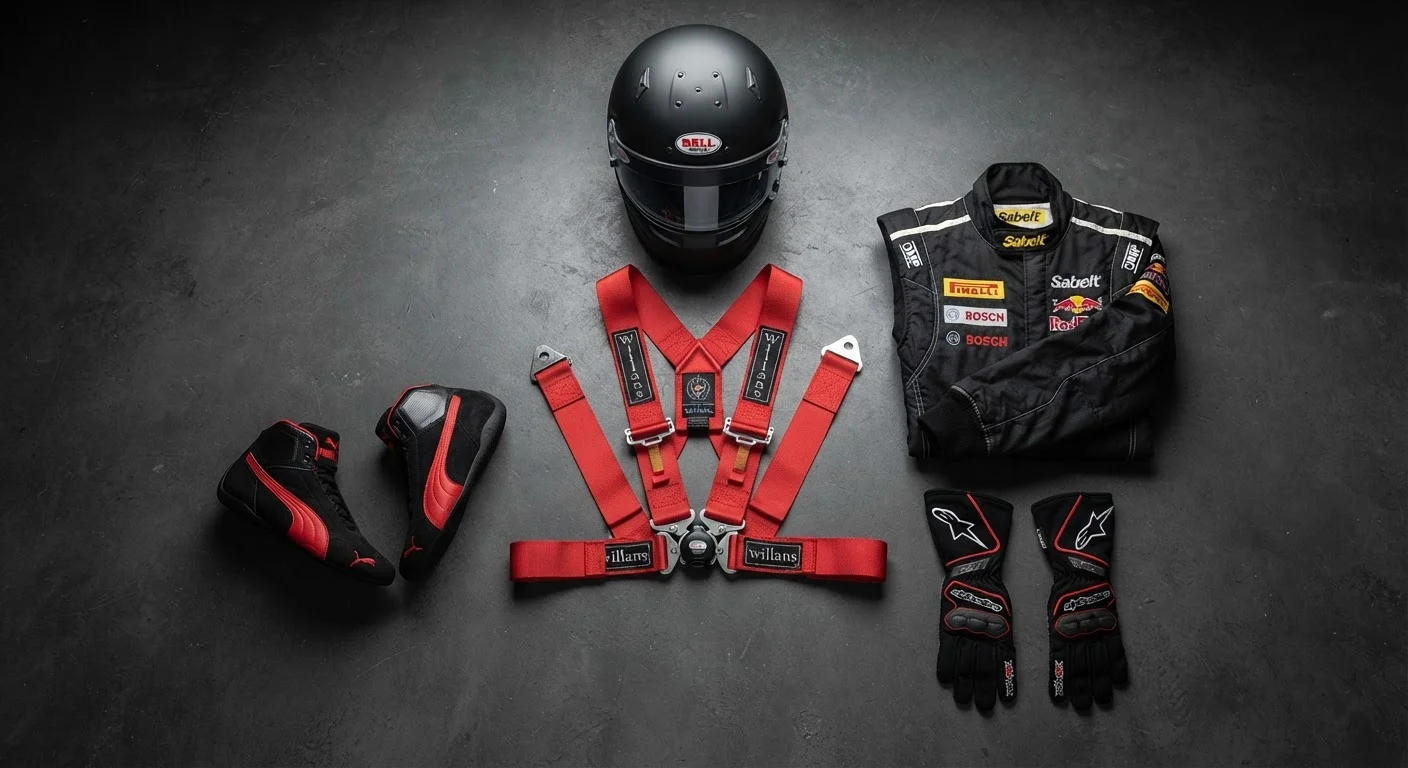
- Aftermarket modifications: Structural or electrical modifications that disturb sensor mounting points or wiring harnesses can interfere with SRS function. For context on how modifications interact with vehicle systems, see driver safety gear fundamentals.
- Age and temperature: Propellant compounds in inflators can degrade over time or through repeated extreme temperature cycling. This is a documented concern with certain recalled inflator designs, and has led to major safety campaigns requiring inflator replacement regardless of visible damage.
Maintain the Correct Seating Position
Keep at least 10 inches of distance between your sternum and the steering wheel airbag housing whenever possible. Adjust seat height and rake so you can reach pedals comfortably without sliding the seat too far forward. This distance gives the deploying airbag room to partially inflate before contacting you - reducing deployment injury risk substantially.
Airbag Coverage: Where and How Many
Modern vehicles commonly include multiple airbag locations beyond the obvious front driver and passenger bags. Side-curtain airbags deploy from the roofline to cover occupant head positions across multiple rows. Seat-mounted side thorax bags protect the torso in lateral impacts. Knee airbags reduce leg and lower-body injury by preventing forward knee travel. Some vehicles now include a front center airbag between front-row occupants to limit head-to-head contact in certain side impacts.
Each airbag zone has its own inflator, sensor logic, and deployment threshold. A curtain airbag designed for a side-pole impact scenario may deploy in a rollover event even when a front bag does not. Understanding that these systems do not operate as a single uniform unit helps explain why post-accident inspections sometimes find that some bags deployed and others did not - that outcome may be entirely by design.
For drivers interested in how passive safety systems complement active technologies, our explanation of anti-lock braking system mechanics covers another layer of modern vehicle safety engineering.
This article is for general educational purposes only. For maintenance, diagnosis, or repair of airbag and SRS systems, always consult a qualified automotive technician. Working with SRS components without proper training can result in accidental deployment and serious injury.