The Problem ABS Solves
When a driver applies the brakes hard enough to fully lock a wheel - stopping it from rotating - the tire transitions from rolling friction to sliding friction. A locked tire has very limited lateral grip, which means the driver cannot steer the vehicle. The car continues in whatever direction it was heading, regardless of where the steering wheel is pointed.
This phenomenon, called wheel lock-up, is the core problem ABS addresses. Before ABS became widespread, experienced drivers were taught to "pump" the brakes manually in emergency situations - rapidly pressing and releasing the pedal to modulate pressure. ABS automates this process at a speed and precision no human foot can replicate, typically modulating pressure 10 to 15 times per second per wheel.
ABS Is Passive from the Driver's Perspective
Drivers do not need to activate ABS or change their braking technique to benefit from it. The system engages automatically when sensor data indicates an imminent lock-up. The only driver input required is sustained, firm brake pressure and deliberate steering - the system handles pressure modulation automatically.
The Four Key Components
ABS is an integrated system. Understanding each component clarifies how they cooperate during an emergency stop.
Wheel Speed Sensors
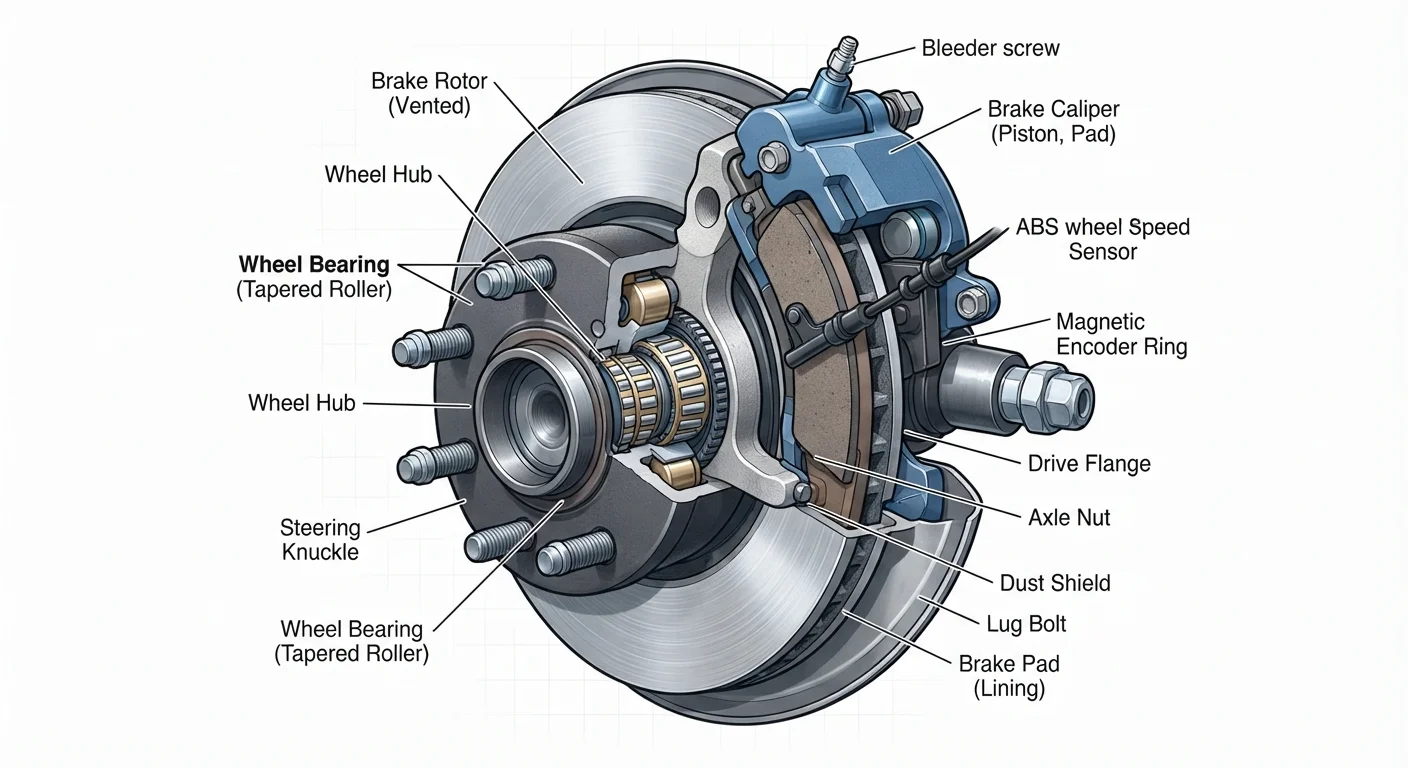
Each wheel has a dedicated speed sensor - usually a magnetic or Hall-effect sensor - mounted near the hub. The sensor reads a toothed ring (called a reluctor ring or tone ring) that spins with the wheel. It continuously sends rotational speed data to the control unit. A sudden dramatic drop in one wheel's speed signals potential lock-up.
Electronic Control Unit (ECU)
The ABS ECU - sometimes integrated into a broader vehicle stability module - receives data from all four sensors simultaneously. It compares each wheel's speed to the others and to the vehicle's overall deceleration rate. When it detects that a wheel is decelerating too rapidly relative to the others, it signals the hydraulic modulator to act within milliseconds.
Hydraulic Modulator and Valves
The hydraulic modulator sits between the master cylinder (the component your brake pedal pressurizes) and the individual brake calipers or wheel cylinders. It contains solenoid-operated valves for each wheel channel. When the ECU commands intervention, the valves cycle through three states: hold (maintaining current pressure), release (reducing pressure to allow the wheel to spin up), and apply (restoring pressure to re-engage braking force). This rapid cycling is what drivers feel as the characteristic pedal pulsation during ABS activation.
Keep Steady Pressure During ABS Activation
When you feel the pedal pulsing, resist the instinct to lift your foot. Maintain firm, continuous pressure on the brake pedal and steer toward your escape path. Releasing the pedal prematurely reduces braking force before the vehicle has slowed sufficiently.
What Happens During an Emergency Stop
When a driver brakes hard, the sequence unfolds rapidly. The wheel speed sensors detect a wheel decelerating faster than the others. The ECU identifies it as approaching lock-up and commands the modulator to reduce hydraulic pressure at that wheel. The wheel spins back up, traction is restored, and pressure is reapplied. This hold-release-apply cycle repeats continuously until the vehicle slows to a near stop or the driver eases brake pressure.
Throughout this process, the remaining three wheels continue receiving braking force normally. The net effect is maximum braking effort without surrendering steering capability - allowing the driver to navigate around an obstacle even while braking hard.
It is worth noting that ABS behavior can vary by surface. On dry pavement, ABS typically produces stopping distances comparable to or shorter than a locked wheel. On loose surfaces like gravel or wet grass, a locked wheel can sometimes build up a wedge of material that reduces stopping distance - meaning ABS may extend the stop slightly. The trade-off, however, is retained steering control, which is often the more critical factor.
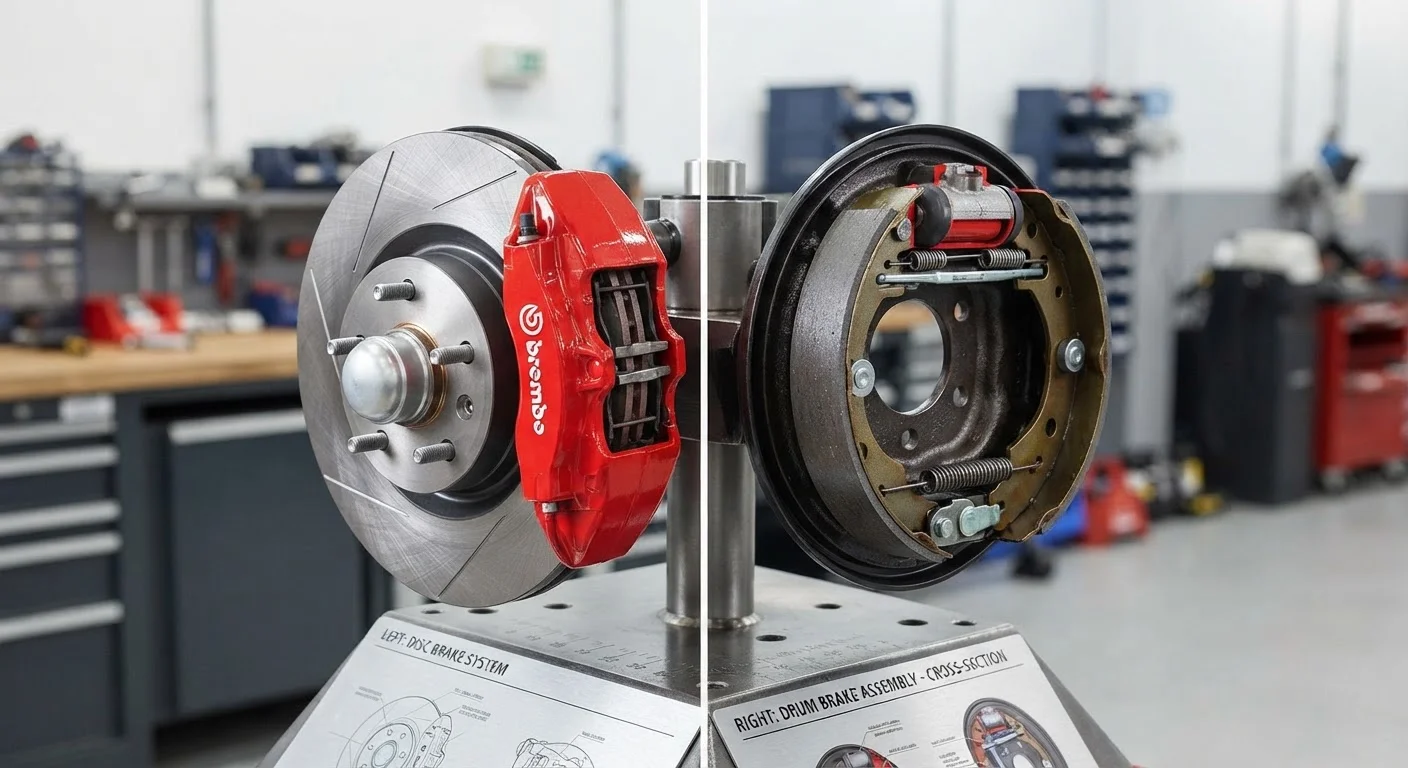
For a broader look at how braking hardware affects stopping behavior, see our comparison of disc and drum brake systems. If you are considering performance modifications that interact with ABS, the brake upgrade considerations guide covers important system-level trade-offs.
10-15x
Brake pressure cycles per second during ABS activation
The hydraulic modulator cycles pressure far faster than a driver can manually pump the brakes, per general automotive engineering principles.
2013
Year ABS became mandatory on US passenger cars
The National Highway Traffic Safety Administration required ABS on all new passenger vehicles sold in the United States starting with model year 2013.
4
Wheel speed sensors in a typical 4-channel ABS system
Most modern passenger vehicles use a four-channel system with an independent sensor and valve circuit for each wheel, allowing precise per-wheel pressure control.
ABS as a Foundation for Modern Safety Systems
ABS did not remain a standalone feature for long. Its sensor network and hydraulic modulator became the infrastructure on which engineers built subsequent active safety technologies. Electronic Stability Control (ESC) uses ABS hardware to selectively brake individual wheels and counter oversteer or understeer. Traction Control Systems (TCS) use the same wheel speed sensors to detect driven-wheel slip during acceleration and reduce engine torque or apply braking accordingly.
This means a malfunctioning ABS system can cascade - disabling or degrading ESC and traction control as well, which is one reason prompt diagnosis of an ABS warning light matters. ABS also plays a role alongside other passive safety systems; for context on how vehicle safety systems interrelate, see our explainer on how airbag systems work.
Understanding ABS also helps set realistic expectations. The system is a tool for maintaining control, not a guarantee of avoiding a collision. Appropriate following distance, reasonable speed for conditions, and attentive driving remain the primary factors in crash prevention.
This article is for informational purposes only. For diagnosis or repair of ABS components, consult a qualified automotive technician.