Why Handling Modifications Deserve a Careful Approach
Suspension and chassis upgrades occupy a different category than most bolt-on modifications. Unlike an air intake or exhaust, handling changes directly affect how your vehicle responds in emergency maneuvers, how it loads during cornering, and how predictably it behaves near its limits. The stakes are higher - and the interaction between components is more complex.
Before committing to any upgrade, it's worth reviewing this pre-upgrade vehicle condition checklist to ensure your car's existing suspension, bushings, and tires are in good shape. Modifications layered onto worn components rarely produce the intended results. With that foundation in place, here are the handling modifications most worth understanding - what each targets, what it costs you, and where it fits in a coherent build.
Anti-Roll Bars (Sway Bars)
Anti-roll bars connect the left and right suspension on an axle and resist body roll during cornering by transferring load between sides. Upgrading to a stiffer bar reduces lean angle in corners, which can sharpen turn-in response and improve driver confidence at moderate to high speeds.
The trade-off is ride quality over broken pavement and single-wheel bumps, where a stiffer bar forces one wheel's movement to affect the other. Front-only sway bar upgrades can also push the handling balance toward understeer if the rear isn't addressed proportionally. This makes sway bar changes one area where front and rear stiffness ratios matter significantly.
Sway bar stiffness ratios between axles determine whether your car understeers or oversteers - don't upgrade just one end without considering the other.
Coilovers
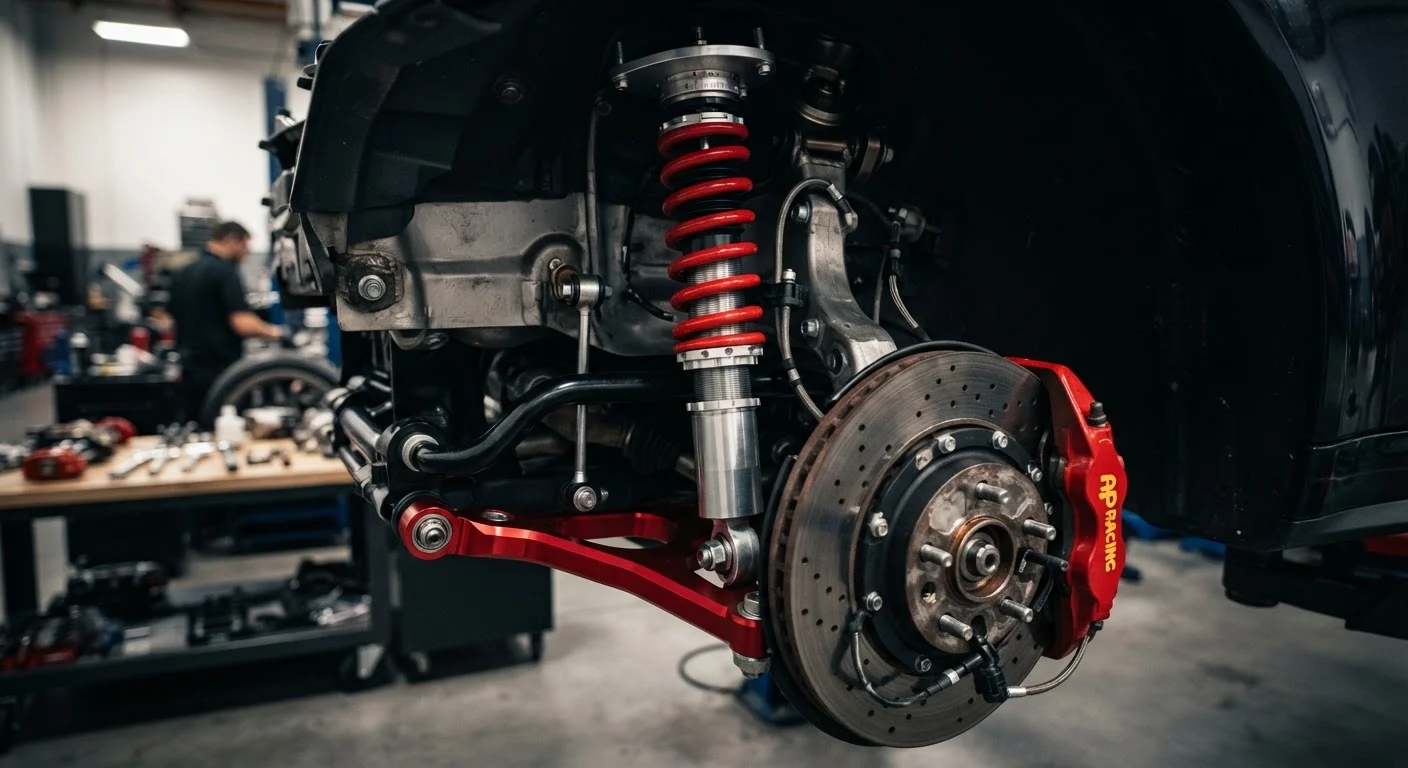
Coilover systems replace the factory spring and shock absorber with a single unit that allows independent adjustment of ride height and, on more sophisticated versions, damping force. They offer far greater tuning flexibility than a simple spring swap and allow the vehicle to be lowered in a controlled, geometry-friendly way.
Key considerations include valving quality (which determines how the shock responds to fast versus slow suspension inputs), adjustability range, and whether the unit is designed for street use, track use, or both. Extremely stiff track-focused coilovers on public roads can cause fatigue and reduce tire contact over rough surfaces. Proper alignment - especially camber and corner weighting - is essential after installation. For those newer to suspension upgrades, coilovers are often better approached as a second-step modification rather than a starting point.
Damping quality matters more than ride height range - cheap valving can make a lowered car handle worse than stock.
Strut Tower Braces and Chassis Bracing
Strut tower braces connect the tops of the front suspension strut mounts across the engine bay, reducing flex in the body structure under cornering loads. On vehicles with relatively flexible unibody construction, this can tighten up steering response and reduce vagueness near the limit.
The effect is most noticeable on older platforms or convertibles where structural rigidity is lower to begin with. On already-stiff modern platforms, the perceptible difference may be minor. Undercarriage bracing (subframe connectors, front-to-rear braces) extends the same logic to the chassis floor. These modifications generally add modest weight and have minimal negative impact on daily use, making them one of the lower-commitment handling investments available.
Chassis bracing delivers the clearest benefit on older or softer platforms - on modern rigid bodies, gains are often marginal.
Upgraded Bushings
Factory rubber suspension bushings are designed to absorb NVH (noise, vibration, and harshness) and tolerate misalignment across a range of conditions. Polyurethane or spherical (pillow ball) replacements reduce flex in the suspension mounting points, sharpening the precision with which the geometry responds to driver inputs.
The compromise is increased NVH transmission into the cabin - polyurethane bushings conduct more road noise and vibration than rubber. Spherical bearings, common in motorsport applications, require periodic lubrication and are generally inappropriate for daily street use. Upgraded bushings work best as part of a broader suspension rebuild rather than as a standalone change, and they're often worth addressing when other suspension components are already being serviced.
Firmer bushings sharpen suspension response but transfer more road noise - the right choice depends on your tolerance for NVH.
Alignment Tuning Beyond Factory Spec
Alignment settings - particularly camber, caster, and toe - have a significant effect on handling behavior and are adjustable on most performance-oriented vehicles. Increased negative front camber improves contact patch loading during cornering at the cost of some straight-line tire wear. Toe settings affect straight-line stability versus turn-in aggressiveness. Caster angle influences steering feel and return-to-center behavior.
Many enthusiasts overlook alignment as a modification category because it doesn't involve purchasing parts. However, dialing in alignment after any suspension change - or as a standalone tuning step - can meaningfully change how a vehicle feels. A qualified alignment technician with experience in performance applications can target settings appropriate to your specific use. This pairs naturally with the broader context of what performance upgrades actually do to vehicle dynamics.
Alignment tuning costs relatively little and can transform how a vehicle handles - it's often the most overlooked performance adjustment available.
Larger or Wider Wheels and Tires
Tire contact patch, compound, and sidewall stiffness are among the most influential variables in handling. Wider tires increase lateral grip potential; lower-profile sidewalls reduce flex during cornering and sharpen response. However, wider tires also add unsprung and rotating mass, increase sensitivity to road surface irregularities, and may require fender modifications depending on offset and clearance.
Wheel weight matters as much as size - heavier wheels increase rotational inertia and can dull acceleration and braking response. Tire compound selection is often more impactful than going wider; a performance-compound tire on a modest width rim frequently outperforms a wider tire in a touring compound. Ride quality will degrade with reduced sidewall height, a trade-off that compounds on vehicles already running stiff suspension. This upgrade intersects closely with brake upgrade considerations, since increased lateral grip raises the demands on your braking system.
Tire compound selection often delivers more cornering improvement than simply going wider - mass and grip compound matter as much as size.
Building a Coherent Handling Setup
The upgrades above don't operate in isolation. A stiffer anti-roll bar paired with soft, worn struts creates unpredictable load transfer. Coilovers set too low may bind against bump stops constantly, negating their intended benefit. The most effective handling builds treat the suspension as a system, where each change is deliberate and complementary.
Change One Variable at a Time
When building a handling setup, resist the temptation to install multiple components simultaneously. Changing sway bars, coilovers, and bushings at the same time makes it nearly impossible to attribute handling changes - positive or negative - to a specific part. Sequential changes, with test drives between each, let you evaluate the actual effect of every modification and catch any setup problems early.
For a deeper look at how these components interact across street and track environments, suspension tuning for street and track use covers alignment settings, sway bar sizing, and coilover setup in practical terms. If you're also weighing chassis stiffness against mass, the engineering perspective in weight reduction trade-offs for performance cars is a useful complement. Handling modifications reward patience and methodical progression - rushing through multiple changes at once makes it nearly impossible to evaluate what's actually working.