Why Suspension Tuning Is a System, Not a Single Upgrade
Suspension tuning is frequently misunderstood as a collection of individual bolt-on improvements. In practice, coilovers, sway bars, and alignment settings are interdependent - changing one alters how the others behave. As covered in Suspension Geometry 101, the relationship between springs, dampers, and geometry is what ultimately determines how a car handles, not any single component in isolation.
The core tension in any suspension build is the conflict between compliance and control. A compliant suspension absorbs road imperfections, keeping tires in contact with the pavement. A stiff, low setup minimizes body roll and improves cornering response - but can cause tires to skip over rough surfaces, reducing actual grip. Understanding this trade-off is the foundation of any intelligent build.
Start With Damping Before Changing Spring Rates
If you're running a coilover system with adjustable damping, experiment with damping settings before swapping to stiffer springs. Many drivers find that properly tuned damping on a modest spring rate outperforms a stiffer spring with poorly matched damping. This approach also makes it easier to isolate what each change is actually doing to the car's behavior.
Coilovers: Spring Rate and Damping Are Not the Same Thing
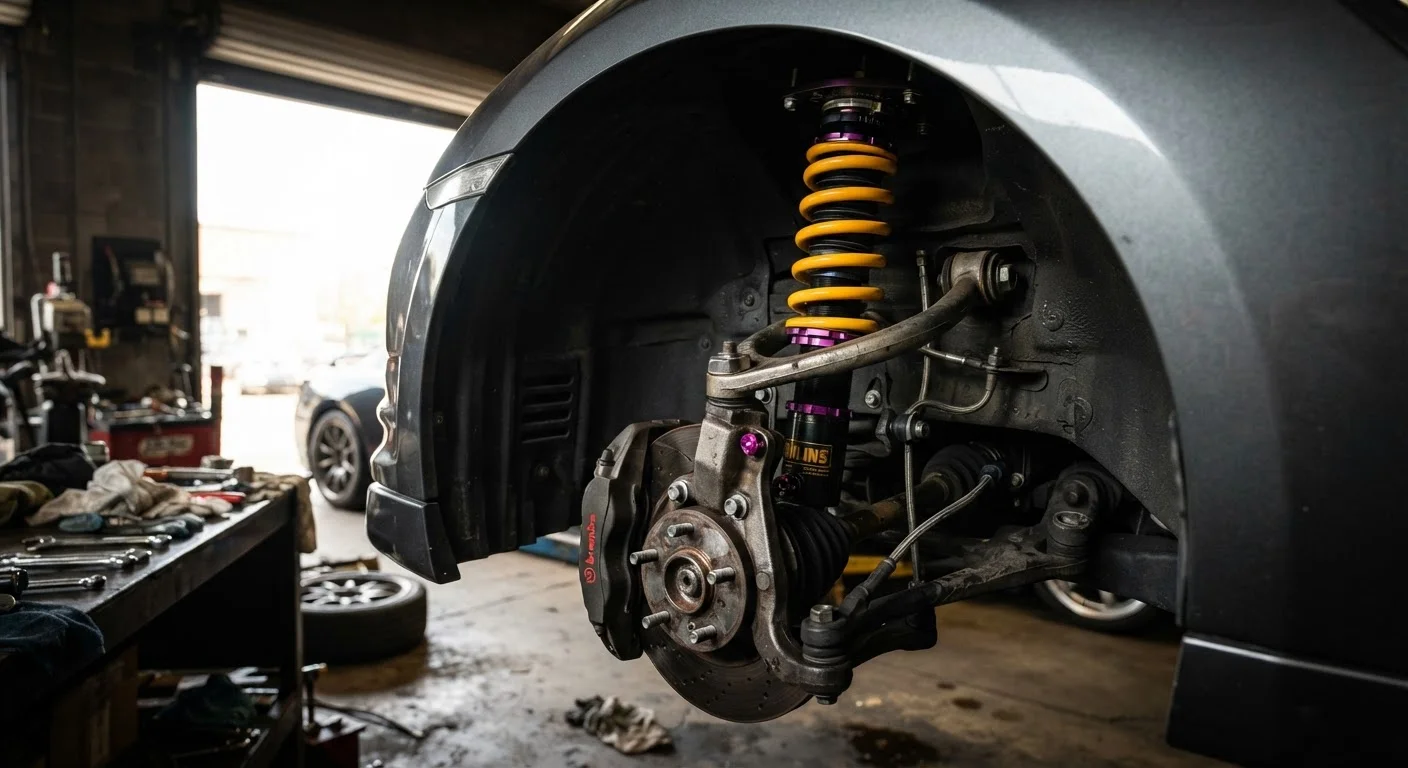
Coilovers allow independent adjustment of ride height, spring rate, and - on higher-end units - damping force. Many enthusiasts conflate spring rate with overall stiffness, but damping rate (how quickly the shock absorber resists movement) is equally critical. A high spring rate paired with under-damped shocks produces a car that rebounds harshly and loses composure on undulating pavement.
For street use, spring rates in the range of 6-10 kg/mm (front) and 5-8 kg/mm (rear) are workable for most sport compacts without producing an unlivable ride. Track-focused setups often run 12-20 kg/mm or higher, tuned for smooth circuit surfaces. The deeper implications of these choices - and why they often matter more than raw power figures - are explored in Suspension Setup and Why It Matters More Than Horsepower.
| Street Setup | Dual-Use Setup | Track-Only Setup | |
|---|---|---|---|
| Spring Rate (front, sport compact) | 6-8 kg/mm | 8-12 kg/mm | 14-20+ kg/mm |
| Front Camber | -0.5° to -1° | -1° to -2° | -2.5° to -3.5° |
| Sway Bar Stiffness | OEM or mild upgrade | Moderate upgrade | Maximum available |
| Damping Adjustability | Not required | Highly recommended | Essential |
| Ride Quality | Comfortable | Firm but tolerable | Harsh on street |
| Tire Wear Impact | Minimal | Moderate | High on public roads |
Sway Bars and Alignment: The Overlooked Half of the Equation
Sway bars (also called anti-roll bars) control body roll by linking opposite suspension corners. A stiffer rear sway bar loosens the rear end under cornering load, promoting rotation - useful on track but potentially unsettling on public roads. Front sway bar upgrades reduce understeer but can make the car more sensitive to mid-corner inputs. The full range of these trade-offs is detailed in Handling Modifications Worth Understanding Before You Commit.
Alignment settings - particularly camber, caster, and toe - shape how tires contact the road during cornering. Negative front camber (typically -1.5° to -3° for track use) keeps the tire contact patch flatter during hard cornering. However, aggressive negative camber accelerates inner tire wear on the street and can reduce straight-line braking performance. Toe settings affect stability (toe-in) versus turn-in response (toe-out). Any suspension modification warrants a full four-wheel alignment; without it, uneven tire wear and unpredictable handling are near-certain outcomes. See Why Your Car Pulls to One Side for symptoms that indicate an alignment issue is already present.
Aggressive Camber Settings Have Real-World Costs
Track-oriented camber values (beyond -2°) can significantly accelerate inner tire wear during street driving and reduce the tire contact patch during straight-line braking. Before committing to aggressive geometry for street use, weigh the handling benefits against the safety and cost implications. If your car sees mixed use, alignment settings closer to the street end of the spectrum are generally more prudent.
Street vs. Track: Choosing the Right Priority
The right suspension balance depends entirely on where and how you drive. The Full Spectrum of Performance outlines how different vehicle categories prioritize these dynamics differently - a grand tourer and a time-attack car share almost no suspension philosophy despite both being described as performance vehicles.
For a dual-use build, adjustable damping is one of the most practical investments available. Being able to soften damping for a daily commute and firm it up for a track day without changing hardware gives the driver genuine control over the compromise. Fixed-rate setups, by contrast, lock the driver into a single point on the street-to-track spectrum. Regardless of build type, any suspension work should be carried out or supervised by a qualified alignment and suspension specialist - particularly when modifying geometry settings that affect tire wear and braking dynamics.
~30%
Handling gain from alignment alone
Suspension engineers commonly note that proper alignment and geometry setup can recover a significant share of handling capability from a misaligned or stock geometry configuration, without any additional hardware.
2-3x
Spring rate difference: street vs. track
Track-focused coilover setups typically run spring rates two to three times higher than street-oriented configurations on the same vehicle platform.