What Each Service Actually Does
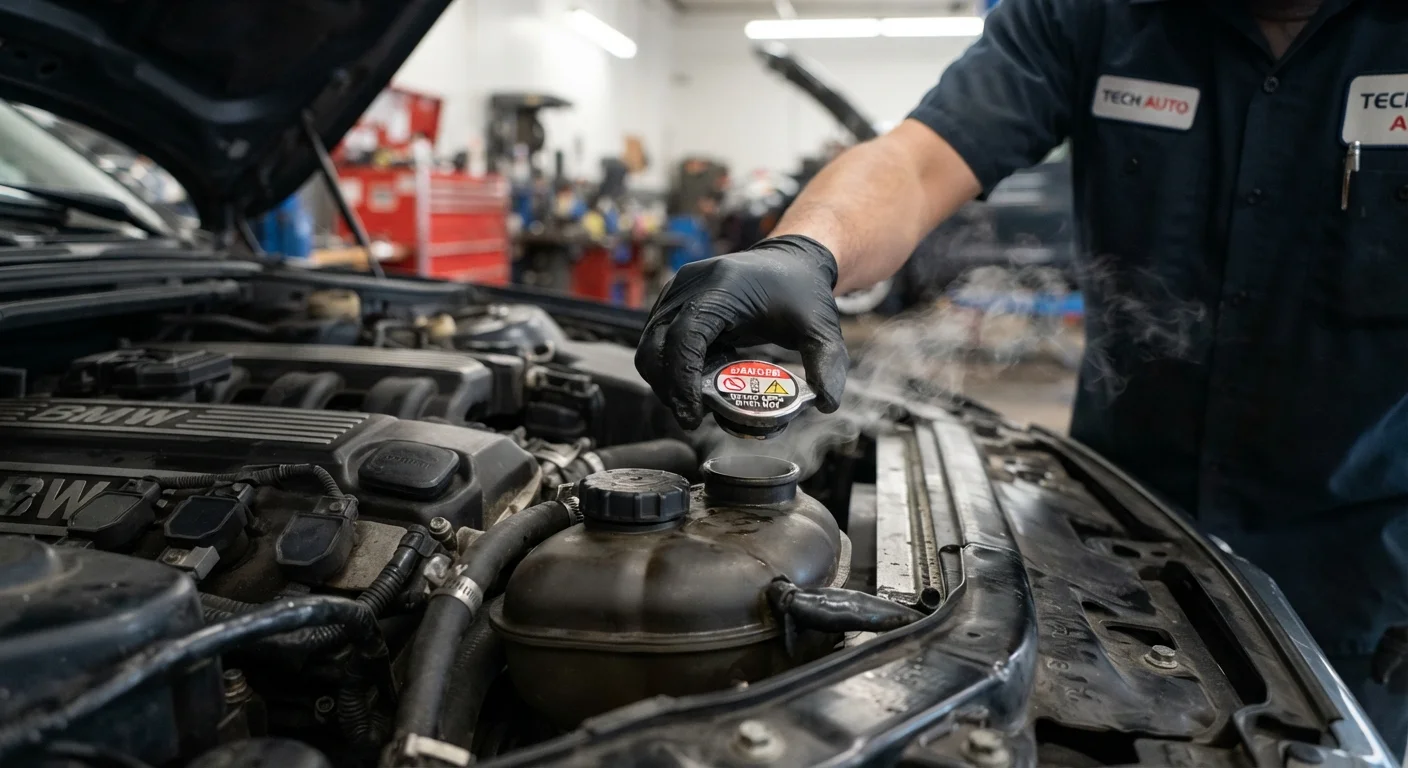
A coolant top-up is straightforward: you add a measured amount of the correct coolant - or a pre-mixed coolant-and-distilled-water blend - to the overflow reservoir until the fluid reaches the proper level. The existing coolant in the system stays in place. This is a maintenance task that takes only minutes and requires no draining.
A coolant flush, by contrast, involves draining the entire cooling system, often flushing it with water or a dedicated cleaning solution, and then refilling it with fresh coolant mixed to the appropriate concentration (typically a 50/50 split of coolant and distilled water). The goal is to remove all old fluid, contaminants, and any accumulated scale or rust particles. To understand how the cooling circuit works as a whole - from the water pump to the thermostat - see our guide to the complete cooling system.
| Criterion | Coolant Top-Up | Coolant Flush |
|---|---|---|
| Purpose | Restore correct fluid level | Replace all system fluid |
| Time required | 5-10 minutes | 1-2 hours |
| Skill level | Basic - owner can perform | Moderate - mechanic recommended |
| When appropriate | Slightly low level, clean fluid | Degraded, discolored, or mixed fluid |
| Frequency | As needed | Every 2-5 years or per manufacturer |
| Addresses inhibitor depletion | No | Yes |
| Resolves contamination | No | Yes |
Why Coolant Degrades and Why It Matters
Coolant - typically an ethylene glycol-based fluid - does more than prevent freezing and boiling. It contains corrosion inhibitors that protect metal surfaces inside the engine block, radiator, heater core, and water pump. Over time, these inhibitors are depleted through chemical reactions with heat, oxygen, and metal ions. Once exhausted, the fluid becomes acidic and begins attacking the very components it was meant to protect.
This is why a coolant level that looks fine is not the same as coolant that is still doing its job. The fluid can be full but chemically spent. A simple test strip (available at most auto parts stores) can measure pH and freeze-point protection to indicate whether the inhibitors are still effective.
2-5 yrs
Typical coolant service interval by type
IAT (conventional green) coolant is generally rated for about 2 years; OAT extended-life coolants are formulated to last up to 5 years under normal operating conditions.
50/50
Standard coolant-to-water mix ratio
Most manufacturers recommend a 50% coolant and 50% distilled water blend, providing freeze protection to approximately -34°F and boil-over protection to around 265°F.
Conventional green coolant (Inorganic Additive Technology, or IAT) depletes its inhibitors relatively quickly - typically within 2 years or 30,000 miles. Extended-life orange or pink coolants (Organic Acid Technology, or OAT) are formulated to last 5 years or up to 150,000 miles under normal conditions. Always verify the specification required for your vehicle in the owner's manual, since using the wrong type can cause inhibitor incompatibility.
The Risks of Mixing Coolant Types
One of the most common - and preventable - cooling system mistakes is topping up with a coolant that differs chemically from what's already in the system. IAT (green) and OAT (orange, pink, or red) coolants use fundamentally different inhibitor packages. When mixed, these packages can interact, sometimes forming a gel-like precipitate that restricts flow through narrow passages like the heater core.
Check Before You Top Up
Before adding any coolant, confirm the type already in the system by checking the owner's manual or the label on the original coolant reservoir. If the existing fluid colour is unclear or unknown, do not assume compatibility. Using a universal or wrong-type coolant as a top-up in a system with a proprietary formulation can reduce inhibitor effectiveness over time, even if no immediate reaction is visible.
Even within OAT coolants, formulations vary by manufacturer. Some vehicles, particularly those from European and Asian manufacturers, specify coolants with proprietary inhibitor blends (sometimes called HOAT - Hybrid Organic Acid Technology). Topping up a system that contains one of these with a generic universal coolant may still cause compatibility issues over time.
If you are unsure what type of coolant is currently in the system - for example, after buying a used vehicle - a full flush is the safest approach. It removes all uncertainty and lets you start fresh with the correct formulation.
Recognizing When a Top-Up Is Enough - and When It Isn't
A single, minor drop in the coolant reservoir level - perhaps observed during a seasonal check - is generally not a cause for alarm. Small amounts of coolant can be lost through the pressure cap over time, and a top-up with the matching coolant type is appropriate.
However, repeated low readings between inspections are a warning sign. Coolant does not simply evaporate from a sealed system; if the level is consistently falling, the system is losing fluid somewhere. That could be an external leak (a hose, clamp, or radiator joint), an internal leak (a failing head gasket allowing coolant into the combustion chamber), or a weeping water pump seal. Continuing to top up without investigating the cause only delays a diagnosis. For guidance on distinguishing a minor coolant shortfall from a more serious engine problem, see our article on overheating engines and what they signal.
As a general rule: if you find yourself topping up more than once within a few months, have the system pressure-tested by a qualified mechanic before proceeding further.
This article is for informational and educational purposes only. Cooling system work involving draining and refilling coolant should be performed in accordance with your vehicle manufacturer's guidelines. Used coolant is a hazardous material - dispose of it at an approved recycling facility, and keep it away from children and animals. If you are uncertain about any procedure, consult a qualified mechanic.