Why Engines Need Active Cooling
Internal combustion generates enormous heat. Fuel igniting inside the cylinders can momentarily reach temperatures above 2,000°F (1,093°C). Left unmanaged, that heat would warp cylinder heads, seize pistons, and destroy gaskets in minutes. The cooling system's job is to absorb that excess heat and release it into the surrounding air - continuously, precisely, and without interrupting engine operation.
Unlike air-cooled engines (found in some older motorcycles and small aircraft), virtually all modern passenger vehicles use a liquid cooling system. Liquid transfers heat far more efficiently than air alone, which allows tighter engine packaging and more consistent temperature control across varying loads and ambient conditions.
For a deeper look at how temperature management interacts with engine output, see our article on high-performance engine anatomy.
~30%
Engine energy lost as heat
Engineering references consistently note that roughly 30% of the energy from combustion exits through the cooling system rather than contributing to forward motion.
180-195°F
Typical thermostat opening range
Most passenger vehicle thermostats are rated to open within this range, balancing combustion efficiency with component protection.
13-16 psi
Cooling system operating pressure
This pressurization raises the coolant's effective boiling point, providing a safety margin against boil-over during heavy load or high ambient temperatures.
Coolant: The Working Fluid
Coolant - also called antifreeze - is the medium that carries heat from the engine to the radiator. Most modern coolants are an ethylene glycol-based formulation mixed with deionized water, typically in a 50/50 ratio. That blend serves two distinct purposes:
- Freeze protection: A 50/50 mix lowers the freezing point to approximately -34°F (-37°C), preventing coolant from expanding and cracking the block in cold climates.
- Boil-over protection: The same mixture raises the boiling point well above the 212°F (100°C) boiling point of plain water, especially under the added pressure of a sealed system.
Coolant also contains corrosion inhibitors that protect aluminum, iron, and rubber components throughout the system. These inhibitors deplete over time - which is why periodic coolant flushes matter even when the fluid appears clean. See our pre-winter vehicle preparation guide for guidance on checking coolant condition before cold weather arrives.
Always mix concentrated coolant with distilled water rather than tap water. Tap water minerals can deposit scale inside the cooling passages and accelerate corrosion of aluminum components.
Mineral deposits reduce heat transfer efficiency over time and can clog narrow radiator tubes, leading to reduced cooling capacity.
When checking coolant level, do so only when the engine is cold. The overflow reservoir - not the radiator cap - is the correct check point on most modern vehicles.
Opening a pressurized hot radiator cap releases scalding steam and coolant, creating a serious burn hazard.
The Radiator and Cooling Airflow
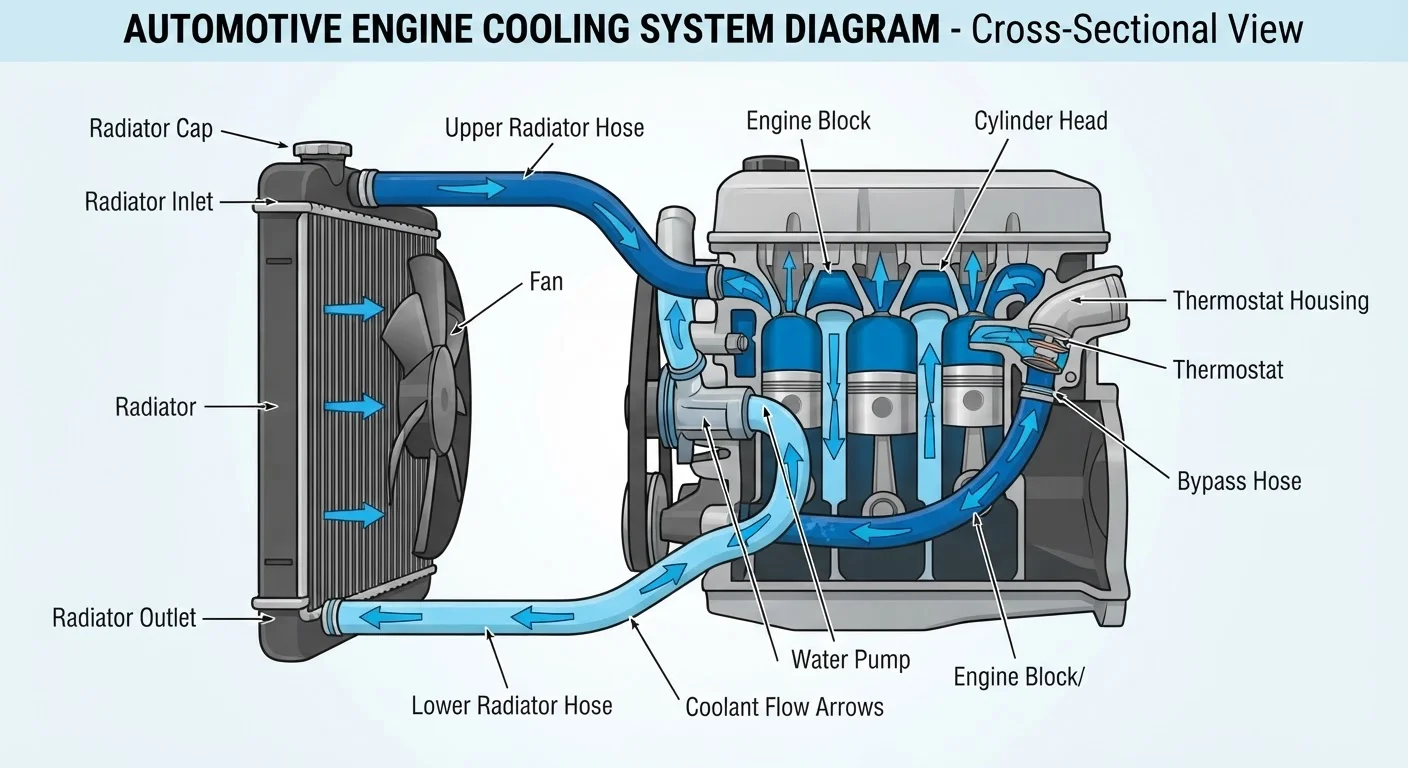
The radiator is a heat exchanger mounted at the front of the vehicle. Hot coolant from the engine enters through the upper or side inlet tank, passes through dozens of narrow aluminum or brass tubes, and exits cooled through the outlet tank. Thin metal fins bonded to those tubes dramatically increase surface area, allowing ambient air passing through the grille to strip heat from the coolant efficiently.
Two additional components assist the radiator:
- Cooling fans: An electric fan (or a belt-driven mechanical fan on older vehicles) pulls air through the radiator when airflow from vehicle motion is insufficient - primarily at low speeds or when idling.
- Pressure cap: The radiator cap seals the system and maintains 13-16 psi of pressure, which raises the coolant's boiling point by roughly 45°F (25°C) above its unpressurized value. Never open a hot radiator cap - releasing pressure on scalding coolant can cause severe burns.
Never Open a Hot Radiator Cap
A cooling system under pressure contains coolant that may be well above 212°F (100°C). Removing the cap while the engine is hot releases that pressure instantly, causing scalding coolant and steam to erupt. Always allow the engine to cool completely - at least 30 to 45 minutes after shutdown - before opening the radiator cap or overflow reservoir. If in doubt, have a qualified technician inspect the system.
The Thermostat: Traffic Controller of Temperature
The thermostat is a small, wax-actuated valve - typically located where the upper radiator hose meets the engine - that regulates coolant flow based on temperature. When the engine is cold, the thermostat remains closed, keeping coolant circulating only within the engine block. This allows the engine to reach its optimal operating temperature quickly, improving fuel combustion efficiency and reducing wear.
Once coolant reaches the thermostat's rated opening temperature (commonly 180-195°F / 82-91°C for most passenger vehicles), the wax element inside expands, pushing the valve open. Coolant then flows into the radiator circuit, where it cools before returning. If the engine cools too much, the thermostat partially closes again - a continuous, self-regulating cycle.
A stuck-closed thermostat causes overheating; a stuck-open thermostat prevents the engine from reaching operating temperature, reducing efficiency and increasing wear. Thermostats are inexpensive and are a standard replacement item during major cooling system service.
The Water Pump and Hose Network
Coolant doesn't move on its own - the water pump provides the mechanical force to circulate it throughout the system. Most water pumps are belt-driven (either by the accessory serpentine belt or the timing belt) and contain an impeller - a rotating disc with curved vanes - that pushes coolant through the engine block, cylinder head, heater core, and radiator in a continuous loop.
Because many timing-belt-equipped engines mount the water pump on the timing belt itself, manufacturers often recommend replacing the water pump whenever the timing belt is replaced, typically every 60,000-100,000 miles. This avoids the labor cost of a second teardown if the pump fails shortly after.
The hose network - upper radiator hose, lower radiator hose, and smaller heater hoses - carries coolant between components. Hoses degrade from the inside out; a hose that looks fine externally may be soft, spongy, or cracked internally. Squeezing hoses while the engine is cold is a basic check, but hose replacement on a schedule (or during major service) is prudent preventive maintenance.
Inspect Hoses During Oil Changes
The oil change interval is a convenient opportunity to visually inspect radiator and heater hoses. Squeeze each hose firmly - it should feel firm but pliable, not rock-hard, mushy, or cracked. Catching a deteriorating hose before it fails prevents a roadside breakdown and potential engine overheating damage.
Recognizing Cooling System Trouble
Early detection prevents expensive repairs. Watch for these warning signs:
- Rising temperature gauge: The needle climbing toward the red zone or a warning light illuminating means the system is struggling. Pull over safely and allow the engine to cool before investigating.
- Sweet smell from the engine bay: Ethylene glycol has a distinctive sweet odor. Detecting it without visible leaking may indicate an internal coolant leak (such as a failing head gasket).
- White exhaust smoke: Coolant entering the combustion chamber burns off as white or gray steam - a serious sign requiring prompt diagnosis.
- Low coolant reservoir: The translucent overflow reservoir should sit between the MIN and MAX marks. Repeated low levels indicate a leak, not just evaporation.
- Bubbling in the reservoir: Combustion gases entering the cooling system - another head gasket indicator.
For a thorough breakdown of overheating severity and when to stop driving immediately, refer to our guide on separating a minor coolant issue from a major failure.
Do Not Drive on an Overheating Engine
Continuing to drive when the temperature gauge is in the red or a coolant warning light is active risks warping the cylinder head, blowing the head gasket, or seizing the engine entirely - repairs that can cost thousands of dollars. Pull over safely, shut the engine off, and allow it to cool before adding coolant or seeking assistance.
Routine Maintenance Intervals
The cooling system requires periodic attention even when no symptoms are present. General service benchmarks - always verify against your vehicle's owner's manual, as intervals vary by manufacturer and coolant type:
| Service Item | Typical Interval |
|---|---|
| Coolant flush and refill | Every 30,000-50,000 miles, or per manufacturer spec |
| Radiator hose inspection | Annually or at each coolant service |
| Pressure cap test | Every 2 years or at coolant service |
| Thermostat replacement | At coolant system failure or major service |
| Water pump (timing-belt-driven) | With timing belt replacement |
Coolant system work - particularly anything involving draining coolant - should be performed carefully. Used coolant is toxic to animals and must be disposed of at a recycling facility or automotive retailer that accepts fluids. If you are not comfortable working with pressurized systems or draining fluids, a qualified mechanic is the appropriate resource.
This article is for informational and educational purposes only. Always consult your vehicle's owner's manual and, where appropriate, a qualified automotive technician before performing maintenance or repair work.