Why Wheels Need to Spin at Different Speeds
Picture your vehicle rounding a gentle curve. The two driven wheels on the same axle are tracing different-radius arcs simultaneously - the outer wheel covers more ground than the inner wheel over the same time period. If both wheels were rigidly connected and forced to rotate together, the tire with the shorter path would scrub sideways across the pavement, fighting the turn. The result: tire wear, understeer, and mechanical stress throughout the drivetrain.
The differential exists specifically to resolve this geometric problem. By allowing each wheel to rotate at whatever speed its path requires, the differential lets your vehicle corner smoothly and efficiently. Understanding this function also sheds light on why drivetrain layout matters - see how drivetrain layout affects handling for a deeper look at how driven-axle placement shapes vehicle dynamics.
The Gear Mechanism: How a Differential Actually Works
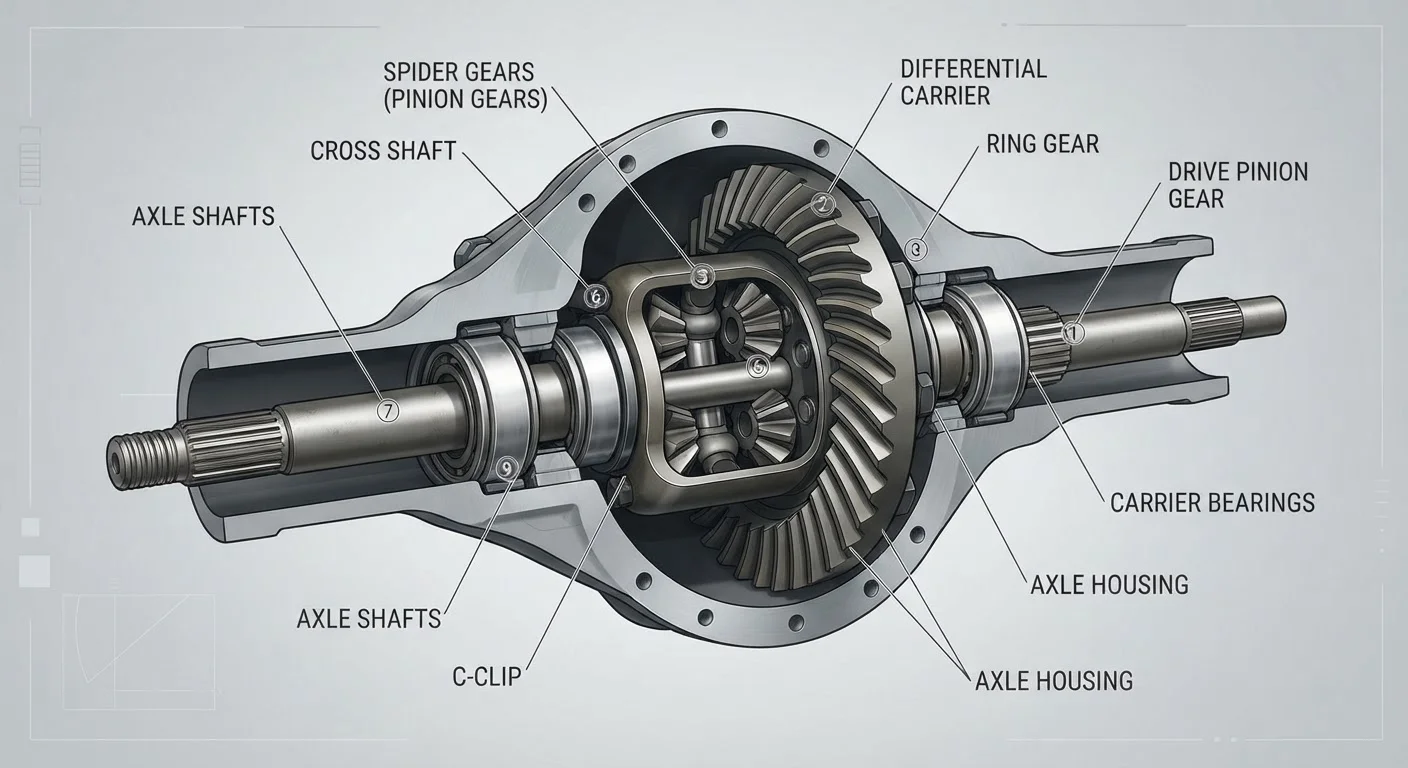
At its core, a conventional open differential uses a compact set of bevel gears. The main components are:
- Ring gear: A large circular gear driven by the driveshaft's pinion gear. It receives torque from the engine via the transmission.
- Differential case (carrier): A housing bolted to the ring gear that rotates with it, carrying the internal spider gears.
- Spider gears (planetary pinions): Small bevel gears mounted inside the carrier on pins. They mesh with the side gears on each axle shaft.
- Side gears: Bevel gears splined directly to each axle shaft, one per wheel.
When driving straight, all gears rotate together as a unit - the spider gears don't rotate on their own pins, and torque is shared equally. During a corner, the outer wheel's side gear slows relative to the carrier's rotation, allowing the spider gears to rotate on their pins. This rotation transfers the speed difference to the inner wheel, which slows down proportionally. Total torque input is conserved; only the speed split changes.
“The differential is one of the most mechanically elegant solutions in automotive engineering - a passive mechanism that continuously solves a dynamic geometry problem without any electronic input.”
— Parts & Maintenance Editorial Team, Automotive Systems Analysis
This elegant arrangement requires no electronic control and adds minimal weight - a key reason it has remained the dominant design in automotive drivetrains for over a century. To understand how this relates to the broader power delivery chain, the transmission's role in managing torque provides useful context.
Open vs. Limited-Slip vs. Locking: Three Differential Types
Not all differentials behave the same way under challenging conditions. Here's how the major types differ:
3
Differentials in a typical AWD vehicle
A full all-wheel-drive system generally uses front, rear, and center differentials to manage speed differences across all driven wheels.
~1886
Year differential gearing appeared in automobiles
Early self-propelled vehicles adopted differential gear technology adapted from horse-drawn wagon axle designs of the mid-19th century.
30K-60K mi
Typical differential fluid service interval
Most manufacturers specify differential fluid replacement within this range, though the exact interval depends on vehicle type and operating conditions.
- Open differential
- The standard design described above. Simple and smooth, but it sends torque preferentially to the wheel with the least resistance. On ice or mud, a spinning wheel can absorb all available torque while the grounded wheel receives almost none.
- Limited-slip differential (LSD)
- Uses clutch packs, Torsen (torque-sensing) gearing, or viscous coupling to resist excessive wheel-speed differences. When one wheel begins to slip, the LSD transfers a greater share of torque to the wheel with traction. This improves performance on uneven or low-grip surfaces without eliminating the speed differential needed for normal cornering.
- Locking differential
- Mechanically or electrically locks both axle shafts together, forcing them to rotate at identical speeds. Used primarily in off-road applications where maximum traction is required. Locking differentials should generally be disengaged on paved roads, as they eliminate the speed differential that cornering requires.
Check Your Differential Fluid Regularly
Many owners overlook differential fluid during routine maintenance. Pull your owner's manual and note the recommended service interval for your specific vehicle. If the fluid appears dark, gritty, or smells burnt when you inspect it, schedule a fluid change sooner rather than later - clean gear oil is the lowest-cost way to extend differential life.
Differential Maintenance: What Owners Should Know
Differentials are lubricated by gear oil (sometimes called differential fluid) that circulates inside the housing. Over time, this oil degrades, loses viscosity, and can become contaminated with metal particles from normal gear wear. Low or degraded differential fluid is one of the most common causes of premature differential failure.
Signs of a differential that needs attention include whining or howling sounds that change with vehicle speed, clunking during acceleration or deceleration, and vibration that wasn't previously present. These symptoms warrant professional inspection - differential repair involves precision component tolerances that are difficult to set correctly without specialized tools.
Fluid service intervals vary by vehicle and differential type; limited-slip differentials often require a friction-modifier additive in their fluid, and using the wrong lubricant can damage clutch packs. Always refer to your owner's manual for the correct specification. If you are unsure about fluid type or service condition, consult a qualified mechanic rather than attempting differential service without verified guidance.