The Core Job of a Transmission
An internal combustion engine produces usable torque - rotational force - only within a relatively narrow RPM (revolutions per minute) band. A transmission's job is to act as a mechanical intermediary, selecting gear ratios that keep the engine operating efficiently while allowing the vehicle to travel at a wide range of road speeds. Without this ratio management, you'd need an impractically large or small engine to cover normal driving conditions.
Both manual and automatic transmissions accomplish this through sets of gears with different diameters. A lower gear ratio multiplies torque at the expense of speed - useful for acceleration or climbing grades. A higher ratio reduces torque multiplication but allows higher vehicle speeds. This same fundamental principle governs everything from bicycle cassettes to heavy truck transmissions; for a look at how it applies in a non-motorized context, see our introduction to bicycle gearing systems.
How a Manual Transmission Works
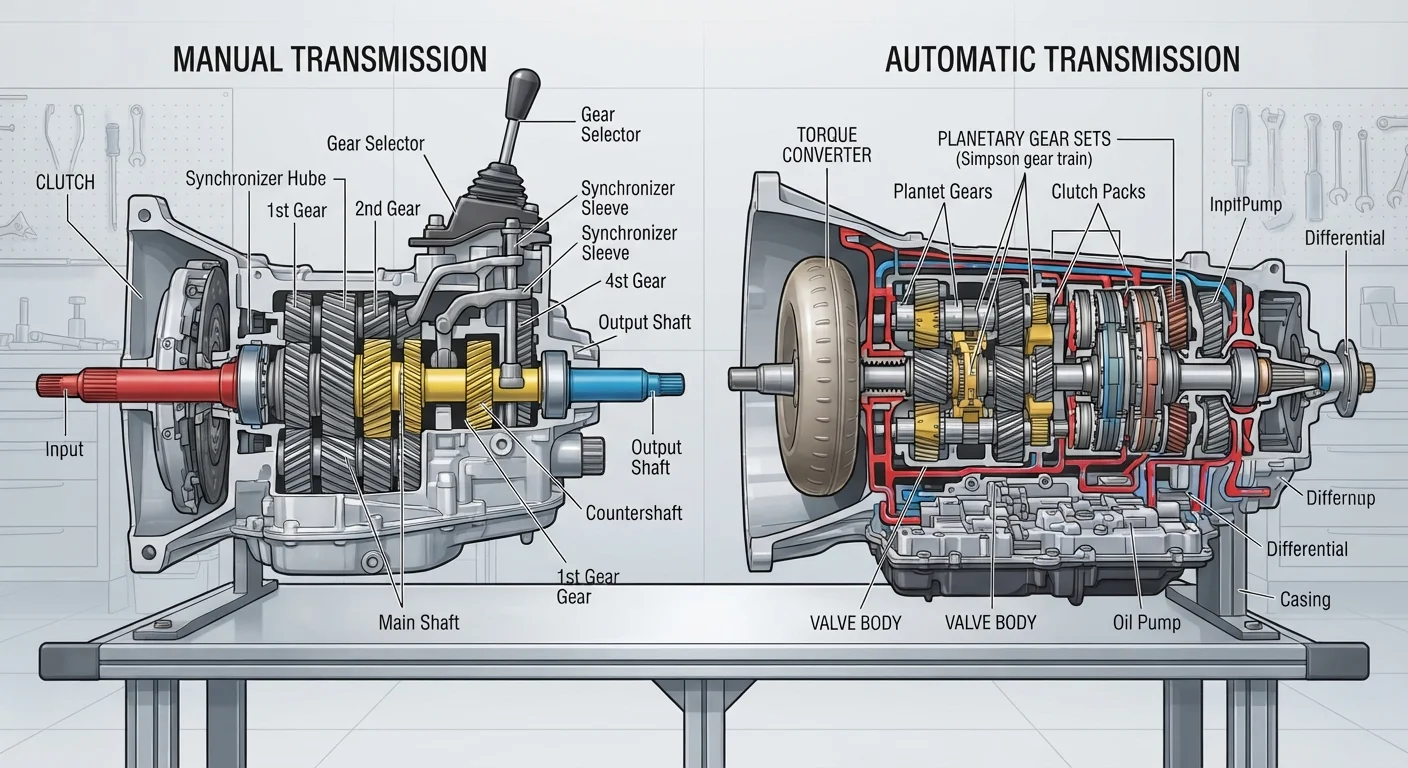
A manual gearbox - sometimes called a MT or standard transmission - relies on a friction clutch assembly positioned between the engine and the gearbox input shaft. When the driver depresses the clutch pedal, a release bearing disengages a pressure plate from a friction disc (the clutch disc), physically interrupting torque flow from the engine. This momentary disconnection allows the driver to select a different gear ratio using the shift lever without grinding the gear teeth together.
Inside the gearbox, pairs of helical gears are always meshed together and spinning, but only one pair at a time transmits torque. Synchronizer rings - cone-shaped friction devices - match the rotational speed of the selected gear to the output shaft before a sliding collar locks them together. This synchronization is what makes smooth shifts possible; older "non-synchro" transmissions required drivers to match speeds manually through a technique called double-clutching.
Once a gear is engaged and the clutch pedal is released, the clutch disc re-engages the flywheel via friction, and torque flows directly through the selected gear set to the driveshaft and ultimately the driven wheels. For more on how that torque continues through the drivetrain, see how the differential manages wheel speed.
Protect Your Clutch with Good Habits
Avoid resting your foot on the clutch pedal while driving - even light pressure applies the release bearing against the spinning pressure plate, accelerating bearing wear. Similarly, don't hold the vehicle on a hill by slipping the clutch; use the handbrake instead. These habits can significantly extend clutch service life.
How an Automatic Transmission Works
An automatic transmission (AT) replaces the manual clutch with a torque converter - a fluid coupling that transmits engine torque to the transmission input shaft through circulating hydraulic fluid. At idle, minimal fluid coupling occurs, allowing the vehicle to sit still without stalling. As engine speed rises, fluid coupling increases until a lock-up clutch (found in most modern units) mechanically connects the converter for efficiency at cruising speeds.
Inside the gearbox, planetary gear sets are the core mechanism. Each set consists of a central sun gear, planet gears orbiting it on a carrier, and an outer ring gear. By selectively holding or releasing different members of this set - using hydraulically actuated clutch packs and brake bands controlled by the transmission's valve body - the unit produces different output ratios without physically moving gear pairs in and out of mesh.
The valve body is essentially a hydraulic computer, directing pressurized transmission fluid through passages to apply specific clutch packs based on vehicle speed, throttle position, and load. Modern automatics replace much of this hydraulic logic with electronically controlled solenoids directed by a dedicated transmission control module (TCM), enabling faster, more precise shifts and adaptive learning algorithms.
| Manual Transmission | Automatic Transmission | |
|---|---|---|
| Torque interruption method | Friction clutch disc and pressure plate | Hydraulic torque converter with lock-up clutch |
| Gear selection mechanism | Driver-operated shift lever and synchronizers | Hydraulic clutch packs and planetary gear sets |
| Control system | Direct mechanical - driver input only | Hydraulic valve body or electronic TCM |
| Primary fluid requirement | Gear oil (less critical to condition) | ATF (condition-critical for clutch packs) |
| Main wear components | Clutch disc, pressure plate, release bearing | Clutch packs, brake bands, torque converter |
| Driver skill requirement | High - clutch and shift timing essential | Low - shifts managed automatically |
Maintenance Implications for Each System
Understanding the mechanical differences has direct practical consequences for maintenance. A manual transmission's primary wear items are the clutch disc, pressure plate, and release bearing - components that experience friction every time the clutch is engaged. Clutch wear rate varies significantly with driving habits; aggressive or repeated slip-clutch launches accelerate wear considerably. Gearbox fluid (typically a gear oil rated by viscosity and service type) should be inspected at intervals specified in the owner's manual, though manual gearboxes are generally less sensitive to fluid condition than automatics.
Automatic transmissions depend heavily on clean, properly conditioned transmission fluid (ATF). Degraded ATF loses its viscosity characteristics and lubricating additives, leading to clutch pack slippage, delayed engagement, and accelerated wear on the valve body. Most manufacturers specify ATF changes at defined mileage intervals; always verify the correct fluid specification before servicing, as using an incorrect type can damage clutch materials or seals. The torque converter itself is a sealed unit and rarely serviced independently outside of a full transmission overhaul.
If you're comparing how different drivetrain layouts interact with these transmission types, our article on rear-wheel drive vs. all-wheel drive in performance cars provides useful context on how power delivery architecture shapes the whole system.
Never Skip ATF Service Intervals
Running an automatic transmission on degraded fluid is one of the most common causes of premature transmission failure. Unlike engine oil, ATF degradation is not always visible - the fluid may look acceptable but have lost critical friction modifiers. Follow the manufacturer's specified service intervals and use only the recommended fluid type for your vehicle. When in doubt, consult a qualified transmission specialist rather than defer service.