How Each System Synchronises Your Engine
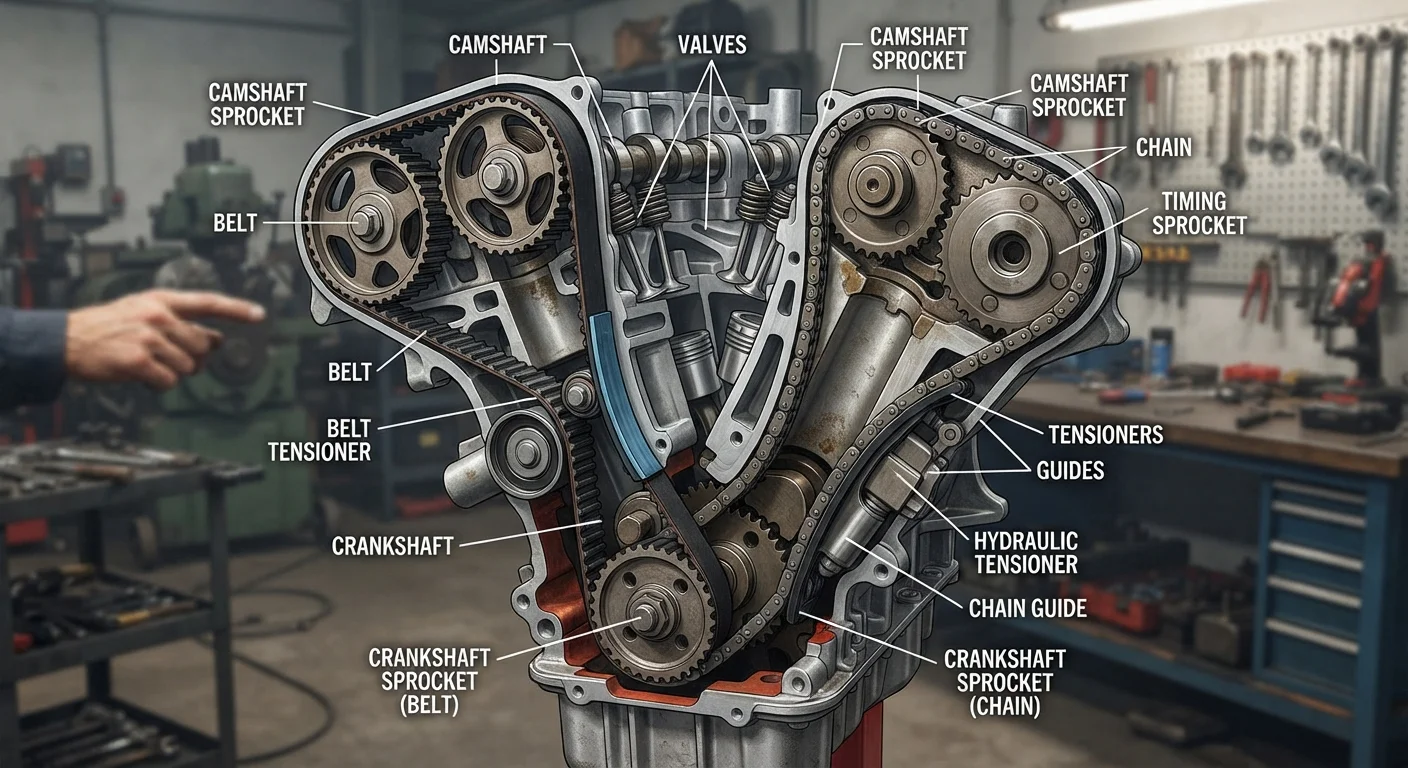
Every four-stroke engine depends on precise coordination between the crankshaft (which drives the pistons) and the camshaft (which opens and closes the intake and exhaust valves). Even a few degrees of misalignment can cause misfires, power loss, or - in the worst cases - a piston colliding with an open valve. The timing belt or chain is what maintains that synchronisation.
Timing belts are toothed rubber and fiber-composite loops that run on pulleys mounted to the crankshaft and camshaft(s). They operate outside the engine's oiling system, running dry in a sealed cover. Their polymer construction makes them lighter and quieter than metal alternatives, and they're cost-effective to manufacture - which is why they became popular in passenger vehicles from the 1970s onward.
Timing chains work on the same principle but use interlocking metal links, similar in concept to a bicycle drive chain. They run inside the engine and are continuously bathed in pressurized engine oil, which both lubricates and cools the chain. Tensioners and guides - typically hydraulic or spring-loaded - keep chain slack controlled as the assembly wears gradually over time.
| Criterion | Timing Belt | Timing Chain |
|---|---|---|
| Material | Reinforced rubber composite | Interlocking metal links |
| Lubrication | Runs dry (no engine oil) | Bathed in engine oil |
| Typical service interval | 60,000-100,000 miles (varies) | No scheduled replacement (oil-dependent) |
| Failure warning | Little to none - sudden failure | Often audible rattle or timing codes |
| Noise level | Quieter operation | Slightly more mechanical noise |
| Weight | Lighter | Heavier |
| Consequence of neglect | Potential engine destruction (interference engines) | Stretch, slack, tensioner failure |
Wear Patterns and Failure Modes
Understanding how each component degrades helps you recognize when your engine needs attention.
Belts degrade on a predictable schedule driven by heat cycling, ozone exposure, and mechanical fatigue - not mileage alone. Even a low-mileage belt can become brittle or crack if the vehicle sits unused for years. Because rubber wear is largely invisible from outside the engine, manufacturers publish specific replacement intervals (commonly 60,000 to 100,000 miles, though this varies widely by engine design) rather than relying on visual inspection. In an interference engine - where pistons and valves occupy overlapping space in the cylinder - belt failure typically results in bent valves and a severely damaged engine. Non-interference engines are more forgiving, but belt failure still leaves you stranded.
Chains wear more gradually and often telegraph trouble before catastrophic failure. A stretched or slack chain may produce a rattling noise at startup (before oil pressure builds), trigger a check-engine light through camshaft timing codes, or cause rough idle. Chain tensioners - particularly hydraulic units - can also fail, especially when engine oil is dirty or low. See our detailed breakdown of timing belt and chain service differences for more on diagnosing these symptoms.
60K-100K mi
Typical timing belt replacement range
Manufacturer-specified intervals vary considerably by engine design; always consult the vehicle's owner's manual for the applicable figure.
~3x
Approximate cost multiplier for engine repair after belt failure
Industry repair data consistently shows interference-engine valve damage from belt failure costs far more than a preventive belt replacement.
Maintenance Requirements Side by Side
The two systems demand very different owner behaviors.
For a timing belt, the primary obligation is respecting the replacement interval specified in your owner's manual - not the generic figure you may find online, which can vary significantly by engine. When a belt is replaced, related components such as the water pump (often belt-driven on the same circuit), tensioner pulley, and idler pulley are typically replaced at the same time. Doing so avoids paying labor costs twice if an ancillary component fails shortly after. For broader guidance on managing wear components proactively, see our maintenance mindset for wear parts.
For a timing chain, the single most important maintenance action is consistent, on-schedule oil changes using the viscosity and specification the manufacturer requires. Clean oil maintains proper tensioner hydraulic pressure and prevents the varnish buildup that causes guides to wear prematurely. There is generally no proactive replacement interval for chains, but if rattling, timing codes, or visible slack are found during engine work, replacement is warranted. Always have timing system concerns evaluated by a qualified mechanic - incorrect timing can cause immediate and expensive engine damage.
When to Involve a Professional
Timing system work - whether replacing a belt or investigating chain noise - requires engine disassembly and precise reassembly to factory specifications. Incorrect timing by even a few degrees can cause immediate engine damage when the engine is started. Unless you have verified mechanical training and the proper tools, timing system service should be performed by a qualified technician. Do not attempt this job based on general instruction alone.