How the Alternator Gets Its Power
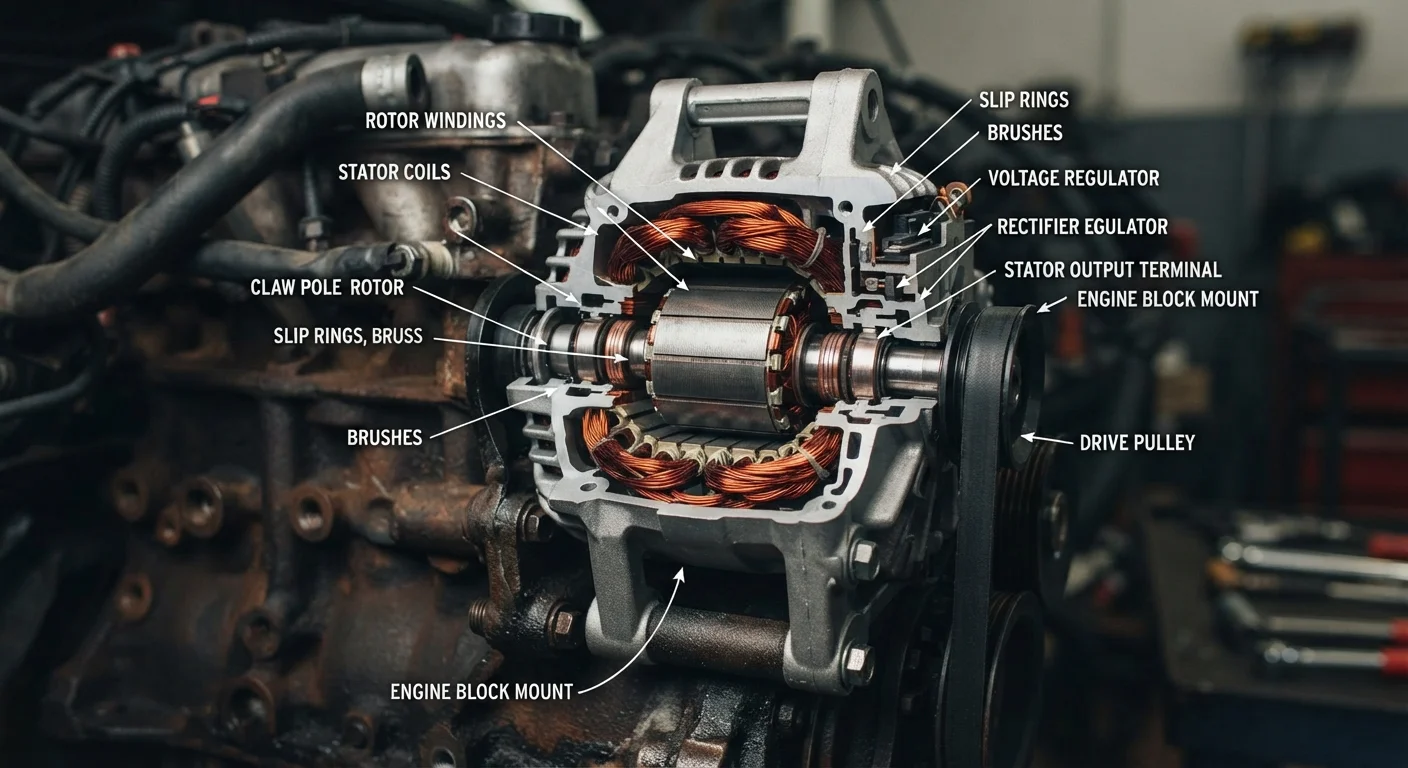
Your alternator doesn't run on its own - it's mechanically driven by the engine. A rubber serpentine belt wraps around a pulley on the engine's crankshaft and loops to a smaller pulley on the alternator. As the engine runs, the crankshaft spins the belt, which spins the alternator pulley, which in turn rotates the internal rotor - a magnetized shaft - inside a stationary ring of copper windings called the stator.
This spinning magnetic field through the stator windings is what generates electricity, following the same principle of electromagnetic induction discovered in the 19th century. The faster the engine spins, the more current the alternator can produce - though a built-in voltage regulator ensures output stays within safe limits regardless of engine speed.
Check Belt Condition During Routine Maintenance
Since the serpentine belt drives the alternator, a worn or cracked belt can reduce alternator output even when the alternator itself is healthy. Ask your mechanic to inspect belt condition and tension during oil changes or scheduled maintenance intervals. Most serpentine belts are recommended for replacement every 60,000-100,000 miles, depending on the manufacturer.
What the Alternator Powers While You Drive
Once your engine is running, the alternator takes over as the primary power source for virtually every electrical system in the vehicle. This includes:
- Headlights, taillights, and interior lighting
- The ignition system and fuel injectors
- Climate control and blower motors
- Infotainment systems, navigation, and instrument clusters
- Power windows, seats, and mirrors
- Charging ports and USB outlets
The battery at this stage acts more as a buffer - absorbing momentary surges in demand and being steadily topped off by the alternator. Modern vehicles with many electrical accessories place considerably more load on the alternator than older models did, which is one reason alternator output capacity has increased over the decades.
13.5-14.8V
Normal alternator output voltage range
Most passenger vehicle charging systems are designed to maintain this voltage range during normal operation to safely charge a 12-volt battery.
~80-220A
Typical alternator current output range
Modern vehicles with high electrical loads - including heated seats, advanced audio, and driver-assistance systems - often require alternators rated at 150 amps or higher.
80,000-150,000 mi
Average alternator service life
Service life varies widely based on electrical load, operating temperature, and maintenance practices; high-demand applications tend toward the lower end of this range.
Voltage Regulation: Keeping Output in Check
Unchecked alternator output could easily overcharge and damage a battery. The voltage regulator - typically integrated into the alternator itself on modern vehicles - continuously monitors system voltage and adjusts the strength of the magnetic field in the rotor to maintain output between approximately 13.5 and 14.8 volts DC.
If voltage climbs too high, the regulator reduces field current; if it drops too low - such as when you turn on the headlights, defrost, and air conditioning simultaneously - the regulator increases it. This dynamic balancing act happens dozens of times per second without any driver input.
Why Voltage, Not Just Current, Matters
A battery requires voltage higher than its own resting voltage (~12.6V) to accept a charge. This is why the alternator targets roughly 13.5-14.8V - it creates a differential that pushes current into the battery. If alternator voltage drops to battery voltage or below, charging stops entirely, even if the engine is running.
Recognizing Alternator Trouble
Because the alternator underpins so much of the vehicle's electrical function, its failure tends to produce distinctive, recognizable symptoms. Watch for:
- Battery warning light - This light monitors system voltage, not just battery condition. It often illuminates when alternator output falls below the threshold needed to maintain charge.
- Dimming or flickering lights - Inadequate alternator output causes lighting to fluctuate, especially at idle when engine speed - and therefore alternator speed - is lowest.
- Unusual electrical behavior - Power accessories slowing down, infotainment resetting, or gauges reading erratically can all indicate insufficient voltage.
- Whining or grinding noise - Internal bearing wear inside the alternator often produces audible noise before full failure occurs.
If you suspect alternator trouble, a qualified mechanic can perform a simple charging system test - typically with a handheld meter - to measure output voltage and confirm whether the alternator, battery, or wiring is the source of the problem. Attempting to diagnose or replace an alternator without proper electrical knowledge carries a risk of short circuits or injury; professional inspection is recommended when in doubt.
Understanding how key vehicle systems work is the foundation of confident ownership. For a different perspective on how mechanical drive systems convert energy into motion, see our drivetrain basics overview. If you're curious how electric-assist vehicles manage power generation and storage differently, the anatomy of an e-bike offers a useful comparison.