The Drivetrain at a Glance
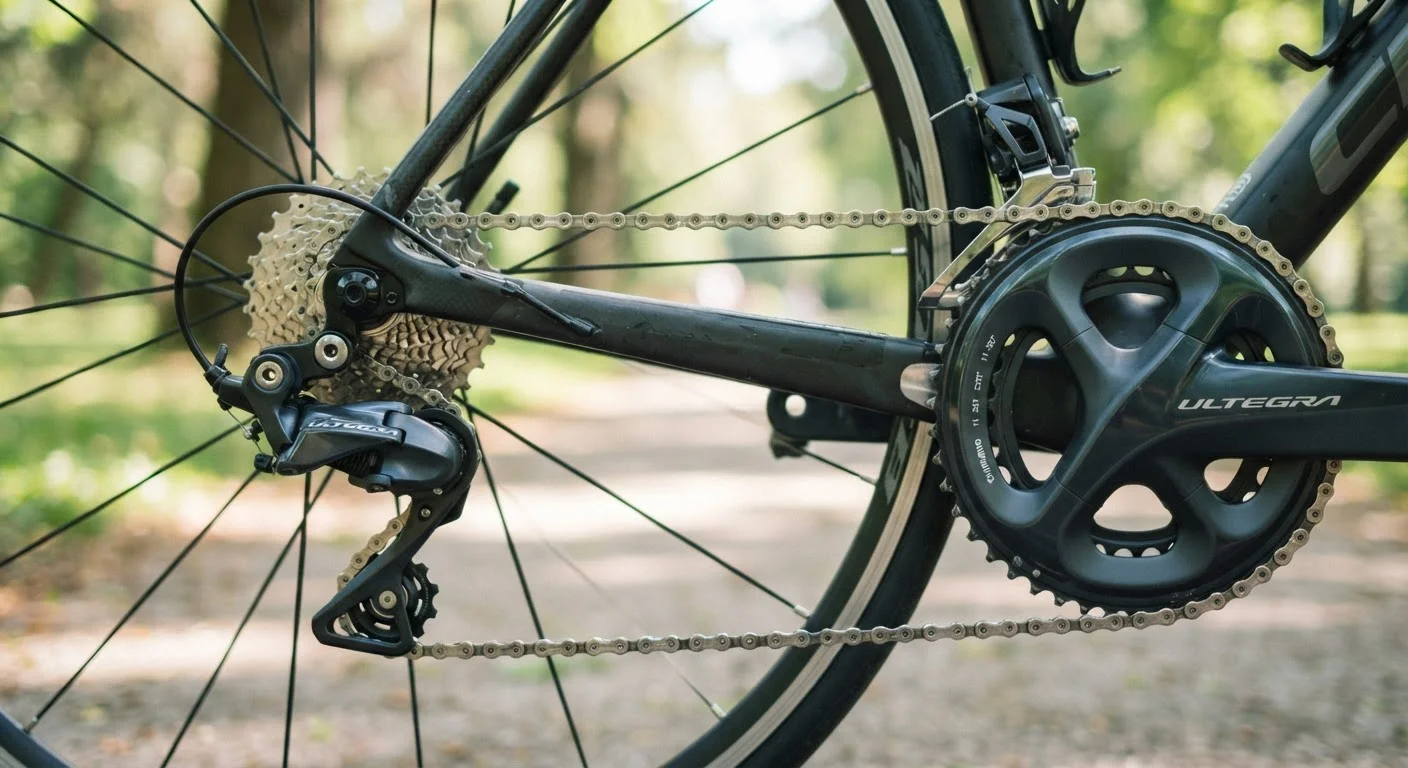
Every time you push down on a pedal, a carefully engineered sequence begins. Your force rotates the crankset - the assembly of crank arms and one or more chainrings (the toothed rings attached to the crank). The chainring engages the chain, which runs rearward to the cassette, a stack of sprockets of varying sizes attached to the rear wheel hub. As the chain pulls on those sprockets, the wheel turns and the bike moves forward.
Understanding this sequence helps you diagnose problems, choose the right components, and get more from every ride. For a broader look at how the drivetrain fits within the whole machine, see Bicycle Anatomy: Every Component Explained.
>95%
Efficiency of a clean chain-drive system
Engineering studies on roller-chain transmission consistently place efficiency above 95% under typical load conditions.
7-12
Sprocket speeds available on modern cassettes
Contemporary groupsets range from basic 7-speed systems to high-end 12-speed cassettes used in road and mountain disciplines.
500-1,000 mi
Recommended chain wear check interval
Most drivetrain manufacturers and professional mechanics advise inspecting chain wear within this mileage range to prevent cassette damage.
Chainrings, Cassettes, and Gear Ratios
The size relationship between your chainring and rear sprocket determines your gear ratio - how far the bike travels per pedal revolution. A large chainring paired with a small sprocket produces a high, fast gear suited to flat roads and descents. A small chainring paired with a large sprocket creates a low, easy gear for climbing.
Multi-speed bikes achieve a wide range of ratios by combining two or three chainrings (a double or triple crankset) with a cassette carrying anywhere from 7 to 12 sprockets. Single-chainring (1x, pronounced "one-by") drivetrains have become increasingly popular because they simplify the front end while wide-range cassettes handle the necessary gear spread.
Bicycle Gearing Systems: A Complete Introduction for New Riders goes deeper on how to read gear ratios and select the right range for your riding style.
Choosing the Right Gear Range for Your Terrain
Before buying or upgrading a drivetrain, map out the elevation profile of your most common routes. Riders who face steep hills benefit from a wide-range cassette (11-42t or larger), while those on flat terrain can prioritize a tighter, faster cluster. Getting the gear range right from the start avoids the need to swap components later.
Derailleurs: The Shifting Mechanism
A derailleur is a spring-loaded guide that moves the chain laterally across the sprockets when you operate a shifter. Most bikes carry two: a front derailleur that moves the chain between chainrings and a rear derailleur that moves it across the cassette. On 1x drivetrains, only the rear derailleur is present.
Cable-actuated derailleurs rely on a stainless steel cable running inside a housing from the handlebar shifter down to the derailleur body. Pulling the cable shifts the chain in one direction; spring tension returns it in the other. Electronic drivetrains replace this cable with a small servo motor in the derailleur, activated wirelessly or by a thin wire from the shifter. Both systems move the chain by the same mechanical principle - lateral displacement across precisely spaced sprockets.
Cable Tension and Indexing Explained
Indexed shifting means each click of the shifter moves the derailleur a precise, preset distance - snapping the chain to the next sprocket cleanly. This precision depends on correct cable tension. If shifts feel sluggish or imprecise, a barrel adjuster at the derailleur or shifter can fine-tune tension without tools. A qualified bike mechanic should handle full cable replacement or housing work.
The Chain: The Link Everything Depends On
The bicycle chain is a roller chain - a series of inner and outer link plates connected by pins and rollers. The rollers seat into the teeth of both the chainring and the cassette sprockets, transmitting force with minimal slippage.
Over time, the pins and link plates wear, causing the chain to elongate - a condition commonly called chain stretch. A stretched chain no longer meshes cleanly with sprocket teeth, accelerating wear across the entire drivetrain. Regular lubrication and periodic wear-checking with a chain-wear indicator are the most cost-effective maintenance habits a rider can develop.
For a comparison of how chain-drive power transmission appears in other vehicles, the Timing Belt vs Timing Chain article explores how automotive engineers face similar design trade-offs.
Drivetrain Variations: From Single-Speed to E-Bike
Not every drivetrain is complex. Single-speed and fixed-gear (track) bikes strip the system down to one chainring, one rear sprocket, and a chain - with no shifting at all. These setups are lighter, mechanically simpler, and extremely durable, making them popular for urban commuting and velodrome racing.
At the other end of the spectrum, e-bikes layer a motor onto a conventional chain drivetrain. Mid-drive motors mount at the bottom bracket and apply power directly into the crank, working through the existing gears. Hub-drive motors spin the rear wheel more directly, partly bypassing the chain system. See The Anatomy of an E-Bike for a full breakdown of how those systems interact.