How an E-Bike Differs from a Conventional Bicycle
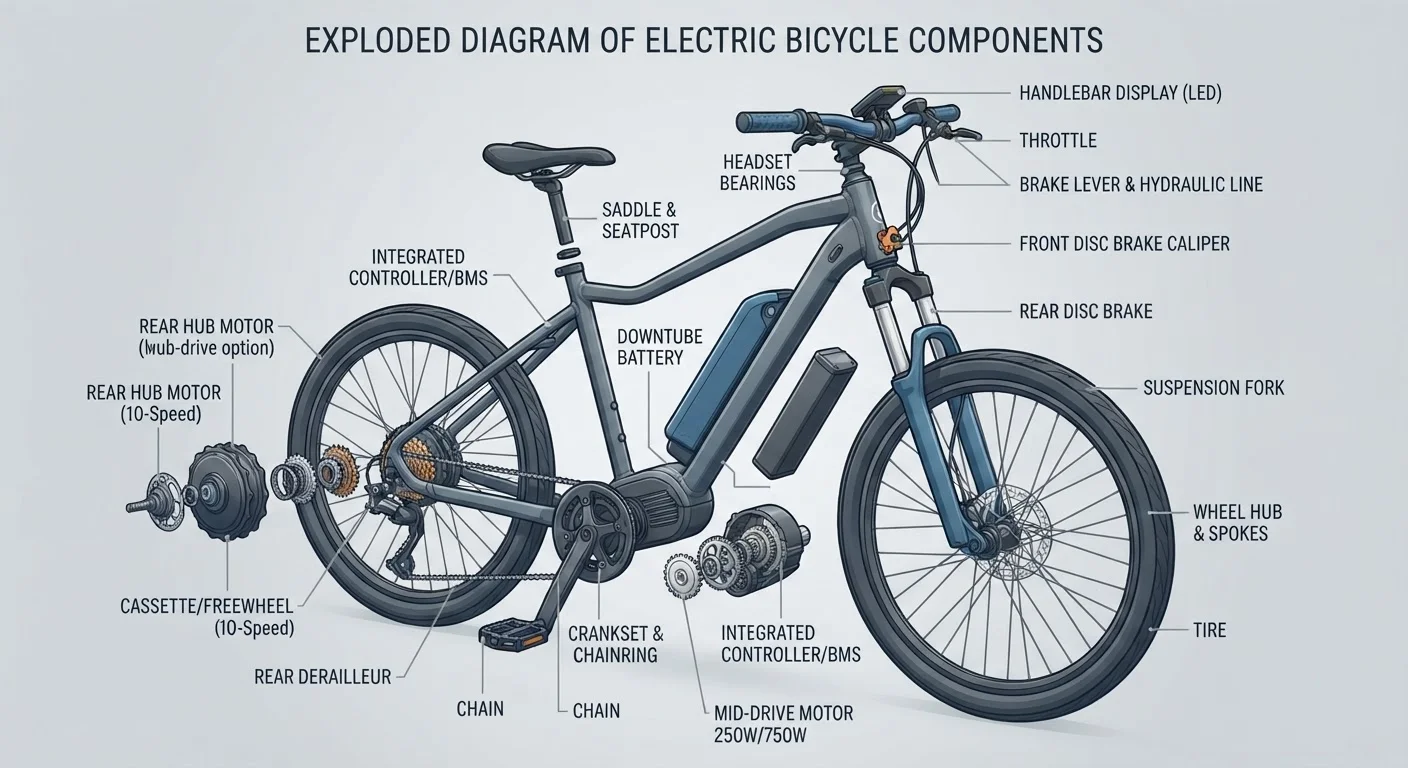
At its core, an e-bike is a pedal-powered bicycle augmented by an integrated electric drive system. The frame, wheels, brakes, and cockpit follow the same fundamentals as any bicycle - covered in depth in our complete bicycle anatomy guide. What separates an e-bike is the addition of four interdependent electrical components: a rechargeable battery, a motor, a controller, and a sensor array. These work together to sense rider input and deliver proportional electric assistance.
That integration creates design tradeoffs. E-bikes are heavier (typically 40-70 lbs depending on class and build), which influences frame geometry, wheel strength requirements, and braking demands. The class of e-bike - which governs top assisted speed and whether a throttle is present - shapes which components are legal in a given riding context. If you're unclear on how classes differ, our e-bike class explainer is a useful companion to this guide.
The Battery and Battery Management System
The battery is the e-bike's fuel tank and one of its most significant cost centers. Nearly all modern e-bikes use lithium-ion (Li-ion) or lithium polymer (LiPo) cells arranged into a pack, typically rated between 250Wh and 750Wh. A higher watt-hour (Wh) rating means more energy storage and, generally, greater range - though actual range depends heavily on assist level, terrain, rider weight, and temperature.
250-750Wh
Typical e-bike battery capacity range
Battery pack capacity directly influences range; real-world range varies widely based on assist level, terrain, and rider weight.
40-70 lbs
Common e-bike weight range
E-bikes are substantially heavier than conventional bicycles, influencing frame design, wheel strength, and braking requirements.
500-1,000+
Charge cycles before significant capacity loss
Lithium-ion cells used in e-bike batteries typically retain most capacity for several hundred full charge cycles under normal use conditions.
Embedded within the pack is a Battery Management System (BMS), a circuit board that monitors individual cell voltages and temperatures, balances charging across cells, and cuts power if conditions fall outside safe parameters. The BMS is not user-serviceable in most consumer e-bikes, but it is the reason why charging habits matter. Repeatedly draining a battery to zero or leaving it fully charged for extended periods can degrade cell chemistry over time, shortening pack lifespan.
Never Modify or Bypass the BMS
The Battery Management System is a safety device, not just a monitoring tool. Attempting to bypass it - or using a charger not rated for your specific pack voltage and chemistry - can cause uncontrolled cell heating, swelling, or in severe cases, thermal runaway. Always use the manufacturer-specified charger and follow the stated charging temperature range. If a pack is swelling or unusually hot after charging, stop using it and consult a qualified service technician.
Battery packs are typically mounted to the down tube, integrated into the frame, or positioned on a rear rack. Frame-integrated batteries offer cleaner aesthetics and a lower center of gravity; external rack-mounted packs are often easier to remove for charging.
The Motor: Types, Placement, and Performance
E-bike motors convert electrical energy from the battery into mechanical torque. Two dominant designs exist: hub motors and mid-drive motors.
Hub Motors
Hub motors are built into the front or rear wheel hub. Rear-hub motors are far more common; they push the bike forward and feel similar to a conventional drivetrain. Front-hub motors pull the bike and can cause handling imbalance on loose terrain. Hub motors are generally simpler, less expensive, and easier to service independently of the drivetrain - but they add unsprung weight to the wheel and cannot take advantage of the bike's gears.
Mid-Drive Motors
Mid-drive motors mount at the bottom bracket, driving the chainring directly. Because they work through the bike's existing gearing, they are more efficient at varying speeds and tend to feel more natural under pedaling. They also keep weight centered and low. The tradeoff: mid-drives put additional stress on the chain and cassette, which may require more frequent replacement. For a closer look at how the mechanical drivetrain interacts with motor output, see our drivetrain basics guide.
When comparing mid-drive motors, look for torque output in Newton-meters (Nm) rather than watt ratings alone - torque determines real-world climbing ability and feel under load.
Watt ratings measure power capacity but not force delivery; a 50Nm torque figure tells you far more about how a motor behaves on steep terrain than its nominal wattage.
If you ride in wet conditions regularly, inspect the motor connector and battery port monthly for signs of corrosion - a small amount of dielectric grease on connector pins can prevent costly faults.
Moisture ingress at electrical connectors is among the most common causes of intermittent assist dropouts and warranty disputes on otherwise functional e-bikes.
Motor power is rated in watts (continuous) and peak watts. In the US, federally defined e-bikes must not exceed 750W continuous output (Class 1, 2, and 3). Nominal ratings (e.g., 250W or 500W) often reflect continuous output; peak figures can be significantly higher for brief intervals.
The Controller and Sensors
The controller - sometimes called the ECU - is the brain of the e-bike's electrical system. It receives data from sensors, interprets rider intent, and regulates how much current flows from the battery to the motor. Controllers are usually housed in a weatherproofed enclosure integrated into the frame or motor unit.
Cadence Sensors vs. Torque Sensors
How the controller decides when and how much to assist depends on the sensor type. Cadence sensors detect whether the pedals are turning and apply a fixed assist level accordingly - they're binary (pedaling or not) and less expensive to implement. Torque sensors measure the actual force a rider applies to the pedals, delivering proportional assist that scales with effort. Torque-sensing systems feel more intuitive and deliver better efficiency, but add cost.
Some e-bikes combine both sensor types. Throttle-equipped models (Class 2) also include a throttle signal input to the controller, enabling motor activation without pedaling - a feature that changes legal access on many trails and paths. See our regulations by riding context article for details on where throttle assist is permitted.
The Drivetrain and How It Works with Electric Assist
The drivetrain - chainring, chain, cassette, and derailleurs - on an e-bike functions identically to that of a conventional bicycle in mechanical terms. The critical difference is stress. Motor assist amplifies the force passing through the drivetrain, particularly with mid-drive systems. Chains, cassette cogs, and chainrings wear faster under higher loads, making regular inspection and lubrication more important than on an unpowered bike.
Many e-bike-specific drivetrains use reinforced chains and wider-range cassettes designed to handle the added torque. Some manufacturers pair their mid-drive motors with internally geared rear hubs (IGH) to eliminate the exposed cassette and derailleur entirely - a setup that trades some efficiency for durability and low maintenance. Our complete bicycle components guide covers conventional drivetrain components in full detail if you want a deeper reference.
Shift Before You Stop Pedaling
On mid-drive e-bikes, always downshift to an easier gear before coming to a stop - just as you would on a conventional bike, but more critically here. Attempting to accelerate from a standstill in a hard gear under motor assist dramatically increases chain and cassette wear. Building this habit can meaningfully extend drivetrain service intervals.
Wheels on e-bikes also carry additional load. Stronger spoke lacing patterns and double-walled rims are common on purpose-built models. For a detailed look at wheel construction, see what bicycle wheels are actually made of.
Display, Brakes, and Supporting Components
Most e-bikes include a handlebar-mounted display (also called a head unit or HMI - Human Machine Interface). This screen shows battery charge level, current assist mode, speed, and often trip data or motor output. Higher-end systems may integrate with smartphone apps for navigation, diagnostics, or firmware updates. The display also serves as the interface for switching assist levels - typically labeled as Eco, Tour, Sport, and Turbo (or equivalent brand-specific naming).
Brakes
Hydraulic disc brakes are strongly preferred on e-bikes due to the additional weight and potential speeds involved. Many e-bike systems incorporate motor inhibitors - microswitches on the brake levers that cut motor power the instant a brake is applied, preventing motor and mechanical braking from working against each other. This is a safety-critical feature; verify it is functioning during any pre-ride check. Our pre-ride checklist walks through exactly how to do that.
Wiring and Connectors
A network of waterproofed wiring harnesses connects the battery, controller, motor, display, sensors, and brake inhibitors. Connector quality varies significantly by price tier. Damaged or corroded connectors are a common source of intermittent faults. Inspect connections periodically, especially after riding in rain or mud.
For new owners looking to understand these systems in the broader context of ownership - charging routines, local laws, and day-to-day habits - our new e-bike owner's starting point provides a thorough foundation.
“The electric drivetrain doesn't replace the rider - it amplifies them. Understanding each component means you're in control of the system, not the other way around.”
— Bicycles & E-Bikes Editorial Team, Cycling industry analysts and e-bike specialists