The Adjustment That Catches Most People Off Guard
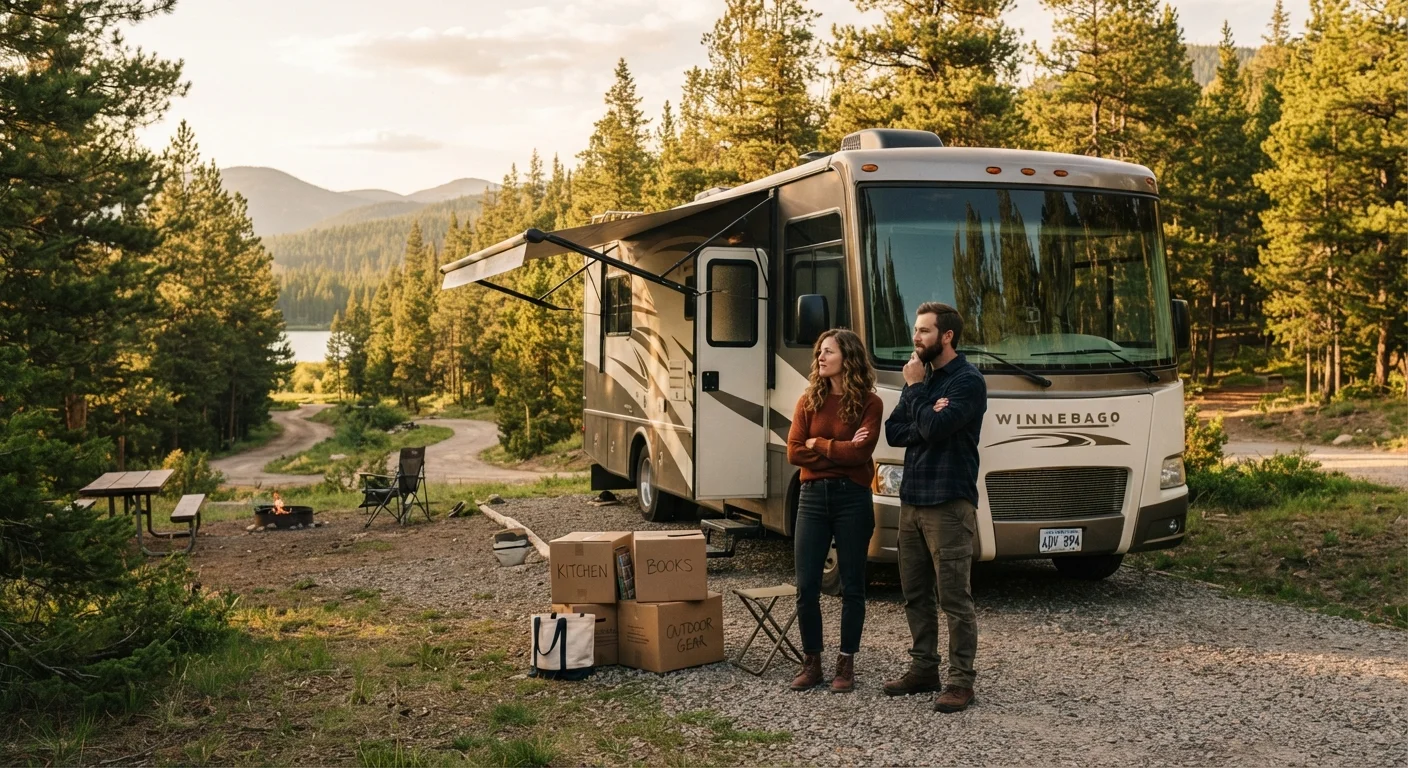
Downsizing into an RV looks, from the outside, like a logistics problem. Sell the furniture, pare down the wardrobe, figure out where to put the kitchen gear. In practice, the physical decluttering - while real - tends to be the part people handle reasonably well. What catches newcomers off guard is everything else: the psychological compression of living in a space that may be a tenth the size of their former home, the erosion of familiar routines, and the social isolation that can emerge when you drive away from an established community.
Full-time RV life looks quite different from the outside than it does after six weeks on the road in close quarters with a partner or family. These are the gaps between expectation and reality that most people underestimate - and the mistakes that follow from them.
Treating downsizing as purely a physical exercise in decluttering.
Why it happens: Most people focus heavily on which belongings to keep or discard, treating the transition as an organizational project rather than a lifestyle overhaul.
Underestimating ongoing costs by fixating on mortgage-free living.
Why it happens: The appeal of eliminating a mortgage or rent payment leads many to assume RV life is dramatically cheaper overall.
Choosing an RV class or floor plan without spending time inside similar units.
Why it happens: Floor plan diagrams and manufacturer specs create a misleading sense of spatial comfort. Advertised dimensions rarely translate intuitively to how a space actually feels when occupied around the clock.
Ignoring storage limitations until after move-in.
Why it happens: New buyers often assume they'll figure out storage organically once they're living in the unit, rather than auditing it during the selection process.
Failing to resolve mail, domicile registration, and healthcare logistics in advance.
Why it happens: Administrative details feel secondary to the excitement of the transition and are routinely deferred until after the move.
Underestimating how much community and social connection require active rebuilding.
Why it happens: People often assume that campgrounds and RV parks will naturally replace the neighborhood connections they leave behind - that community will simply happen.
The Costs and Logistics No One Warned You About
Financial miscalculation is among the most damaging early mistakes, in part because it's rooted in a genuinely appealing premise: eliminating a mortgage or rent payment. The error is in stopping the calculation there.
1 million+
Full-time RVers in the United States
Industry research from the RV Industry Association estimates over one million Americans live in their RVs full-time, a figure that has grown steadily over the past decade.
~160 sq ft
Typical livable RV interior space
Most Class A and Class C motorhomes offer between 100 and 400 square feet of interior space, with the average single-slideout Class C closer to 160 usable square feet.
$1,500-$3,000
Estimated monthly full-time RV expenses
Self-reported cost surveys from full-time RV communities suggest monthly expenses typically fall in this range, varying significantly by travel pace, location, and campsite choice.
Campsite fees, fuel, propane, maintenance reserves, and connectivity solutions accumulate quickly. Many newcomers also discover that their chosen travel pace - moving every few days - drives fuel costs that a slower, more stationary approach would substantially reduce.
Budget Surprises Can Derail the First Year
Campsite fees, propane, fuel, dump station costs, and unexpected mechanical repairs can add up faster than most newcomers project. Many first-timers also underestimate the cost of connectivity solutions - cell boosters, satellite internet, or unlimited data plans - which become near-essential for remote work or regular communication. Build a conservative reserve fund before committing to the full-time lifestyle.
The legal infrastructure of RV living adds another layer that surprises many first-timers. Without a fixed address, vehicle registration, voter registration, health insurance networks, and mail delivery all require deliberate planning. For a thorough walkthrough of what to resolve before departure, see the pre-departure checklist for aspiring full-timers.
Domicile and Legal Address Matter Immediately
Establishing a legal domicile state isn't optional - it affects vehicle registration, driver's licensing, voting rights, and health insurance eligibility. Many full-timers use mail forwarding services tied to a chosen domicile state, but the decision has lasting tax and legal implications. Research each state's residency requirements and consult a qualified attorney or tax professional before making a final choice.
Choosing the right RV class is the foundation that everything else rests on. Misreading what each class actually involves - in terms of driving requirements, setup complexity, and livability - is a distinct and common problem covered in detail in our guide to what first-time buyers get wrong about RV classes. For a broader orientation, the fundamentals of life on the road offers grounded context for anyone still calibrating expectations.