How Each System Works
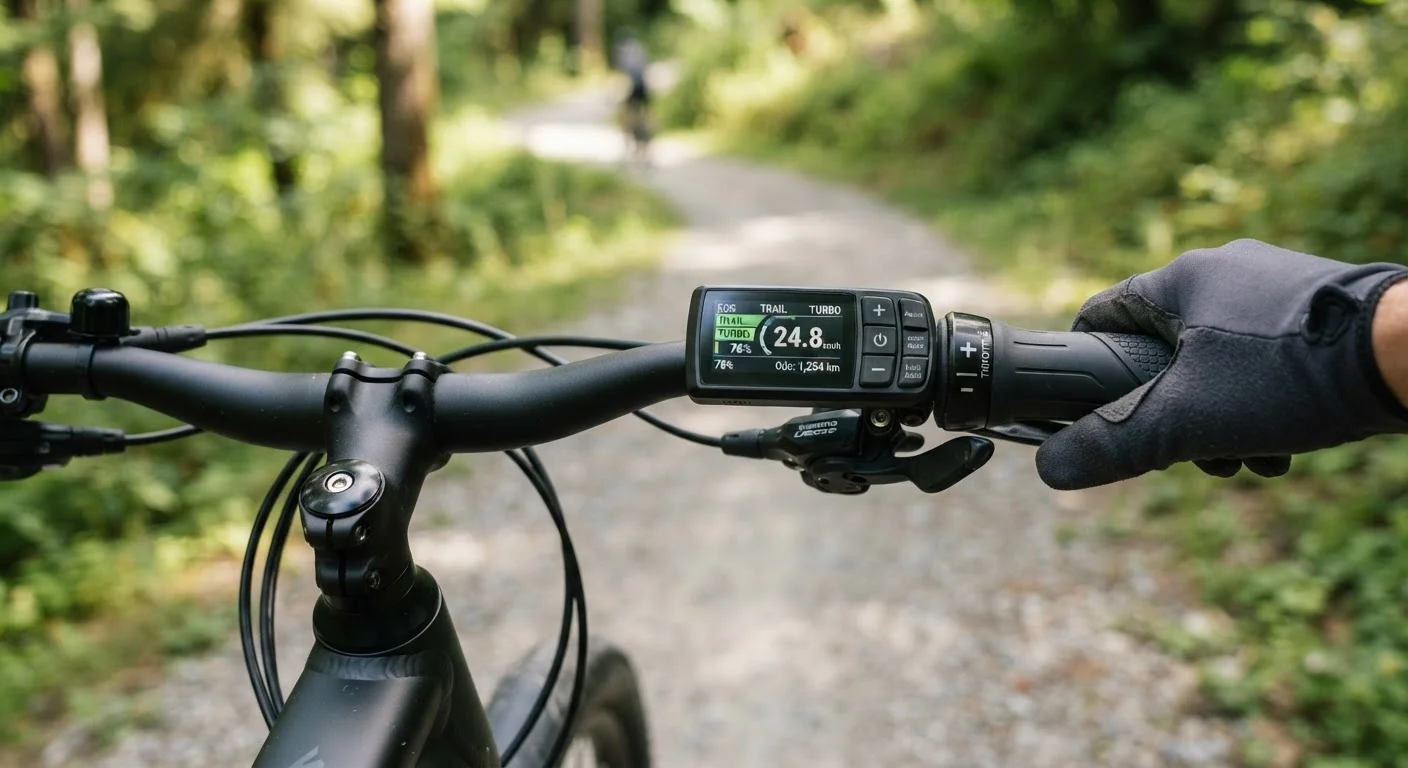
Pedal assist - often labeled PAS or EPAC (Electrically Power Assisted Cycle) - uses a sensor to detect when the rider is pedaling and delivers proportional motor power in response. Most systems offer multiple assist levels (typically 1-5), letting the rider dial in how much amplification they want. The two main sensor types differ meaningfully in feel: cadence sensors activate assist whenever the cranks turn, while torque sensors modulate power based on how hard you're actually pushing. See our guide to torque vs cadence sensors for a detailed breakdown of that distinction.
Throttle systems work independently of pedaling. Twist or thumb a throttle and the motor engages - no crank movement required. The result is an experience closer to a moped than a traditional bicycle. Some e-bikes offer only throttle; many include both PAS and a throttle so riders can switch between modes. Throttle control is also commonly used for low-speed walking-mode assist when maneuvering a heavy bike on foot.
| Criterion | Pedal Assist (PAS) | Throttle |
|---|---|---|
| Activation | Requires pedaling to engage motor | On-demand, no pedaling needed |
| Ride feel | Natural, leg-integrated effort | Moped-like, immediate power |
| Battery efficiency | Higher - rider contributes energy | Lower - motor carries full load |
| Typical US class | Class 1 or Class 3 | Class 2 (up to 20 mph) |
| Trail access | Broad - most paths and trails | Restricted - roads and select paths |
| Exercise benefit | Significant - rider still pedals | Minimal - rider can be passive |
| Usefulness with mobility limits | Limited if pedaling is difficult | High - no pedaling required |
Legal Landscape: Where Each System Is Permitted
In the US, e-bike legality is governed primarily by a three-tier classification system adopted by most states. Understanding it is essential before choosing a power delivery mode. Our article E-Bike Classes Explained covers the full framework, but the core point here is that throttle access is more restricted than pedal assist access.
- Class 1: Pedal assist only, motor cuts off at 20 mph. Permitted on most bike paths, lanes, and trails that allow conventional bicycles.
- Class 2: Throttle-equipped, motor cuts off at 20 mph. Allowed on roads and many paths, but frequently excluded from natural-surface trails and some bike paths.
- Class 3: Pedal assist only, motor cuts off at 28 mph. Generally road-only; restricted from most multi-use paths and trails.
State and local rules vary - some jurisdictions permit Class 2 bikes where others ban throttle systems outright on public trails. Always verify regulations for your specific riding area before purchasing.
Regulations Vary by Jurisdiction
Federal guidelines and the PeopleForBikes classification framework provide a national baseline, but individual states, counties, and land management agencies (such as the US Forest Service or local parks departments) may set their own rules. A throttle-equipped Class 2 bike legal on a city bike path may be prohibited on a nearby rail trail or national forest route. Always check the specific rules for any trail or path system you intend to use regularly.
Range, Efficiency, and Ride Character
Battery range is a practical differentiator. Pedal assist is inherently more efficient because the rider contributes physical power, reducing the load on the battery. Continuous throttle use draws more energy from the battery to move the same mass without rider input, which shortens range - sometimes significantly on longer rides or grades.
20-30%
Typical range reduction from throttle vs PAS use
Industry testing across multiple e-bike platforms generally shows continuous throttle use reduces range by roughly 20-30% compared to equivalent pedal assist levels, though results vary by terrain, rider weight, and assist level.
Class 1
Most broadly permitted e-bike class in the US
As of current state-level adoption, Class 1 pedal-assist-only e-bikes are permitted in more jurisdictions - including many natural-surface trails - than any other e-bike class.
The feel of each system also differs in ways that matter day-to-day. Pedal assist tends to produce a natural, flowing ride - the motor feels like an extension of your own legs. Throttle delivers more immediate, controllable power on demand, which some riders find liberating and others find disconnected from the cycling experience. The motor technology underneath also plays a role: hub motors and mid-drive units each have different torque characteristics that interact with both assist modes. For more on that layer, see our hub motor vs mid-drive comparison.
Which System Fits Which Rider
The decision ultimately comes down to how you plan to ride, where you're legally permitted to ride, and what physical experience you want from the bike. Pedal assist suits riders who value exercise integration, broader trail access, and extended range. Throttle access is meaningful for riders managing joint issues, running cargo loads, or needing reliable power for stop-and-go urban commuting without the exertion of continuous pedaling.
Neither system is objectively superior - they solve different problems. Many riders considering an e-bike for the first time may find it useful to first examine broader ownership trade-offs. Our overview of e-bike ownership trade-offs covers the practical realities beyond just power delivery. And if assumptions about effort or legitimacy are shaping your thinking, common e-bike myths addresses many of the persistent misconceptions riders bring to these decisions.