Where the Motor Lives - and Why It Matters
Every e-bike needs a motor, but where that motor is positioned fundamentally shapes how the bike rides, handles, and wears over time. The two dominant approaches - hub motors and mid-drive motors - solve the same propulsion problem in very different ways.
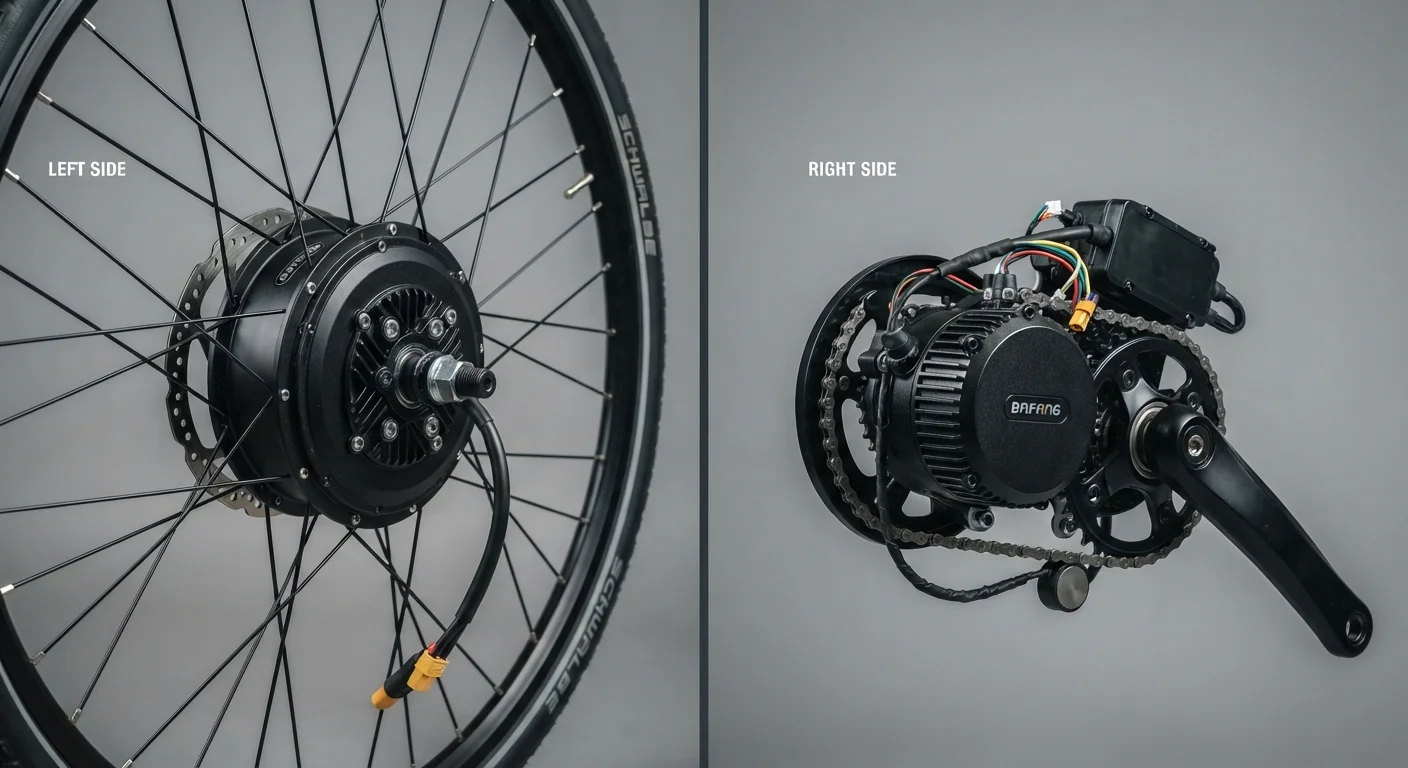
A hub motor is built directly into the center of either the front or rear wheel. When activated, it drives the wheel directly, entirely bypassing the bicycle's chain and gears. A mid-drive motor, by contrast, is mounted at the bottom bracket - the central axis where the pedal cranks meet the frame. It applies power to the chain, meaning the bike's gearing system acts as a mechanical intermediary between the motor and the rear wheel.
This positional difference isn't trivial. It influences weight distribution, maintenance demands, climbing ability, and battery efficiency. To understand how power flows through a conventional bike before any motor enters the picture, see our drivetrain basics guide - mid-drive motors interact directly with that system.
| Criterion | Hub Motor | Mid-Drive Motor |
|---|---|---|
| Motor position | Inside front or rear wheel | At the bottom bracket |
| Drivetrain interaction | Independent of gears | Works through gears and chain |
| Hill climbing efficiency | Limited - fixed load on climbs | High - uses gear leverage |
| Weight distribution | Off-center (at wheel) | Central and low |
| Drivetrain wear | Minimal - chain unaffected | Elevated chain and sprocket wear |
| Typical cost | Generally lower | Generally higher |
| Ride feel | Distinct power push at wheel | Natural, pedal-integrated assist |
| Rear wheel removal | More complex (wiring/torque arms) | Standard quick-release or thru-axle |
Performance, Efficiency, and Terrain
The core efficiency argument for mid-drive motors centers on gearing. Because the motor outputs power through the chain and cassette, riders can downshift before a climb and keep the motor operating in a more efficient RPM range. This is the same reason a cyclist drops to a lower gear on a hill - it reduces mechanical load. Hub motors lack this advantage; they push a fixed load regardless of terrain, which can cause them to run hotter and draw more battery current on sustained climbs.
For flat-terrain commuting, however, the gap narrows considerably. Hub motors deliver smooth, consistent power on level ground and are entirely adequate for the majority of urban riders. Rear hub motors, the more common configuration, also provide a straightforward riding dynamic because the driven wheel is the same as on a conventional bike.
~50%
Potential range gain on hilly terrain
Industry testing has indicated mid-drive motors can extend range significantly over hub motors on hilly routes, due to more efficient use of gear ratios - though actual figures vary by load, assist level, and terrain.
2-5×
Increased chain wear rate on mid-drives
Cycling industry technicians commonly note that mid-drive e-bike chains wear several times faster than those on unpowered bikes, making chain inspection and timely replacement an important maintenance habit.
Weight distribution is another consideration. Mid-drives place the heaviest component at the bike's center and low, which most riders and frame designers regard as favorable for handling. Hub motors, particularly rear-hub units, add weight at the wheel's edge - a position that affects wheel rotational inertia and can make rear-wheel removal (for flat repairs) more involved.
For a broader look at how motor choice connects to the full e-bike system, the anatomy of an e-bike article covers how each component interacts.
Maintenance, Ride Feel, and Practical Trade-Offs
Hub motors are mechanically isolated from the drivetrain, which has a real maintenance advantage: chain wear, derailleur adjustments, and cassette replacement don't affect the motor's function. Mid-drive motors transmit all their power through the chain, which measurably increases chain and sprocket wear compared to a conventional unpowered bicycle - particularly for riders who use higher assist levels frequently.
Ride feel is where mid-drives often earn strong preference among experienced cyclists. Because the motor assists at the crank rather than the wheel, the power delivery mimics the sensation of simply having stronger legs. This integration is especially pronounced when paired with a torque sensor, which modulates output based on how hard you're actually pedaling. Our comparison of torque sensors vs cadence sensors explains how sensor type shapes that experience regardless of motor position.
Hub motors with cadence sensors can feel more abrupt - power comes on at a set level when pedaling is detected, rather than scaling with effort. That said, hub motors are not monolithic: some higher-end rear-hub systems now incorporate torque sensing and deliver a noticeably smoother assist.
Finally, consider how motor choice relates to the full ownership picture. Trade-offs around weight, range, and repairability all feed into the day-to-day reality of e-bike ownership - a topic explored in depth in our e-bike ownership trade-offs article.
Front Hub Motors: A Third Configuration
While rear hub motors dominate the market, front hub motors exist and are worth noting. They drive the front wheel, leaving the rear drivetrain entirely untouched - which simplifies installation and gear compatibility. The trade-off is reduced traction, particularly on loose surfaces or steep climbs, since the driven wheel carries less of the bike's weight. Front hub setups are relatively uncommon on purpose-built e-bikes but appear frequently in conversion kits.