What Separates a Hardtail from a Full-Suspension Bike
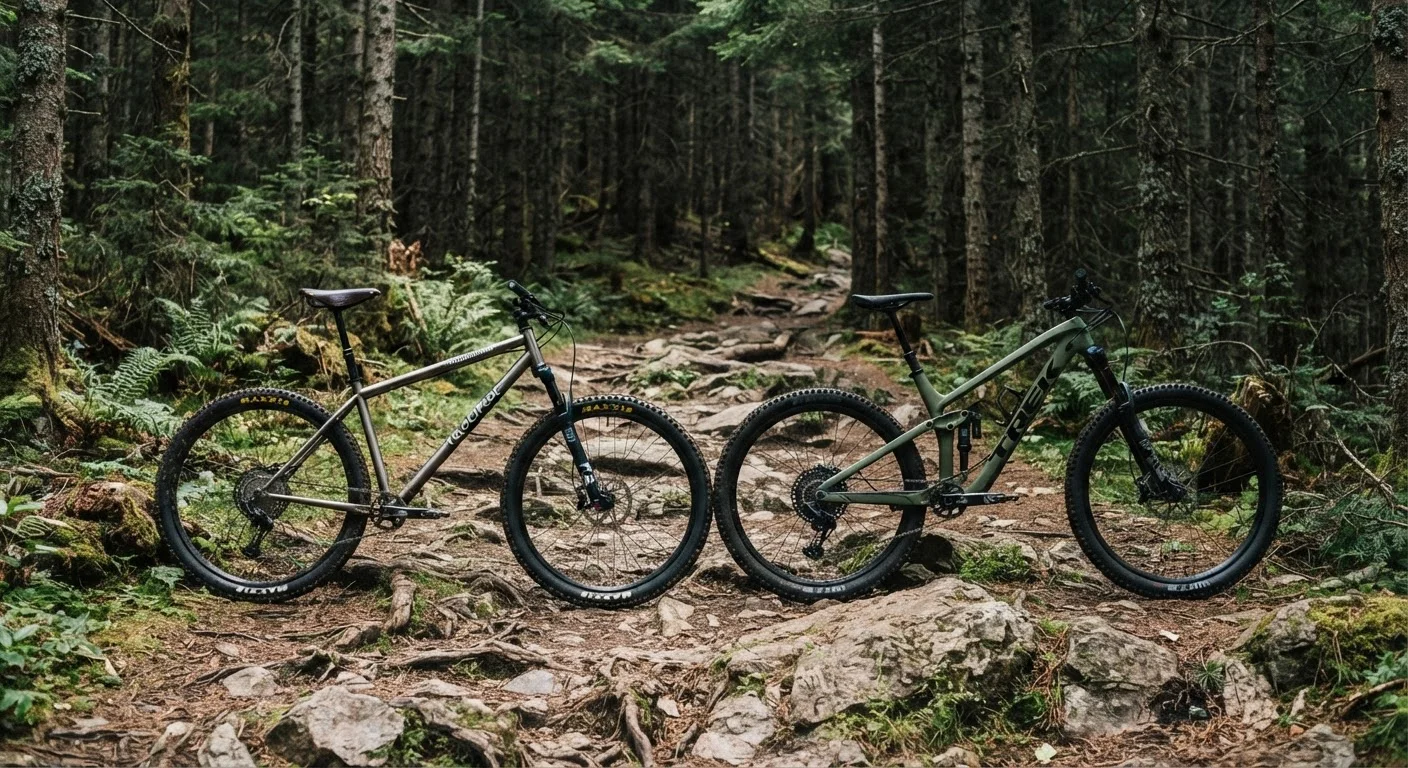
The defining difference is straightforward: a hardtail has a suspension fork up front but a rigid rear frame, while a full-suspension (or "full-sus") bike adds a rear shock and pivot linkage that allows the rear triangle to move independently of the main frame. Both fall squarely within the mountain bike category - if you want a primer on what qualifies as a true MTB, see what makes a mountain bike a mountain bike.
That rear shock changes how a bike behaves fundamentally. On a hardtail, every bump transfers directly into the rider's body and the rear wheel's contact with the ground. On a full-suspension bike, the linkage absorbs that energy, keeping the tire planted and the rider more controlled. The tradeoff is weight, mechanical complexity, and cost.
| Criterion | Hardtail | Full-Suspension |
|---|---|---|
| Rear suspension | None (rigid rear) | Rear shock + linkage |
| Typical weight | Lighter by 1-2.5 lbs | Heavier due to rear system |
| Climbing efficiency | Higher on smooth gradients | Slightly reduced; varies by design |
| Technical descent control | Requires more rider input | Better traction and stability |
| Maintenance complexity | Lower - fork only | Higher - shock, pivots, bearings |
| Component value at same price | Generally better spec | Budget spread across suspension |
| Ideal terrain | XC, flow trails, moderate singletrack | Technical, rocky, enduro terrain |
Performance on the Trail: Where Each Design Shines
Hardtails are efficient climbers. Because the rear triangle is rigid, pedaling energy goes directly into forward motion rather than being partially absorbed by suspension movement - a phenomenon sometimes called pedal bob. On smooth or moderately rough climbs, hardtails feel snappy and responsive. Many cross-country racers still favor hardtails for this reason.
Full-suspension bikes earn their reputation on the descents. When rear suspension is properly tuned, the rear wheel tracks irregular terrain more consistently, providing grip where a hardtail's rear end would bounce and skip. Over extended technical sections - rock gardens, rooted chutes, drop features - that traction advantage reduces both rider fatigue and the risk of losing control. Riders who venture into enduro-style riding or bike park laps generally find full-suspension to be a meaningful upgrade in confidence and capability.
100-160mm
Typical trail hardtail fork travel
Most trail-oriented hardtails use forks in this travel range, balancing efficiency and bump absorption on moderate terrain.
120-170mm
Common full-suspension rear travel
Rear travel varies significantly by intended discipline - cross-country bikes sit at the lower end, enduro bikes toward the higher end.
1-2.5 lbs
Average weight added by full-suspension
The rear shock, linkage hardware, and additional pivot hardware typically add this range over a comparable hardtail frame.
It's worth noting that modern full-suspension designs have significantly reduced pedaling inefficiency through improved linkage geometry. Many contemporary trail bikes are remarkably efficient under power compared to older designs. Still, hardtails retain a slight edge in raw climbing efficiency on smooth gradients.
Cost, Weight, and Maintenance Considerations
At the same price point, a hardtail almost always offers better component quality than a full-suspension equivalent. Rear suspension systems - shock absorbers, bearings, pivots, and linkage hardware - add significant manufacturing cost. That budget has to come from somewhere, often the drivetrain, wheels, or fork specification.
Weight is another factor. A full-suspension frame adds anywhere from roughly 1 to 2.5 pounds compared to a comparable hardtail, depending on the design and materials. For riders who hike-a-bike sections or commute on mixed terrain, that weight difference becomes tangible. Picking a bike for mixed terrain explores this tradeoff further.
Maintenance demands diverge meaningfully as well. Hardtails have fewer moving parts - primarily the fork, which needs periodic lower-leg servicing and oil changes. Full-suspension bikes add pivot bearings that wear over time and a rear shock that requires air pressure checks, damper servicing, and eventual rebuilds. Riders who prefer a lower-maintenance ownership experience often favor the hardtail's simplicity. The components section covers what's involved in routine suspension upkeep.
Choosing Based on Your Terrain and Goals
The most practical question to ask is: what does the majority of your riding actually look like? If your local trails are predominantly smooth singletrack, fire roads, or machine-built flow trails, a hardtail will perform well and save money that can go toward better components. If you're regularly riding technical rocky descents, steep chutes, or enduro-style terrain, rear suspension is likely to change your experience meaningfully.
Skill level matters too, but not in the direction many expect. Experienced riders on hardtails become highly skilled at reading terrain and absorbing impacts with their body - techniques that are genuinely valuable. Newer riders on rough terrain, however, may find a full-suspension bike more forgiving and less intimidating, which can support confidence-building. Before committing, consult the questions to ask before settling on a bike style framework for a structured self-assessment.
Test Rides Make a Real Difference
Specifications on paper rarely convey how differently two bikes feel on actual dirt. If possible, arrange test rides on your local trails before committing. Many bike shops and demo events offer this opportunity, and riding both platform types back-to-back on familiar terrain is the most reliable way to understand which suspension setup suits your body and your riding.