Two Rule Sets, One Goal: Preventing Collisions
Every operator on U.S. waterways is governed by navigation rules - a framework designed to ensure that vessels interacting with each other follow predictable, standardized behavior. The foundational principle is simple: prevent collisions through defined roles, clear communication, and consistent action.
The U.S. Coast Guard enforces two parallel rule sets. COLREGS (the International Regulations for Preventing Collisions at Sea, established by the International Maritime Organization) apply seaward of established demarcation lines - generally offshore coastal and ocean waters. The Inland Navigation Rules, codified under U.S. law, apply inside those lines on rivers, bays, lakes, and harbors. Understanding which rule set applies starts with knowing where you're operating. See our guide to inland vs. offshore water environments for context on how operating environment shapes vessel selection and rules alike.
While the two sets are closely aligned, distinctions exist - particularly in the interpretation of maneuvering sound signals. Boaters who frequently cross between inland and offshore waters should be familiar with both.
The Hierarchy of Vessels: Who Yields to Whom
Navigation rules establish a clear hierarchy based on a vessel's type, propulsion, and operational status. From highest to lowest priority, the general order is:
- Vessels not under command - those unable to maneuver due to mechanical failure or exceptional circumstances
- Vessels restricted in their ability to maneuver - such as dredges, cable-laying vessels, or those conducting diving operations
- Vessels constrained by their draft - large ships in shallow channels with limited deviation room
- Vessels engaged in fishing - commercial or recreational vessels with gear deployed that limits maneuverability
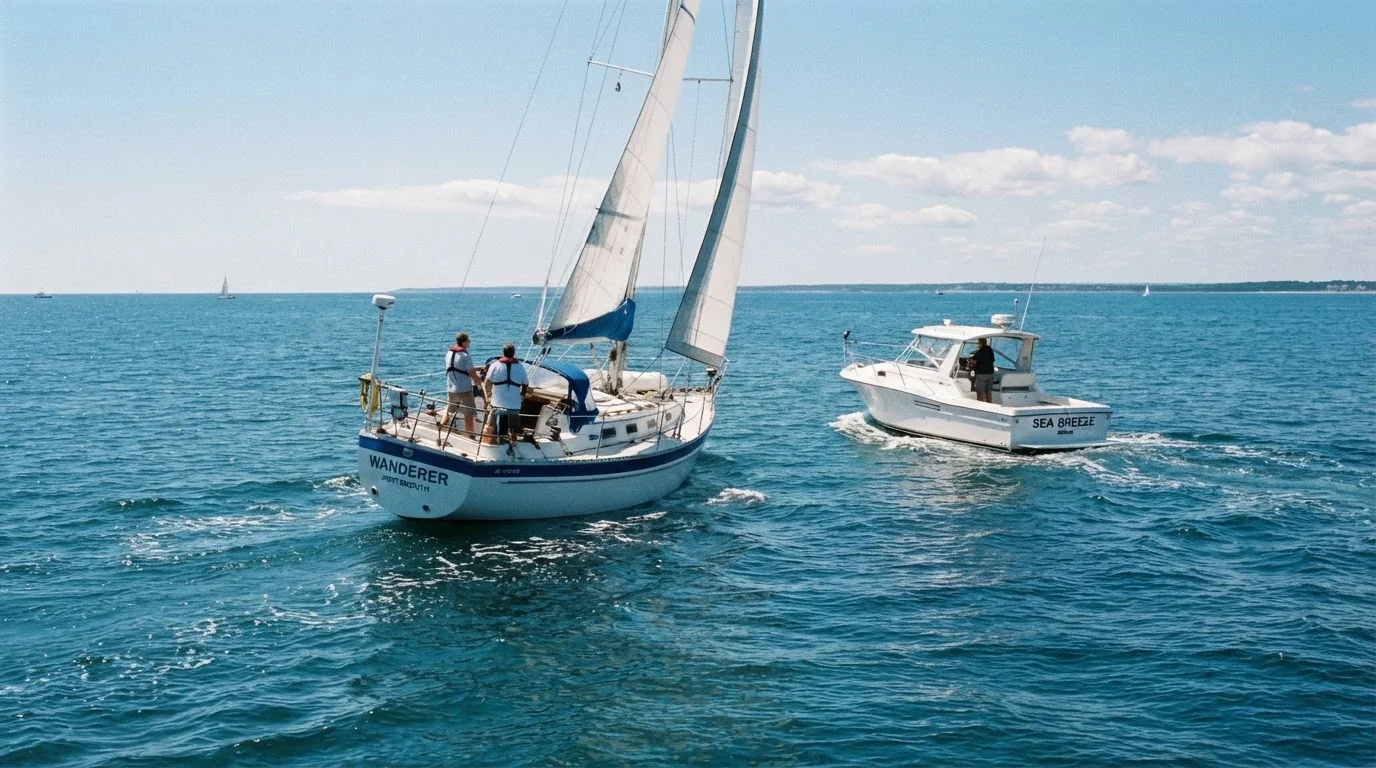
- Sailing vessels under sail alone - no engine in use
- Power-driven vessels - the most maneuverable and therefore lowest in the hierarchy
The vessel with the obligation to yield is called the give-way vessel; the one maintaining course is the stand-on vessel. The give-way vessel must take early, substantial, and unambiguous action - a minor course adjustment is not sufficient.
75%+
Boating fatalities involving operator error
U.S. Coast Guard Recreational Boating Statistics consistently attribute the majority of fatal accidents to operator error, including inattention and failure to follow navigation rules.
72 ft
Minimum length triggering additional light requirements
Under both COLREGS and Inland Rules, vessels 72 meters (approximately 236 feet) or longer have additional mandatory light and signal requirements, but vessel-type lighting requirements begin at much smaller sizes for recreational craft.
Even as stand-on vessel, a boater is not absolved of responsibility. If a collision becomes imminent and the give-way vessel has failed to act, the stand-on vessel is required by rule to take whatever action is necessary to avoid impact.
Lights, Shapes, and Sound Signals
Navigation rules also govern how vessels communicate their presence and status. Three communication systems are required under law:
Navigation Lights
Between sunset and sunrise - and during restricted visibility - vessels must display specific light configurations based on their type and size. A power-driven vessel underway shows a white masthead light forward, red (port) and green (starboard) sidelights, and a white stern light. Different configurations apply to sailing vessels, anchored craft, and vessels towing. These patterns allow other operators to determine the type of vessel, its heading, and its activity at night.
Day Shapes
During daylight hours, certain vessels must display geometric shapes that convey their status. A vessel at anchor hoists a black ball. A vessel not under command shows two black balls in a vertical line. A vessel restricted in its ability to maneuver uses a ball-diamond-ball configuration. These shapes substitute for lights when visibility conditions don't require illumination.
Sound Signals
Horns and whistles are required equipment and carry defined meanings. One short blast indicates a vessel altering course to starboard. Two short blasts signal a port turn. Five or more short blasts signal danger or doubt - a critical signal every boater should recognize immediately. In restricted visibility, vessels must sound signals at prescribed intervals regardless of whether other traffic is visible.
Practice Sound Signals Before You Need Them
Many boaters learn sound signals in theory but freeze when it matters. Spend a few minutes before each outing reviewing the signals for your most likely encounter scenarios - crossing, overtaking, and restricted visibility. A horn mounted within easy reach of the helm ensures you can signal without looking away from traffic.
Pairing sound signal knowledge with proper electronics improves situational awareness significantly. Our overview of marine electronics explains how VHF radios and chartplotters support safe navigation.
Restricted Visibility and Special Circumstances
Fog, heavy rain, and low-light conditions create scenarios where the standard encounter rules are harder to apply. When operating in or near an area of restricted visibility, all vessels - regardless of stand-on status - are required to proceed at a safe speed, maintain a proper lookout, and sound the appropriate fog signals.
Channels deserve particular attention. In a narrow channel, vessels must keep to the starboard (right) side as far as safely practicable. Smaller vessels are not to impede the passage of large vessels that can only safely navigate within the channel itself - a rule that surprises many recreational boaters who assume equal footing on shared waterways.
State Rules Layer on Top of Federal Rules
Federal Inland Navigation Rules establish the baseline, but individual states often add regulations covering speed limits, no-wake zones, age restrictions, and required safety equipment. Always check with your state's boating authority before operating on unfamiliar waterways. What is federally compliant may still violate a local ordinance.
Knowing the rules is only part of the picture. Avoiding misconceptions about boating safety is equally important - our article on common boating myths addresses dangerous assumptions new operators frequently carry onto the water.
Navigation rules also require every vessel to maintain a proper lookout at all times using all available means - eyes, hearing, radar, and radio. Distraction at the helm, including phone use, is incompatible with this requirement. Compliance is not just legal obligation; it is the baseline of seamanship.
For those developing broader navigation skills, understanding how to read nautical charts is a natural complement to mastering the rules - charts reveal channel boundaries, depth restrictions, and hazard zones that directly affect how rules apply in practice.