Before You Even Step Aboard
The first lesson of boating happens before the engine starts. Experienced mariners follow a pre-departure routine every single time - not because they're overly cautious, but because conditions on the water change fast and small problems ashore become serious ones offshore.
Start by checking the weather. Marine forecasts differ from standard weather apps; they account for wind speed at the water's surface, wave height, and visibility. Resources like NOAA's National Weather Service provide dedicated marine forecasts by zone. If a small craft advisory is in effect for your area, that's a clear signal to stay put. Reading weather before leaving the dock is a skill worth developing early.
Next, walk through a pre-departure checklist: verify that fuel levels are adequate, that navigation lights function, that the bilge is dry, and that all required safety equipment is on board and accessible. Many state boating agencies publish standardized checklists you can print and keep aboard.
File a Float Plan Before Every Trip
A float plan is a simple document left with someone ashore that describes your vessel, your intended route, and your expected return time. If you don't check in on schedule, that person knows when and where to alert the Coast Guard. It costs nothing and can be life-saving.
The Language of the Boat
Nautical terminology exists for precision and speed - two things that matter when you need to communicate quickly on the water. Before your first outing, familiarize yourself with the core directional and structural terms used aboard any vessel.
Bow
The front of the boat. When you're moving forward, the bow leads the way.
Stern
The rear of the boat, where the engine or outboard motor is typically mounted.
Port
The left side of the boat when you're facing the bow. Remembered by noting that 'port' and 'left' both have four letters.
Starboard
The right side of the boat when you're facing the bow.
Beam
The widest point of the boat, measured side to side. Relevant when estimating whether a vessel fits a slip or passage.
Draft
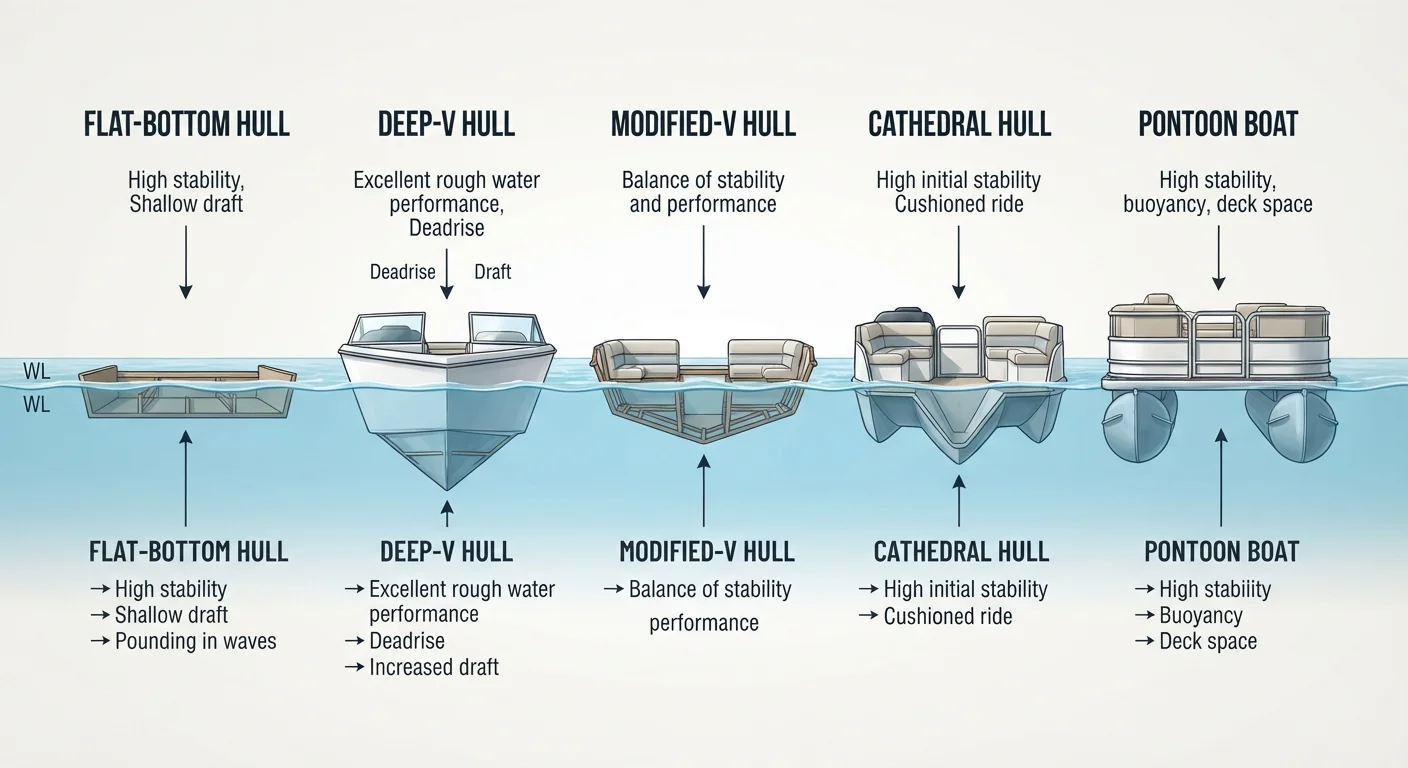
The depth of water a vessel needs to float without grounding. Critical knowledge for navigating shallow areas.
Knot
A unit of speed equal to one nautical mile per hour. Mariners use knots rather than miles per hour.
Understanding these terms lets you follow crew instructions, read boating guides, and communicate clearly with the US Coast Guard or other vessels if needed. For a deeper walkthrough of vessel components, see the anatomy of a boat. And if you're still getting oriented on vessel types, the new boater's map to boat categories is a useful starting point.
What the Water Itself Will Throw at You
New boaters are often surprised by how dynamic the water environment is, even on what looks like a calm day. Three forces tend to catch first-timers off guard: wind, wakes, and current.
- Wind affects steering and docking far more than it does driving a car. Even a light breeze can push a boat sideways during low-speed maneuvers, making docking and launching more challenging than expected.
- Wakes - the waves generated by passing vessels - can rock your boat unexpectedly. Learning to orient your bow into a large wake at a slight angle reduces the roll and keeps passengers comfortable.
- Current on rivers, tidal channels, and inlets can work with you or against you depending on direction. Always know which way the water is moving before you approach a dock or narrow passage.
The environment you boat in also shapes what to watch for. Freshwater and saltwater boating present meaningfully different challenges in navigation, equipment, and maintenance.
Navigation Rules Apply on the Water Too
The US Inland Navigation Rules (and COLREGS for international waters) govern right-of-way, lighting requirements, and safe speed - much like traffic laws on land. New boaters should familiarize themselves with basic stand-on and give-way vessel concepts before operating independently. The US Coast Guard publishes the full ruleset free of charge.
Safety Gear and Why It's Non-Negotiable
Federal law requires specific safety equipment on all recreational vessels, and state requirements often go further. At minimum, every boat must carry a US Coast Guard-approved life jacket for each person aboard, a throwable flotation device, a visual distress signal (on certain waters), a sound-producing device, and a fire extinguisher on motorized boats.
Life jackets deserve special attention. A jacket that doesn't fit properly offers significantly less protection than one that does. Modern inflatable designs are far more comfortable than older foam styles, which removes one of the most common excuses for not wearing one. Common boating myths - including the idea that life jackets are only needed in emergencies - can create real risk for new boaters.
Alcohol and Boating: A Serious Risk
Operating a vessel under the influence of alcohol or drugs is illegal in every US state and carries significant criminal penalties. Sun exposure, wind, and motion amplify the effects of alcohol on the water compared to land. Keep all alcohol off the helm and wait until the vessel is securely docked before consuming any.
Beyond the legal minimum, experienced boaters typically carry a VHF marine radio, a first aid kit, an anchor with appropriate rode, and an emergency position-indicating radio beacon (EPIRB) or personal locator beacon (PLB) for offshore use.
Building Confidence After Day One
Most new boaters feel overwhelmed after their first time out - and that's completely normal. The gap between knowing the theory and managing a real vessel in variable conditions is real. What closes that gap is structured practice and honest feedback.
A hands-on boating safety course from an organization such as the US Power Squadrons or the American Red Cross gives you supervised time on the water alongside formal instruction. These courses cover navigation rules, emergency procedures, and docking techniques in a way that reading alone cannot replicate.
As your hours on the water accumulate, you'll naturally start noticing features that matter most for daily usability - things like storage layout and access to key systems that affect every outing. And when you're ready to evaluate vessels more thoroughly, a complete guide to watercraft features provides a structured framework for comparing options.
Boating rewards patience. Each trip teaches something the last one didn't, and the skills compound over time into genuine seamanship.