Why Dead Rise Matters Beyond the Spec Sheet
When you open a boat specification sheet, dead rise angle often appears as a single number - say, 21° - with no further context. For buyers unfamiliar with hull geometry, it reads as technical filler. In practice, this figure tells you more about a hull's rough-water manners than almost any other measurement on the page.
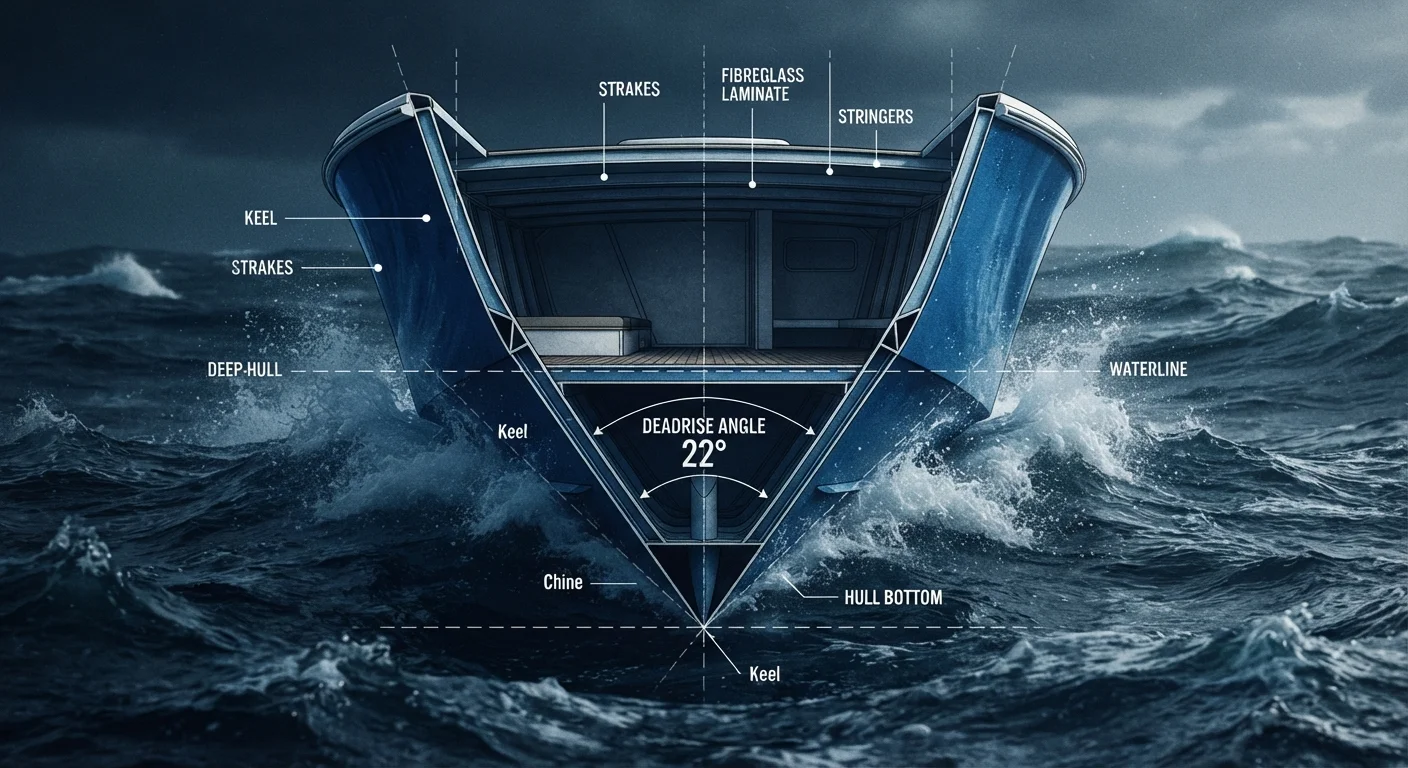
Dead rise determines how a hull interacts with an oncoming wave face. A steep V-shape (high dead rise) allows the keel to enter the water first, progressively spreading wave energy outward. A flatter hull strikes the wave's surface more broadly, transmitting that energy directly upward through the boat and into anyone aboard. The difference in perceived ride quality between a 13° and a 22° dead rise boat in two-foot chop is immediately and unmistakably obvious.
See our guide to reading a boat specification sheet for a breakdown of how dead rise fits alongside other key hull measurements like beam, draft, and displacement.
21°
Typical transom dead rise on offshore center consoles
Many purpose-built offshore fishing and cruising hulls cluster around 20°-22° at the transom, reflecting the industry's standard for open-water rough-water performance.
~10°-14°
Common dead rise range for bay and flats boats
Shallow-water fishing platforms favor flatter hulls for poling stability and draft management in protected inshore environments.
24°+
Dead rise on dedicated offshore performance hulls
High-performance offshore sportfish and express cruisers often exceed 24° to manage sustained high-speed runs in open Atlantic or Gulf conditions.
The Tradeoffs Between Comfort and Stability
Dead rise is fundamentally a compromise dial. Increasing it softens the ride in waves but introduces tradeoffs that buyers need to understand before they commit.
High Dead Rise (20°-24°+)
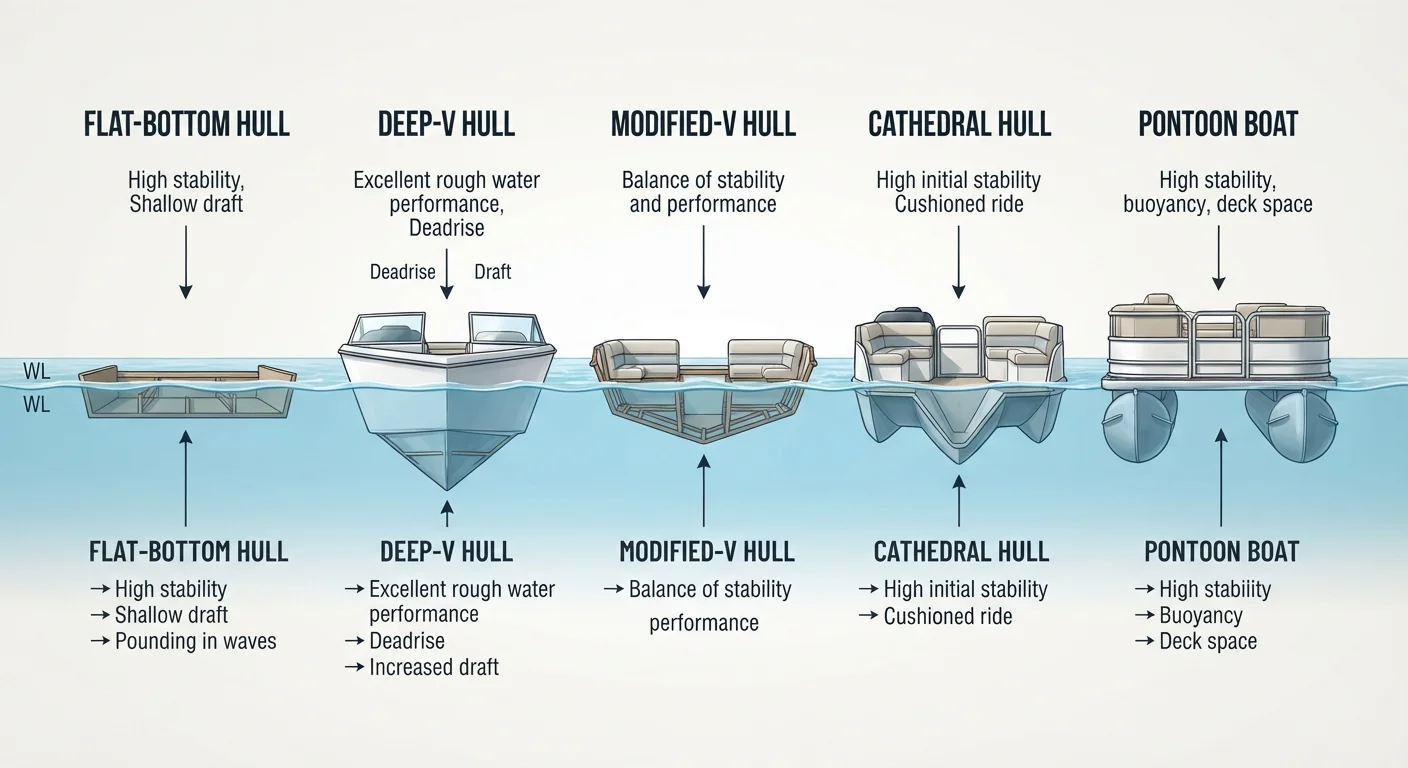
A hull with a dead rise of 20 degrees or more at the transom is well-suited to open-water conditions where wave height and chop are unpredictable. The sharper V slices rather than pounds, reducing fatigue on long offshore runs. The downside is that these hulls are inherently less stable when stationary - they tend to rock in beam seas or when passengers move around the cockpit. High dead rise boats also require more power to get on plane.
Low Dead Rise (Under 15°)
Flatter-bottomed hulls prioritize stability at rest and fuel economy while planing. They're the dominant design in aluminum fishing boats, bay boats, and pontoons - platforms where calm, protected waters are the norm. In chop, however, the ride becomes noticeably harsher. Wave energy transfers more directly through the hull, making longer trips in rough conditions uncomfortable.
Moderate Dead Rise (15°-20°)
Most recreational runabouts, family bowriders, and versatile fishing boats occupy this middle range. They deliver an acceptable ride in moderate conditions and remain reasonably stable at rest - a practical balance for boaters who encounter mixed conditions throughout the season.
For more context on how these tradeoffs play out across different hull geometries, the overview of watercraft hull design explores how shape affects ride, stability, and speed in greater depth.
“Dead rise is the first number I look at when someone asks me about offshore capability. You can adjust weight distribution and trim tabs, but you can't change the fundamental shape of the hull once you've bought the boat.”
— Dave Gerr, Naval architect and author of The Nature of Boats
How to Use Dead Rise When Evaluating a Boat
Dead rise alone doesn't tell the complete story - hull strakes, chines, and overall length all influence how a boat ultimately behaves on the water. But it remains one of the most reliable starting filters when narrowing down options for a specific use case.
Always Sea Trial in Representative Conditions
A calm-day demo can mask the real differences between hull designs. When evaluating a boat based on dead rise, try to arrange a sea trial when there is at least some chop present - even one foot of wave height will begin to reveal how the hull actually behaves. If that isn't possible, ask the dealer or seller to arrange a test in conditions closer to your typical operating environment before making a final decision.
When comparing boats, confirm whether the manufacturer measured dead rise at the transom or at midship. A 24° midship measurement on a hull that flattens significantly toward the transom will not ride like a true 24° deep-V. This distinction matters when cross-shopping across brands, and it's a common source of confusion that the article on hull shape misconceptions addresses in detail.
Also consider your primary operating environment. Boaters who spend most of their time on protected bays, rivers, or lakes can prioritize stability and efficiency without sacrificing much comfort. Those running offshore - particularly beyond inlets where ocean swells and wind chop combine - should weight dead rise more heavily in their evaluation. Understanding how hull type connects to handling is foundational; the primer on hull types and handling provides a useful companion reference for putting dead rise in a broader context.