The Core Hull Families: A Practical Overview
Every hull traces back to a handful of fundamental geometric profiles, each with distinct trade-offs. Understanding these families is the foundation for evaluating any boat listing or specification sheet. For a deeper look at how these measurements appear in manufacturer data, see our guide on reading a boat specification sheet.
Flat-Bottom Hulls
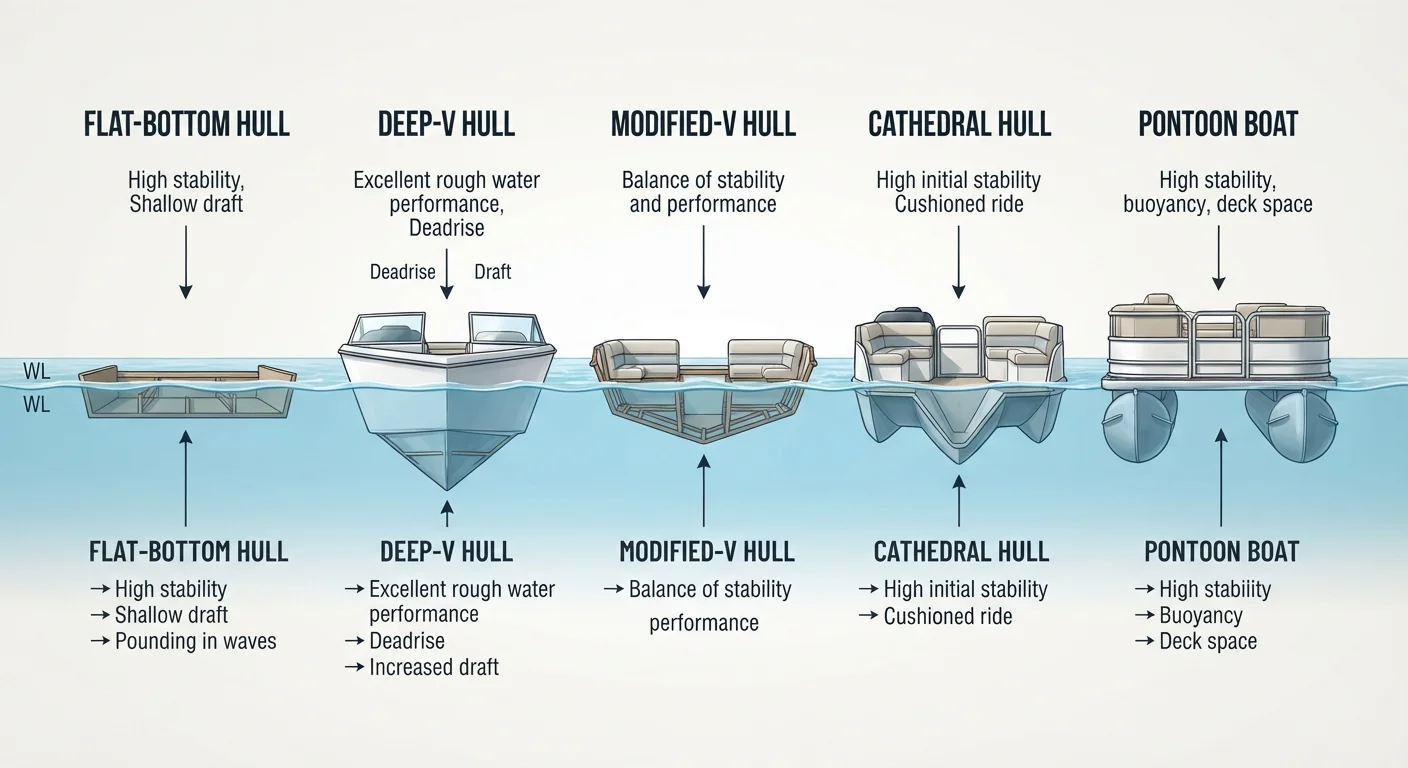
As the name implies, the hull bottom runs nearly parallel to the waterline. This geometry maximizes initial stability - the resistance to side-to-side rocking when the boat is at rest or moving slowly. Flat-bottoms plane quickly because less surface needs to lift out of the water, and their shallow draft makes them ideal for rivers, marshes, and back-country fishing. The trade-off is significant: in open water with any chop, a flat bottom slaps hard against incoming waves, producing a jarring ride and reduced control.
Deep-V Hulls
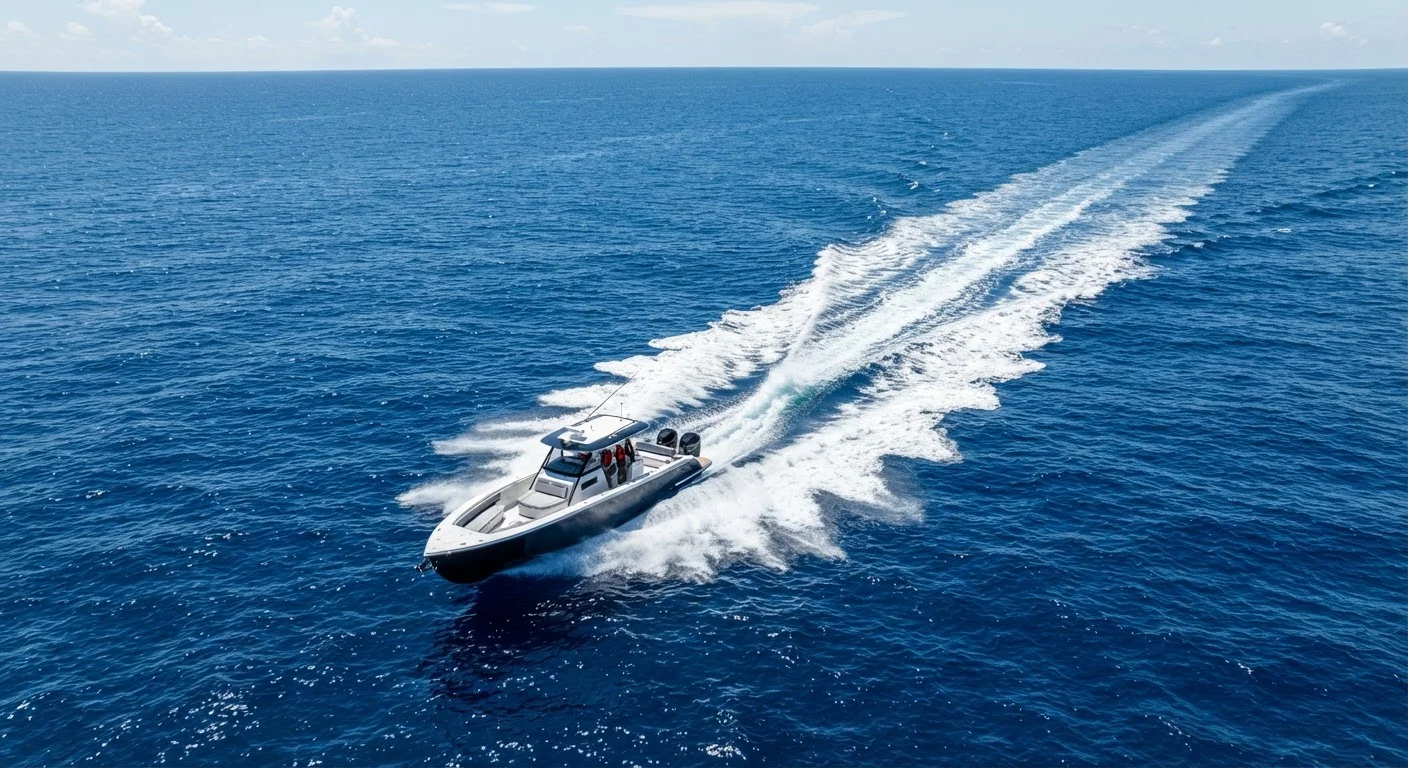
Deep-V hulls feature a pronounced V-shape running from the bow to the transom, typically with a deadrise angle of 20 degrees or more. That sharp entry angle cleaves through waves rather than slamming into them, delivering a dramatically smoother ride in offshore or rough-lake conditions. The cost is a higher center of gravity and reduced initial stability - the boat rocks more noticeably at idle or anchor. Deep-V hulls also require more power to reach planing speed and generally carry a higher fuel consumption profile at low speeds.
Modified-V Hulls
The modified-V is the industry's most common compromise. Deadrise angles in the 12-18° range provide acceptable rough-water performance while retaining enough flat surface near the stern to maintain stability and efficient planing. Most family runabouts, bowriders, and mid-size cruisers use some variant of this geometry. It is broadly versatile, though it is not the optimal choice at either performance extreme.
Deadrise Is Measured at the Transom
When manufacturers list a deadrise angle, it refers to the measurement at the transom (stern), not the bow. Most V-hulls have significantly more deadrise at the bow - often 50-60 degrees - which tapers toward the stern. A boat listed as '18-degree deadrise' has 18 degrees at the transom; the forward sections are considerably sharper. This is why the transom deadrise figure is the standard comparison metric across hull types.
Cathedral, Pontoon, and Tunnel Hulls
Beyond the V-family, several specialized hull forms address specific performance or use-case requirements.
Cathedral (Tri-Hull) Hulls
Cathedral hulls feature two outer sponsons (lateral floats) flanking a central V, creating a triple-hull profile at the bow. This generates exceptional initial stability and a wide, dry deck - qualities that made them popular for family day boats in the 1970s and 1980s. In rough water, however, the sponsons can pound uncomfortably, and the design has largely been supplanted by modified-V profiles for general recreational use.
Pontoon Hulls
Pontoon boats rest on two or three aluminum tubes (logs) rather than a traditional displacement or planing hull. They offer remarkable deck space and stability for their size, making them dominant in the lake recreation and entertainer segment. Performance in waves is limited - pontoons are designed for calm inland water and are not suited to offshore or high-chop environments. Tri-toon configurations (three logs) improve planing efficiency and rough-water handling modestly.
Tunnel Hulls
Tunnel hulls (also called catamaran hulls in the powerboat context) use two outboard sponsons with an air channel running between them. At speed, trapped air lifts the hull partially clear of the water, dramatically reducing drag and enabling very high speeds. They are common in performance racing and some bass-boat applications but require flat or near-flat water for safe operation at pace. For a structural comparison of multi-hull concepts, our monohull vs. catamaran overview covers the key engineering trade-offs.
20°+
Deadrise angle of typical offshore deep-V hulls
Naval architects generally classify any hull with 20 degrees or more of transom deadrise as a deep-V design, engineered for rough-water operation.
~6"
Minimum draft achievable with flat-bottom skiffs
Purpose-built shallow-water skiffs using flat or tunnel hulls can operate in as little as six inches of water, according to manufacturer specifications for that vessel class.
3
Aluminum logs in a tri-toon pontoon configuration
Adding a third center log to a standard twin-tube pontoon measurably improves planing efficiency and wave resistance compared to traditional two-log designs.
Matching Hull Geometry to Real-World Conditions
Selecting a hull is ultimately an exercise in honest self-assessment about where and how you boat. The most common mistake buyers make is optimizing for the rare occasion - choosing a deep-V for occasional offshore trips when 90 percent of their time is spent on a calm reservoir - or the reverse, buying a flat-bottom skiff and then venturing into open coastal water.
A useful framework: identify your primary water type (protected inland lake, coastal bay, open ocean, river/shallow backwater), your primary activity (fishing, watersports, cruising, day use), and your typical passenger and gear load. Each of these factors points toward a different hull geometry.
Beyond the hull bottom profile, consider how transom design interacts with the hull shape - the stern geometry directly affects how the boat exits a wave and how efficiently power is transferred from the engine to forward motion.
For a comprehensive breakdown of every design feature category - including hull type alongside propulsion, electronics, and safety systems - the Watercraft Features End to End guide provides a thorough reference. And if you've encountered conflicting information about what hull shapes can and cannot do, our companion piece on common hull shape misconceptions separates engineering reality from popular myth.
Test in Real Conditions Before Committing
If possible, arrange a sea trial on the type of water you actually boat on - not just calm marina conditions. A hull that feels rock-solid tied to a dock may behave very differently in a two-foot chop at speed. Many dealers and boat shows offer demo rides; take advantage of them with your intended use case in mind.