How the Configurations Differ at a Glance
The distinction between single and twin engine boats goes well beyond simply counting motors on the transom. Engine count shapes a vessel's performance envelope, handling character, operational cost, and risk profile in ways that affect every trip you take. Understanding these differences is fundamental to matching a boat to how and where you actually use it.
For a broader look at how propulsion type factors into this decision, see our propulsion systems comparison - the single vs. twin question often intersects with inboard, outboard, and sterndrive choices simultaneously.
| Criterion | Single Engine | Twin Engine |
|---|---|---|
| Purchase cost | Lower initial outlay | Significantly higher upfront cost |
| Fuel consumption | More economical per hour | Roughly double at similar speeds |
| Engine redundancy | None - one failure disables vessel | One engine can get you home |
| Low-speed maneuverability | Steering-dependent only | Independent throttle control |
| Maintenance complexity | One set of service requirements | Two sets of service intervals |
| Typical use case fit | Nearshore, inland, protected waters | Offshore, bluewater, remote passages |
| Weight and transom load | Lower - simpler transom design | Higher - reinforced structure needed |
Performance: Speed, Range, and Handling
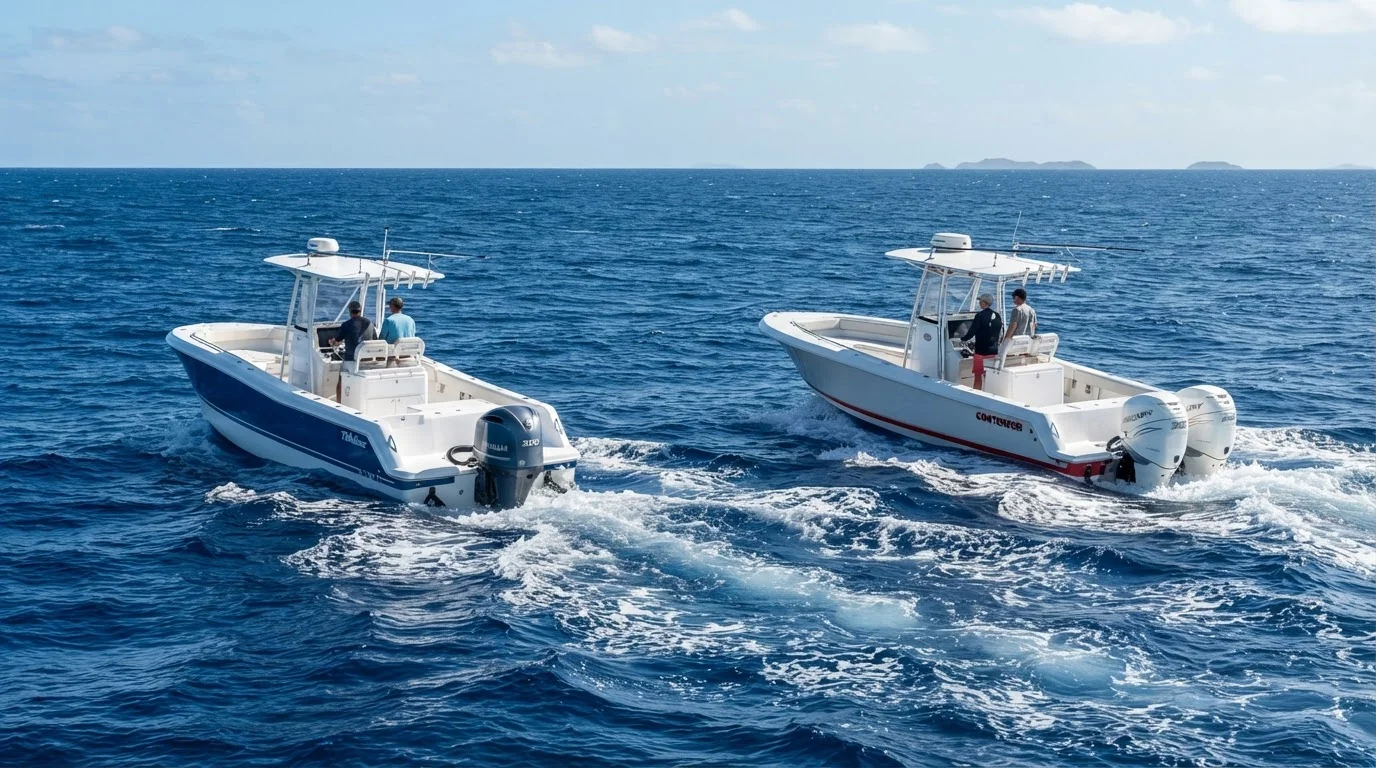
A single engine installation typically delivers adequate performance for nearshore and inland use. Modern single outboards - particularly in the 150-350 hp range - can push mid-size center consoles and express cruisers to planing speeds efficiently. However, a single engine generally produces a narrower handling envelope: turning radius is governed solely by rudder or steering geometry rather than differential throttle input.
Twin engines unlock a qualitatively different level of maneuvering control. Operators can use independent throttle inputs to spin a vessel nearly in place, a major advantage when docking in crosswinds or currents. At speed, twin installations also tend to produce more stable, predictable planing because thrust is distributed symmetrically across the transom.
Range, however, often favors the single engine setup. Twin motors consume fuel at roughly twice the rate of a comparable single, compressing effective operating range unless tankage is scaled up significantly. Buyers should calculate total fuel capacity and expected consumption rates carefully - not just peak horsepower numbers.
2×
Approximate fuel consumption increase with twin engines
Twin-engine boats generally consume fuel at roughly double the rate of a comparable single-engine setup at similar planing speeds, though efficiency varies by throttle setting and engine model.
40+ mi
Offshore distance where redundancy becomes critical
Marine safety authorities generally note that vessels operating well beyond coastal towing range - commonly 40 miles or more offshore - face materially higher risk from a single-engine failure.
$5K-$20K+
Typical additional rigging cost for a second outboard
Industry estimates for adding a second outboard engine - including motor, controls, wiring, and transom work - commonly range from several thousand to over $20,000 depending on horsepower and installation scope.
Safety and Redundancy: The Core Argument for Twin Engines
The safety case for twin engines is straightforward: if one engine fails offshore, the other gets you home. This redundancy is genuinely meaningful when operating in conditions where a disabled vessel could become a serious emergency - offshore fishing grounds, open-ocean passages, or remote waterways without reliable towing coverage.
For nearshore and inland boaters, the calculus shifts. Engine failures on a lake or within a few miles of a marina are inconvenient, not life-threatening. Towing services, VHF radio assistance, and nearby help reduce the practical impact of a single-engine failure substantially.
It's also worth noting that twin engine reliability is not simply additive. Two engines introduce two sets of components that can fail, two fuel systems, and two sets of maintenance requirements. Neglected twin-engine boats can actually present more failure opportunities than a well-maintained single. Diligent maintenance schedules are especially important in dual-engine configurations. Our overview of outboard vs. inboard engine differences covers maintenance access considerations that directly affect twin-engine upkeep.
Cost of Ownership: Purchase, Fuel, and Maintenance
Cost differences between single and twin engine configurations accumulate across multiple categories. At purchase, twin engine rigs carry a premium - not just for the second motor, but for the reinforced transom, additional controls, wiring, and plumbing required. Rigging costs for a second outboard can range from several thousand to over $20,000 depending on engine size and installation complexity.
Ongoing costs amplify the gap. Two engines require two sets of annual service items: impellers, filters, spark plugs, gear oil, and periodic lower-unit service. Fuel costs at similar operating speeds are broadly proportional to total displacement, meaning twin setups will consistently consume more per hour than a single of equivalent total horsepower - though modern fuel-injected outboards have narrowed efficiency gaps at cruising throttle settings.
Insurance premiums also tend to be higher for twin-engine vessels, reflecting the greater replacement cost. Buyers should request comparable insurance quotes for both configurations before finalizing a purchase decision. For readers also evaluating broader hull design questions alongside engine configuration, the monohull vs. catamaran comparison is a relevant companion read.
Horsepower Ratings and Transom Limits
Every boat hull carries a maximum horsepower rating established by the manufacturer and, for vessels under 20 feet, often reflected on a Coast Guard capacity plate. Adding a second engine to reach or exceed this rating is unsafe and may void manufacturer warranties. Always verify that a twin-engine configuration falls within the hull's rated capacity before specifying engine sizes.