Two Organizations, Two Different Methodologies
When sedan shoppers encounter safety ratings, they typically see two distinct sources: NHTSA (the National Highway Traffic Safety Administration, a U.S. federal agency) and IIHS (the Insurance Institute for Highway Safety, an independent nonprofit funded by auto insurers). Understanding that these are separate programs with different goals is the essential starting point.
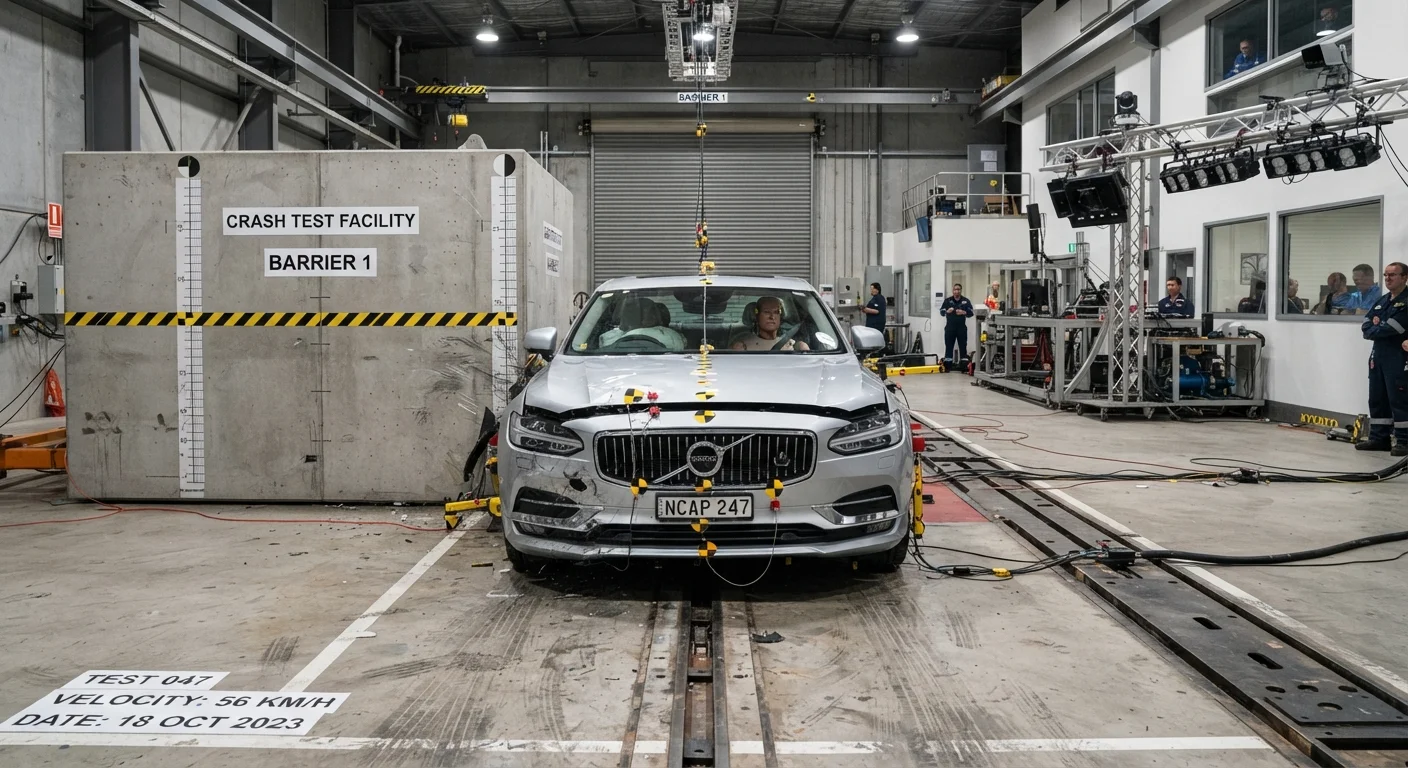
NHTSA's New Car Assessment Program uses a five-star scale and focuses on measuring injury probability across frontal, side, and rollover tests. The resulting star ratings reflect how likely an occupant is to sustain a serious injury in each scenario - five stars signals less than a 10% probability in that category.
IIHS, by contrast, uses a descriptive four-level scale - Good, Acceptable, Marginal, Poor - and evaluates structural performance, injury measures recorded by crash dummies, and increasingly, the quality of active safety technology. IIHS introduced the challenging small overlap front test in 2012 and has continuously updated its side-impact protocol to account for the growing prevalence of taller vehicles like SUVs and trucks on U.S. roads.
Ratings Are Model-Year Specific
Safety ratings apply to the exact model year tested. Manufacturers sometimes make structural or technology changes mid-cycle, meaning a 2022 model may have different ratings than a 2023 version of the same nameplate. Always verify the model year of the vehicle you are evaluating against the year tested in published results.
Trim and Package Variations Can Affect Results
IIHS and NHTSA typically test one or a limited number of configurations of any given sedan. Optional safety packages - such as upgraded headlights or additional AEB functionality - may or may not be present on the tested vehicle. Confirm which packages were included in the tested trim before drawing conclusions about a differently-equipped version.
Because the two systems test different crash scenarios at different speeds and measure outcomes differently, a high rating from one organization does not predict performance in the other's tests. Reviewing both is essential for a complete picture.
What NHTSA's Stars Actually Measure
NHTSA tests vehicles in three primary categories: frontal crash (driver and passenger), side crash (moving barrier and pole), and rollover resistance. Each earns its own star rating, and an overall vehicle score is derived from those components.
One important nuance: NHTSA's frontal test uses a full-width barrier, meaning the entire front of the vehicle contacts the barrier simultaneously. This differs significantly from real-world crashes, where partial-overlap impacts - where only a portion of the front structure absorbs the force - are common. That gap is precisely why IIHS developed its offset and small overlap tests.
25%
Vehicle front width in IIHS small overlap test
IIHS's small overlap front test strikes only 25% of the vehicle's front structure, simulating corner-impact collisions that NHTSA's full-width barrier test does not replicate.
2012
Year IIHS introduced small overlap front test
IIHS introduced the small overlap front crash test in 2012, revealing significant structural weaknesses in many vehicles that had previously scored well under older protocols.
4
IIHS rating levels for each test category
IIHS assigns one of four ratings - Good, Acceptable, Marginal, or Poor - to each crash test and equipment evaluation, offering more descriptive granularity than a simple numerical score.
When comparing sedans using NHTSA data, look beyond the headline overall rating. A vehicle might earn five stars overall but only three stars in the side pole impact test, which simulates hitting a tree or utility pole. That granularity matters for understanding real-world risk profiles.
Decoding IIHS Ratings and the Top Safety Pick Designations
IIHS evaluates sedans across a broader set of crash configurations than NHTSA, including the small overlap front test (where 25% of the vehicle's front strikes the barrier), the moderate overlap front test, side impact, roof strength, and head restraint and seat performance.
Beyond crash structure, IIHS also rates front crash prevention systems - the automatic emergency braking (AEB) technology that can slow or stop a vehicle before a collision - and, critically, headlight quality. Poor or inadequate headlights are associated with elevated nighttime crash risk, and IIHS has been vocal that many vehicles still earn only marginal or poor headlight ratings even in otherwise high-performing models.
The two IIHS award tiers work as follows:
- Top Safety Pick (TSP): Requires Good or Acceptable ratings on all six crash tests, plus at least Advanced or Superior front crash prevention, plus at least one Acceptable headlight option.
- Top Safety Pick+ (TSP+): The same crash test requirements, but demands Good or Acceptable front crash prevention and at least Good headlights on at least one available trim.
Because headlight quality often varies by trim level, a sedan might earn TSP+ with a specific lighting package but not with base-level headlights. Always verify which exact configuration earned the designation. See our full sedan buyer's framework for how safety ratings fit into a broader evaluation process.
Using Both Systems Together When Comparing Sedans
Experienced sedan shoppers use NHTSA and IIHS data as complementary inputs rather than substitutes. A vehicle that earns five NHTSA stars and IIHS TSP+ is demonstrably well-regarded across different testing regimes. But a vehicle with five NHTSA stars and a Marginal IIHS small overlap rating warrants closer scrutiny - the structural performance in offset crashes may be a genuine concern.
Sedan body style introduces some specific considerations. Compared to SUVs and trucks, sedans typically have lower hood lines and different structural geometries, which can affect how they perform in side impacts with taller vehicles. IIHS has updated its side-impact protocol specifically to simulate the real-world scenario of a sedan being struck by an SUV-height barrier - a meaningful change for anyone cross-shopping body styles. For that broader comparison, see our sedan vs. SUV analysis.
Cross-Check Both Databases Before Deciding
Visit both NHTSA's official ratings database (nhtsa.gov) and the IIHS ratings search (iihs.org) and look up the specific model year and trim you are considering. Pay attention to individual category scores rather than composite ratings alone. A strong overall score can sometimes mask a weaker performance in one specific crash configuration that may be most relevant to your driving environment.
Also worth noting: driver-assistance features like lane-keeping assist, blind-spot monitoring, and rear cross-traffic alert are not directly tested or scored by either NHTSA or IIHS crash programs, though IIHS does evaluate AEB performance separately. A sedan's overall safety profile in day-to-day driving depends on these systems too, not just its structural integrity in standardized collisions.
For sedan shoppers who also want to understand how spec sheet numbers translate into real-world performance, our guide to reading sedan spec sheets provides useful context.