Why SUVs Handle Differently from Sedans
When a driver transitions from a sedan to an SUV, the vehicle beneath them has changed in almost every structural dimension. SUVs are taller, heavier, and - depending on the type - built on an entirely different architectural platform. These factors combine to produce handling characteristics that can feel unfamiliar, even disorienting, to someone whose driving experience began in a lower-slung car.
The most fundamental difference comes down to physics. Sedans keep their mass close to the road, which promotes stability during cornering and emergency manoeuvres. SUVs, by contrast, carry their mass higher. That difference influences how the vehicle responds to steering inputs, how quickly weight transfers from one side to the other in a turn, and how the suspension manages body roll.
It is also worth distinguishing between two broad categories of SUV. Traditional body-on-frame SUVs - where a separate body sits atop a rigid frame - tend to be taller and heavier, with handling characteristics that feel notably different from a sedan. Crossovers, which use a unibody construction shared with most modern cars, sit lower and handle in a way that is closer to sedan dynamics. To understand how these platforms differ structurally, see our article on the architecture behind modern SUVs.
Centre of Gravity (CoG)
The point in a vehicle where its total mass is considered to be concentrated. A higher CoG means the vehicle is more prone to body roll and lateral weight transfer during cornering.
Body Roll
The lean a vehicle exhibits when cornering, caused by weight transferring to the outside wheels. SUVs experience more body roll than sedans due to their higher centre of gravity.
Electronic Stability Control (ESC)
A computer-controlled safety system that detects skidding or loss of directional control and selectively applies brakes to individual wheels to help the driver maintain intended direction.
Unibody Construction
A vehicle design where the body and frame are built as a single integrated structure. Most crossovers and sedans use this approach, which generally lowers the centre of gravity compared to body-on-frame SUVs.
Turning Radius
The minimum space a vehicle needs to complete a U-turn or full circular turn. Larger SUVs typically have a wider turning radius than compact sedans, requiring more room to manoeuvre.
Traction Control
A system that prevents wheel spin on slippery surfaces by reducing engine power or applying brakes to spinning wheels, helping the driver maintain forward grip.
Centre of Gravity and Rollover Awareness
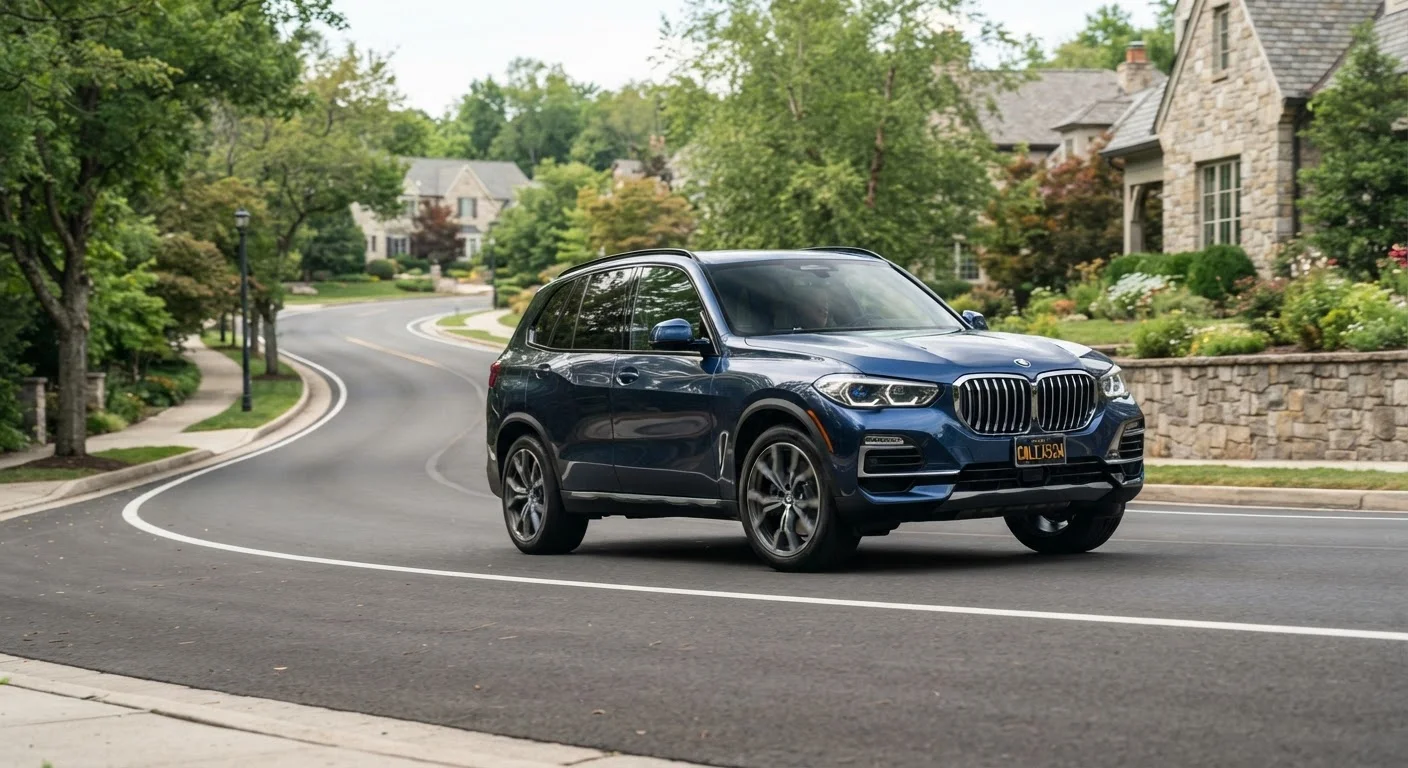
The centre of gravity (CoG) is the point around which a vehicle's mass is balanced. In a sedan, this point sits relatively low - typically close to the passenger compartment floor. In an SUV, particularly a traditional body-on-frame model, the CoG is higher. This matters because when a vehicle corners, its weight shifts toward the outside wheels. The higher the CoG, the more pronounced this lateral weight transfer, and the greater the lean - known as body roll.
Excessive body roll does not automatically mean a vehicle will tip over, but it does reduce tyre contact with the road and can make the vehicle feel unstable. In extreme cornering scenarios - especially at speed on a curve, or when overcorrecting a skid - a high CoG increases rollover risk relative to a low-profile sedan.
Do Not Rely on ESC to Compensate for Speed
Electronic Stability Control is a reactive system - it responds after the vehicle begins to lose control, not before. Entering a corner at excessive speed or making an abrupt steering correction can exceed what ESC is capable of correcting. The most effective safety measure remains choosing an appropriate speed before the corner, not after.
Modern SUVs address this through several engineering measures: wider wheelbases, stiffer anti-roll bars, and adaptive suspension systems. More importantly, Electronic Stability Control (ESC) - mandatory on all US passenger vehicles from model year 2012 - detects impending loss of control and selectively applies brakes to individual wheels to maintain vehicle direction. While ESC is a meaningful safety net, it is not a substitute for appropriate entry speeds into corners.
Braking, Turning, and Spatial Awareness
Mass is the dominant variable in braking performance. SUVs are heavier than most sedans, which means they require more force - and more distance - to come to a complete stop from the same speed. The precise stopping distance varies considerably by model, tyre specification, and road surface, but the principle is consistent: if you're used to a sedan's braking feel, you should increase your following distance when driving an SUV.
Turning radius is another adjustment point. Larger SUVs have wider turning circles than compact sedans, which becomes relevant in parking structures, tight U-turns, and narrow residential streets. New drivers often underestimate how much space an SUV requires to complete a manoeuvre cleanly.
Spatial awareness - understanding where the corners, sides, and rear of the vehicle are - takes time to develop. An SUV's longer hood, taller roofline, and wider body create blind spots that differ from what sedan drivers are accustomed to. Modern features such as rearview cameras and blind-spot monitoring assist significantly, but they supplement rather than replace active observation.
Use Your Technology as a Learning Tool
Rearview cameras, parking sensors, and blind-spot monitors are especially valuable during the adjustment period when spatial awareness for a new vehicle is still developing. Actively use them in the first weeks of driving your SUV rather than relying solely on the instincts you built in a smaller vehicle. Over time, you will build a natural sense of the vehicle's dimensions that reduces dependence on these aids.
Electronic Safety Systems That Help New Drivers
Contemporary SUVs come with a suite of electronic safety technologies that meaningfully reduce the handling gap for inexperienced drivers. Understanding what these systems do - and what they cannot do - is part of using them effectively.
- Electronic Stability Control (ESC): Monitors vehicle direction versus driver input and intervenes if a skid is detected. Federally required since model year 2012 in the US.
- Rollover Mitigation: An extension of ESC that specifically identifies conditions associated with rollover and applies targeted braking.
- Traction Control: Limits wheel spin on slippery surfaces by reducing engine power or applying brakes to spinning wheels.
- Automatic Emergency Braking (AEB): Uses sensors to detect an imminent collision and applies the brakes autonomously if the driver does not react in time.
- Blind-Spot Monitoring: Alerts the driver to vehicles in adjacent lanes that may not be visible in mirrors.
None of these systems override the laws of physics. Entering a corner too fast, for instance, can exceed what ESC can correct. The systems work within limits - and those limits are defined in part by the vehicle's speed, road conditions, and the decisions made before an emergency occurs.
Practical Tips for Adjusting Your Driving Style
Most of the adaptation involved in driving an SUV comes down to consciously recalibrating habits formed in a sedan. The core adjustments are not complicated, but they require deliberate practice rather than passive familiarity.
- Slow your corner entry speed. Approach turns more gradually than you would in a sedan. This is the single most effective way to manage body roll and maintain tyre contact.
- Increase following distance. Give yourself more stopping space - a conservative rule of thumb is to add at least one additional car length per 10 mph compared to your sedan habit.
- Use mirrors and cameras actively. Learn the camera and sensor systems your specific SUV provides before driving in high-density environments.
- Practice parking in open areas. Spend time in an empty lot understanding the vehicle's turning radius and rear visibility before parking in tight urban spaces.
- Avoid abrupt steering corrections. Sharp overcorrection at speed is a common trigger for loss of control in taller vehicles. Smooth, deliberate inputs are always preferable.
If you are also evaluating which drivetrain makes sense for your typical conditions, our AWD vs 4WD guide explains how each system affects real-world handling and traction. And for a full picture of what SUV ownership involves beyond handling, the Complete Guide to SUVs covers every major dimension of the decision.