
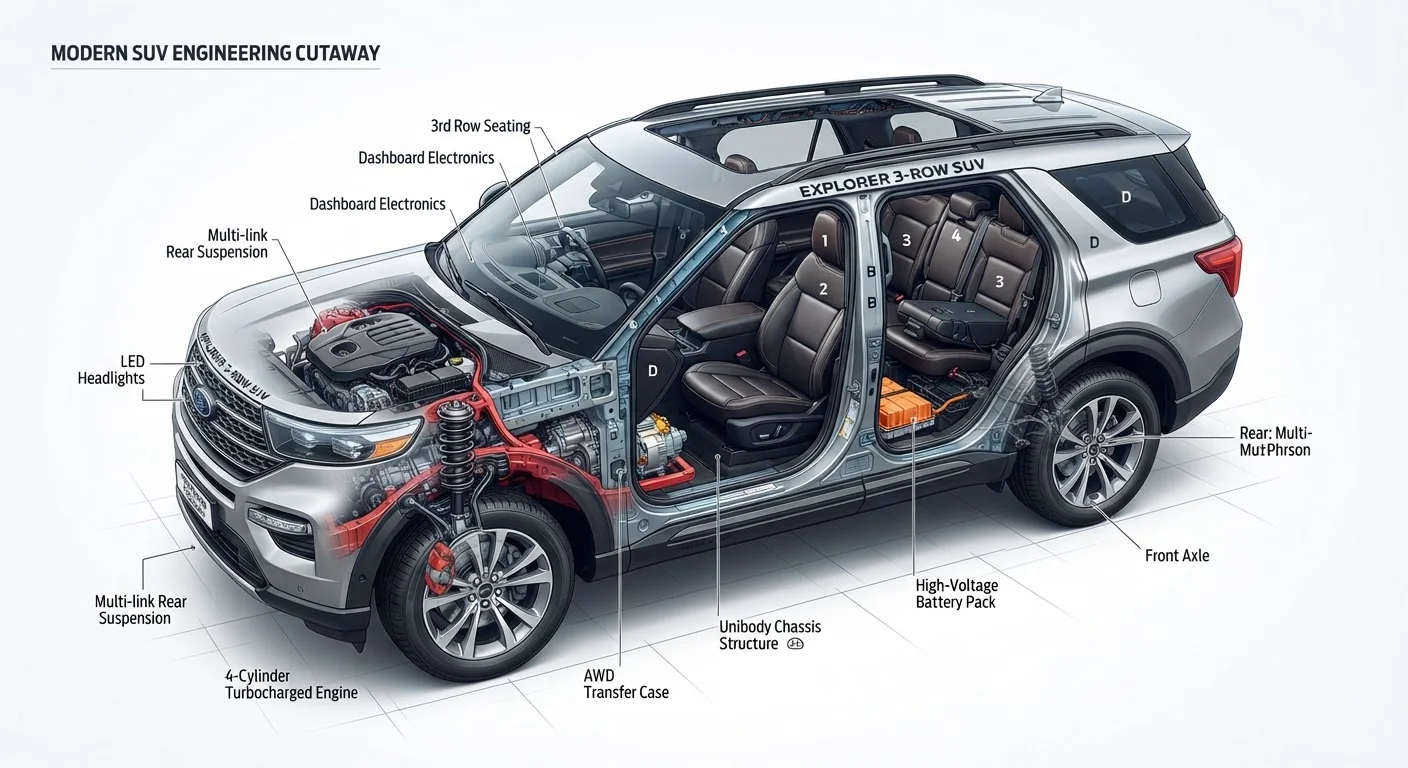
Unibody vs. Body-on-Frame: The Foundation Matters
The single biggest structural decision in any SUV's design is whether it uses a unibody or body-on-frame platform. These two architectures produce vehicles that behave very differently on and off the road.
Unibody construction - where the body panels and structural frame are welded into a single assembly - is the dominant approach for modern crossovers and car-based SUVs. It reduces overall weight, lowers the vehicle's center of gravity, and contributes to the car-like handling that many drivers expect. Crumple zones engineered into unibody structures also improve passive safety performance.
Body-on-frame construction separates the passenger cabin body from a rigid ladder frame underneath. This design handles higher stress loads from towing and off-road abuse without flexing, which is why heavy-duty full-size SUVs continue to use it. The trade-off is added weight, greater ride height, and a rougher ride on paved roads compared to unibody alternatives.
Understanding the structural differences between SUVs and crossovers helps clarify why two vehicles marketed similarly can feel completely different to drive.
Platform Sharing Is Common Across the Industry
Many SUVs share platforms with sedans, minivans, or pickup trucks from the same manufacturer. This is not inherently a quality concern - shared platforms benefit from broader development investment and wider parts availability. Understanding which vehicles share a platform can also help buyers find reliability trends across a larger real-world sample of owners.
AWD, 4WD, and What the Drivetrain Actually Does
Drivetrain configuration is one of the most commonly misunderstood specs on any SUV window sticker. All-wheel drive (AWD) and four-wheel drive (4WD) both send power to all four wheels, but their engineering and intended use cases are distinct.
AWD systems operate automatically, using sensors and differentials to distribute torque between the front and rear axles in real time. They require no driver input and are optimized for on-road traction - wet pavement, light snow, or loose gravel. Most crossovers use this configuration because it complements their unibody architecture and everyday driving profile.
4WD systems - especially part-time variants - require the driver to manually engage them, typically through a lever, dial, or button. When engaged, the front and rear driveshafts are locked together, providing maximum traction for serious off-road conditions. Using part-time 4WD on dry pavement can cause drivetrain binding and accelerated wear. Full-time 4WD systems include a center differential to allow road use without this limitation.
1-3 mpg
Typical AWD fuel economy penalty vs. FWD
Industry testing consistently shows AWD configurations reduce fuel efficiency relative to front-wheel drive equivalents, with the gap varying by vehicle weight and AWD system design.
~70%
Share of U.S. SUV/crossover sales using unibody construction
The crossover segment's dominance in U.S. new-vehicle sales reflects the market's shift toward unibody platforms that prioritize ride quality and fuel efficiency over body-on-frame durability.
Fuel economy is one practical consideration when choosing between FWD, AWD, and 4WD - AWD typically adds mechanical drag and weight, reducing mpg by a measurable margin depending on the vehicle.
Body Styles, Row Configurations, and Packaging Trade-Offs
Modern SUVs span a wide range of body styles, from compact two-row crossovers to extended three-row haulers. Each configuration involves deliberate engineering compromises that determine what the vehicle does well - and where it falls short.
Compact crossovers prioritize a lower roofline, lighter weight, and a tighter footprint for urban use. Mid-size SUVs balance passenger space with manageable exterior dimensions. Full-size SUVs maximize interior volume, towing capacity, and powertrain options - often at the cost of parking ease and fuel efficiency.
Three-row layouts introduce a third seating row folded into the vehicle's rear section, which compresses cargo space behind it. Automakers engineer this trade-off differently: some use a power-folding mechanism, others rely on manual fold-flat seats. Evaluating three-row SUVs carefully means examining third-row legroom, access ease, and how much usable cargo space remains when all rows are occupied.
Match Platform Type to Your Actual Use Case
Before focusing on trim levels or interior features, identify whether your primary use involves daily commuting, hauling heavy loads, or off-road access. A unibody crossover with AWD covers most everyday scenarios efficiently. Body-on-frame construction with 4WD is worth the trade-offs only if you genuinely need serious towing capacity or frequent off-road use - not just occasional unpaved roads.
For buyers interested in SUV architecture as part of a broader vehicle education, the complete SUV guide covers platform choices, safety ratings, and segment comparisons in depth.
How Platform Engineering Shapes the Driving Experience
Platform architecture is not just an engineering abstraction - it directly shapes what a driver feels every time they get behind the wheel. Suspension geometry, wheelbase length, track width, and weight distribution all flow from platform decisions made early in the development process.
A longer wheelbase generally improves straight-line stability and passenger comfort over bumps by reducing the angular pitch between axles. However, it also increases the turning radius, which matters in tight urban environments or when towing in reverse. Track width - the distance between left and right wheels - affects lateral stability; a wider track lowers the perceived risk of body roll during cornering.
New drivers transitioning to SUVs should understand that a higher center of gravity - inherent in taller vehicles - changes how the vehicle responds to sudden steering inputs compared to a low-slung sedan.
Shared platforms across model families also mean that suspension tuning, steering feel, and powertrain calibration can be similar between vehicles that look quite different on the surface. Recognizing platform families helps buyers use reliability data from one model to inform expectations for a related one.