How Each System Actually Works
The terms AWD and 4WD are often used interchangeably in dealership brochures, but they describe fundamentally different engineering approaches. Understanding the mechanical distinction is the first step toward choosing the right system.
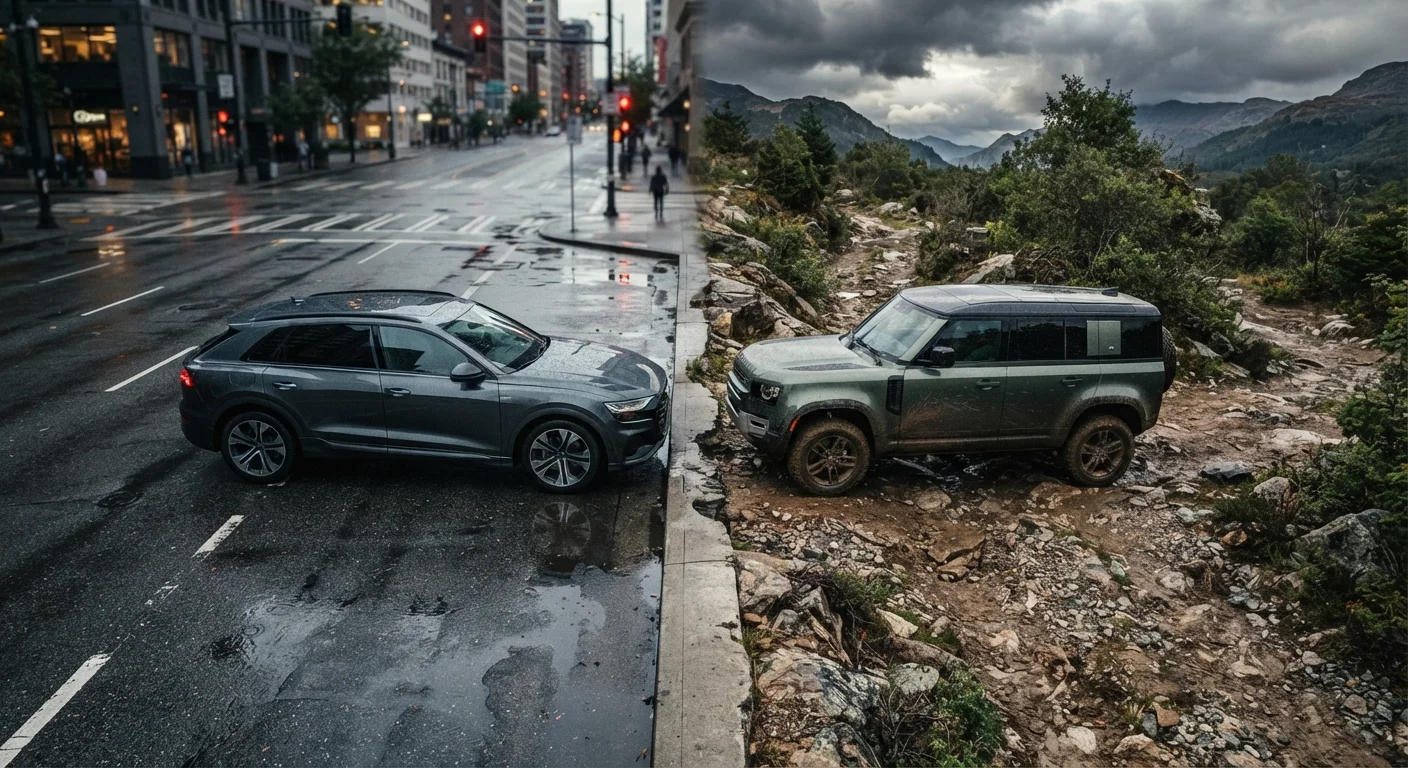
All-wheel drive (AWD) continuously monitors wheel slip and automatically distributes torque between the front and rear axles - and in more sophisticated setups, between individual wheels. Most AWD systems on crossovers use a centre differential or electronically controlled clutch pack. The driver does nothing; the system reacts in milliseconds. Some AWD setups are part-time, disengaging the rear axle during steady highway driving to save fuel, then re-engaging when sensors detect slip.
Four-wheel drive (4WD), by contrast, is traditionally a driver-engaged system found on body-on-frame SUVs. It uses a transfer case - often with a high-range (4H) and a low-range (4L) setting. 4L multiplies torque dramatically, making it indispensable for rock crawling, deep sand, or extracting a vehicle from serious mud. Driving in 4H or 4L on dry pavement can damage drivetrain components because the front and rear axles are locked together without differentiation.
For a deeper look at how these architectures fit into the broader SUV landscape, see the full breakdown of SUV platforms and drivetrains.
| Criterion | AWD | 4WD |
|---|---|---|
| Driver engagement | Fully automatic | Manual engagement required |
| Low-range torque multiplication | Not available | Available (4L setting) |
| On-road usability | Excellent - always active | Good in 4H; 4L only off-road |
| Off-road capability | Moderate - handles light terrain | High - suited for technical terrain |
| Typical platform | Unibody crossovers | Body-on-frame SUVs |
| Fuel economy impact | Minor; rear axle can decouple | Greater; heavier drivetrain |
| Maintenance complexity | Lower; fewer components | Higher; transfer case service needed |
Real-World Performance: Where Each System Shines
Knowing the hardware is useful, but the more practical question is: where does each system actually outperform the other?
AWD in daily use: For most American drivers - dealing with wet interstates, packed snow, and the occasional gravel parking lot - AWD is genuinely sufficient and impressively transparent. It never requires the driver to think about it. Families in the Pacific Northwest, Upper Midwest, or Mountain West who face regular winter precipitation will find AWD crossovers like unibody three-row SUVs handle those conditions competently. AWD also tends to weigh less and carry fewer mechanical components than 4WD, which contributes to better everyday fuel economy.
4WD off the pavement: When terrain becomes genuinely technical - steep descents, axle-deep ruts, loose rock - 4WD with low range is the appropriate tool. The torque multiplication provided by 4L can mean the difference between crawling through an obstacle confidently and getting stuck. Purpose-built 4WD SUVs also typically offer features like locking differentials and skid plates that complement the transfer case.
~3-5%
Fuel economy penalty for AWD vs. FWD
The EPA and independent testing generally show AWD crossovers consume roughly 3-5% more fuel than equivalent front-wheel-drive models, depending on system design.
4L
Transfer case setting enabling low-range torque
Low-range 4WD typically multiplies torque by a ratio of 2:1 to 4:1, allowing controlled crawling over obstacles that would stall a vehicle in high range.
~70%
New SUV/crossover sales with AWD in the US
Industry sales data consistently shows the majority of new SUVs and crossovers sold in the US are equipped with AWD rather than 4WD, reflecting a shift toward car-based platforms.
It's also worth noting that neither system improves stopping distance. Traction control aids acceleration and cornering grip, but braking physics are governed by tires and weight, not drivetrain layout. This distinction matters especially in winter conditions where drivers sometimes overestimate AWD or 4WD capability. For a comparison of how these principles apply in performance contexts, see how AWD and RWD differ in performance cars.
Truck buyers face a similar choice - 4WD vs AWD in trucks carries its own set of trade-offs worth reading before cross-shopping a truck-based SUV.
Winter Tires Matter More Than Drivetrain
A common misconception is that AWD or 4WD can substitute for winter tires in cold climates. In reality, a front-wheel-drive vehicle equipped with dedicated winter tires will outperform an AWD vehicle on all-season tires in most snowy or icy conditions. Drivetrain improves traction during acceleration; tires govern grip during braking and cornering. If winter driving is your primary concern, prioritize tire choice alongside drivetrain selection.
Matching the Drivetrain to Your Lifestyle
The right choice depends less on which system sounds more capable and more on an honest assessment of how you actually use your vehicle week to week.
If your off-road miles consist of occasionally pulling into an unpaved campsite or navigating a snowy driveway, AWD will handle those moments without drama. If you actively seek out trails rated for four-wheel-drive vehicles, tow a boat down a sloped gravel ramp weekly, or live somewhere that sees serious seasonal flooding or deep snow, a 4WD-equipped SUV gives you headroom AWD simply cannot match.
Consider your vehicle platform too. Most crossover-based SUVs - the overwhelming majority of the market - are offered exclusively with AWD, not 4WD, because their unibody construction and independent rear suspension aren't designed around a solid rear axle and transfer case. Body-on-frame SUVs remain the primary home of traditional 4WD.
New SUV drivers especially should calibrate expectations carefully - higher centers of gravity affect handling regardless of drivetrain. Understanding SUV handling dynamics before relying on traction systems is a valuable starting point. For a comprehensive view of how to factor drivetrain into a full purchase decision, the complete SUV guide covers body styles, tech, and lifestyle fit in useful depth.