What Concours Judging Actually Evaluates
A concours d'élégance is not a beauty contest decided by the loudest crowd. It is a structured, points-based evaluation in which trained judges assess a vehicle against documented factory standards - and the margin between a class winner and an also-ran can hinge on a single incorrect fastener. Understanding the criteria before you begin preparation is essential.
Most major concours organizations divide scoring into distinct categories: originality, correctness, condition, and presentation. Each carries weighted points, and the relative weight varies by event. Some prestigious events, for instance, award the majority of points purely to factory correctness, making a well-executed restoration with even one non-period component significantly less competitive than a preserved original. See how the philosophy of preservation versus full restoration shapes these decisions in our article on originality vs. restoration.
| Primary Judging Domains | Originality, Correctness, Condition, Presentation |
| Documentation Types Valued | Build sheets, factory invoices, titles, service records, marque-specific decoder reports |
| Key Authenticity Marker | Date-coded components within the vehicle's production window |
| Judging Team Structure | Specialists assigned by vehicle system (body, engine, interior, chassis) |
| Common Point Deduction Triggers | Incorrect fasteners, non-period finishes, replacement components lacking date codes |
| Scoring Methodology | Points-based, with category weights varying by event organization |
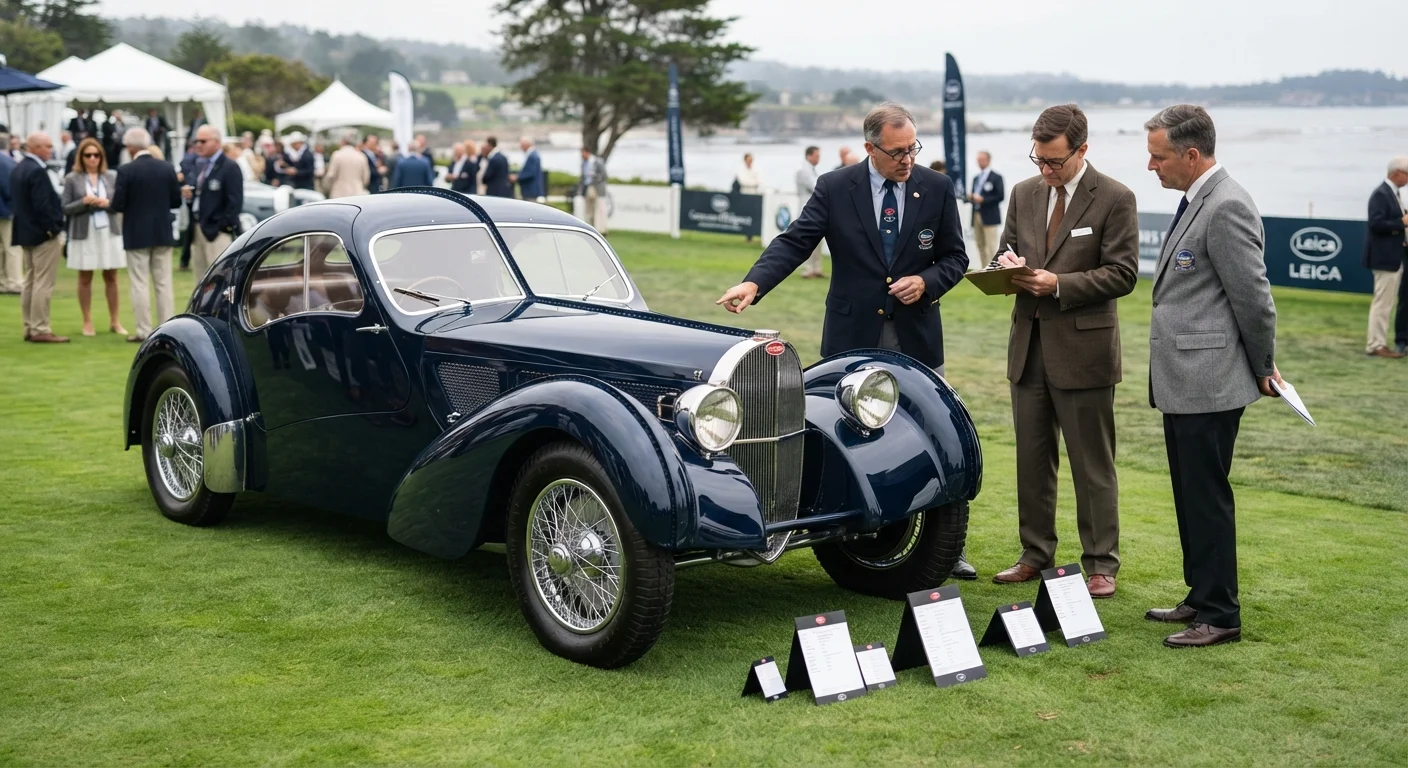
Judges typically work in teams assigned to specific vehicle systems - body, engine, interior, chassis - and score independently before scores are tallied. This specialization means a judge evaluating your engine bay may have decades of marque-specific knowledge and will recognize a replacement bolt head style from ten feet away.
The Core Judging Criteria Explained
Preparation begins with knowing precisely what judges are measuring. The four primary domains break down as follows.
Matching Numbers
A vehicle in which major stamped or cast identification numbers - typically engine, transmission, and body - correspond to the original factory-assigned figures for that specific car. Matching-numbers status is a significant factor in both concours scoring and market valuation.
Date Code
A manufacturer's stamping or casting mark on a component that indicates when it was produced. Judges use date codes to confirm that parts were manufactured within the acceptable window preceding the vehicle's assembly date.
Provenance
The documented ownership and history of a vehicle, supported by original paperwork such as build sheets, titles, and service records. Strong provenance substantiates authenticity claims and can meaningfully affect judging outcomes.
Concours d'Élégance
A formal competitive event in which vehicles are judged against established standards of originality, correctness, and condition. The term is French for 'competition of elegance' and traces its origins to 17th-century France.
Broadcast Sheet
A factory production document, sometimes found hidden within door panels or under carpeting, that lists every option and specification ordered for a specific vehicle. Broadcast sheets are among the most valuable provenance documents a concours entrant can possess.
Correct Finish
A surface finish - paint, plating, or coating - that matches the factory specification for texture, sheen, application method, and color for that vehicle's production year and plant. Period-correct finish quality is evaluated separately from mere color accuracy.
Provenance and Documentation
Judges at top-tier events increasingly weight provenance - the documented history of a vehicle - as heavily as its physical condition. A matching-numbers drivetrain supported by the factory build sheet, dealer invoice, and continuous ownership records can score significantly higher than a mechanically identical car lacking paperwork. Gather every document you can before entering: window stickers, Marti Reports (for Ford products), PHS documentation (for GM), broadcast sheets, and service records all substantiate a vehicle's identity.
Correctness and Authenticity
Correctness refers to the degree to which every component matches what the factory installed on that specific vehicle for that model year, production date, and option combination. Judges use marque-specific reference materials, factory assembly manuals, and internal databases to verify part numbers, casting dates, date codes on ancillary components, and finish specifications. An engine block casting date that postdates the vehicle's production window, for example, is a deduction - regardless of how cleanly the engine presents. The pre-purchase inspection framework used by informed buyers covers many of the same mechanical checkpoints judges use.
Condition and Finish Quality
Beyond correctness, judges assess the quality of all finishes - paint, chrome, brightwork, rubber seals, interior materials, and undercarriage coatings. At senior levels, finishes are expected to replicate factory application methods and textures, not merely approximate the color. Overspray patterns, undercoating textures, and weld seam treatments are scrutinized. A show car with a flawless modern-finish paint job over a factory-spec color may still lose points if the surface lacks the period-correct orange-peel texture or finish depth expected from that era's manufacturing process.
Presentation
Presentation covers cleanliness, accessibility, and demeanor during judging. Judges expect all compartments - trunk, engine bay, door jambs - to be accessible and clean. Vehicles that arrive with protective covers that cannot be quickly removed, or with owners who hover and interrupt the judging process, may face deductions at some events. Review the specific rulebook for each event you enter, as presentation standards vary meaningfully between organizations. For a broader view of how concours events differ from less formal gatherings, see concours d'élégance vs. car show.