Origins: A Culture Born from Resistance and Pride
The lowrider tradition did not emerge from a manufacturer's design studio or a performance racing circuit. It grew from the streets of East Los Angeles and the barrios of the American Southwest in the years following World War II, shaped by Mexican-American communities asserting their presence and creativity in a society that too often marginalized them.
Chicano veterans returning from military service brought with them mechanical skills and a desire to express cultural pride through the vehicles they drove. Rather than pursuing the speed-oriented modifications favored by the emerging hot rod scene - as explored in our look at how drag racing built its own community - lowrider builders moved in a deliberate opposite direction. The philosophy was elegance over aggression: low, slow, and in full control.
The phrase "lowriders ride low and slow" became a guiding principle, distinguishing the culture from speed-obsessed automotive subcultures and centering the experience on visibility, craftsmanship, and social connection. Cruising - the act of driving slowly through a neighborhood - became its own ritual, a public display of artistry and community pride.
The 'Go Low, Go Slow' Philosophy
The deliberate rejection of speed as a primary value was both an aesthetic and a political statement. In the postwar era, customizing for slowness rather than performance distinguished the lowrider scene from the predominantly white hot rod culture and asserted a different set of values: elegance, patience, and visibility. That philosophy remains central to the tradition today.
The Vehicle as Canvas: Craft and Artistic Tradition
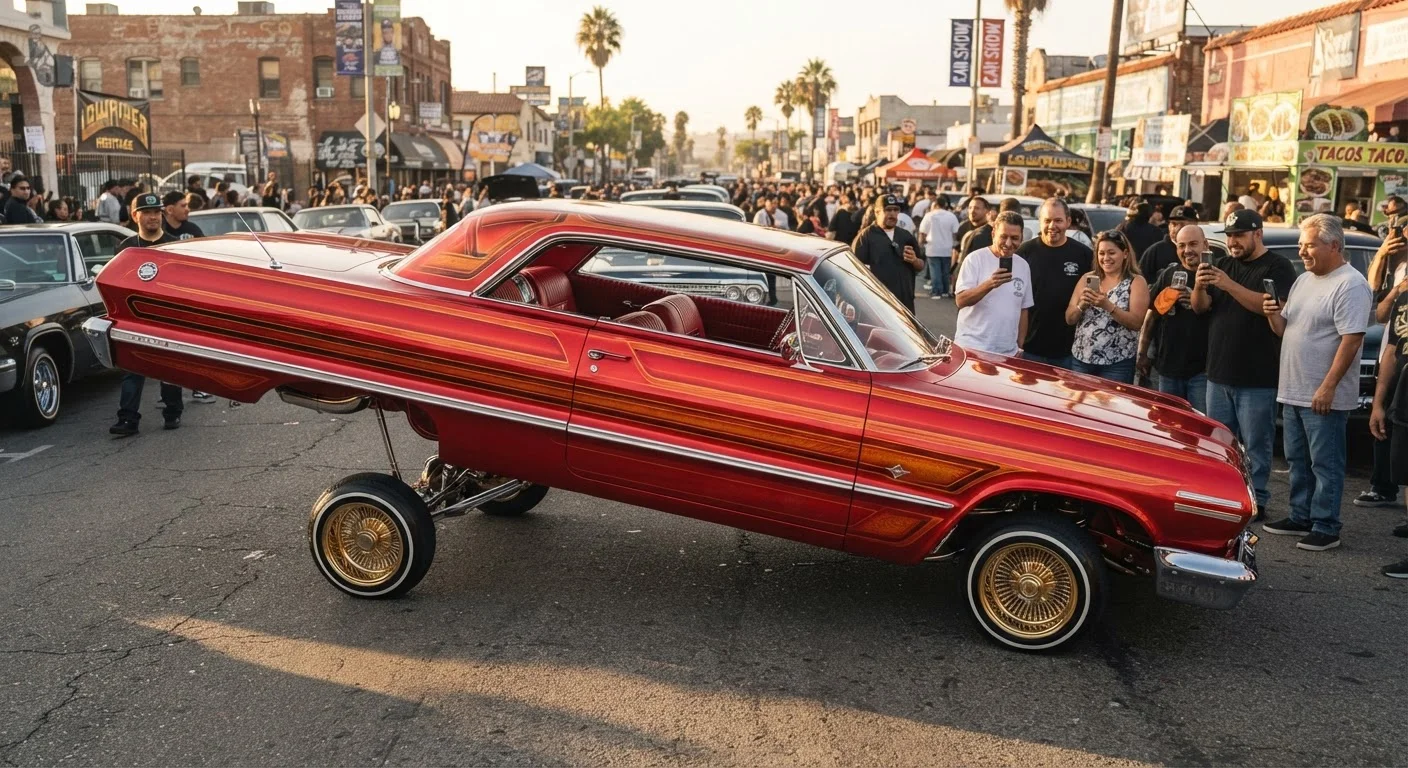
What separates a lowrider from a merely modified car is the depth and intentionality of its customization. Every surface is treated as an opportunity for artistic expression. Paint jobs often involve dozens of layers, metalflake finishes, candy-coat applications, and hand-applied pinstriping - techniques requiring hundreds of hours of skilled labor.
Airbrushed murals are a defining feature of the most celebrated builds. These panels frequently depict Chicano cultural iconography: Aztec imagery, Virgen de Guadalupe figures, family portraits, and neighborhood landscapes. Interiors receive equal attention, with hand-stitched velvet or leather upholstery, intricate pleating patterns, and custom steering wheels. Chrome plating is applied to mechanical components that most drivers never see, simply because the builder knows they are there.
1940s-50s
Decade lowrider culture formally emerged
Historians and cultural scholars broadly place the origins of organized lowrider customization in post-World War II Chicano communities of the American Southwest.
200+
Coats of paint on elite competition builds
Top-tier show lowriders can involve more than 200 individual layers of paint, primer, and clear coat, applied over hundreds of hours of skilled labor.
3 ft+
Hydraulic hop height in competition
Championship-level hydraulic hopping competitions have recorded front-end lifts exceeding three feet off the ground, showcasing the engineering extremes of the hobby.
The hydraulic system - the mechanical heart of a true lowrider - is itself an engineering discipline. Early builders adapted aircraft surplus hydraulic pumps in the 1950s and 1960s. Modern setups can include multiple pumps, batteries, and solenoid switches capable of lifting the vehicle's corners independently, enabling the "hopping" competitions that have become a spectator sport at lowrider shows.
This convergence of mechanical expertise and fine-art technique is precisely why institutions like the Smithsonian National Museum of American History have collected lowrider vehicles as significant cultural artifacts. The tradition is increasingly recognized not as a fringe hobby but as a legitimate and uniquely American art form.
Car Clubs and the Architecture of Community
No element of lowrider culture is more foundational than the car club. Since the 1950s, clubs have served as the primary social institution of the scene - part fraternal organization, part mentorship network, part arts collective. Membership carries real obligations: maintaining a build to club standards, participating in events, and upholding the reputation of the group.
Clubs organize the shows and cruises that structure the lowrider calendar. These gatherings function simultaneously as competitions, reunions, and public exhibitions. At major events, judges evaluate vehicles across dozens of categories - paint, interior, engine bay, undercarriage, hydraulics - with the rigor of a fine-arts jury. The social architecture of lowrider culture has much in common with other vehicle communities built around belonging and shared values, as reflected in the muscle car culture's own community formation of the same era.
Interested in Lowrider Culture? Start with Shows
Regional lowrider shows and cruises - many open to the public at no cost - are the best way to experience the culture authentically. Attending events allows you to speak directly with builders, understand the range of build styles, and witness the community dynamics firsthand. Major shows in California, Texas, and New Mexico draw participants from across the country and internationally.
Multigenerational participation is a hallmark of established clubs. It is common to find grandparents, parents, and children all active in the same organization, with builds passed down as family heirlooms. This continuity of knowledge and tradition is what gives lowrider culture its remarkable durability across decades of social change.
Global Reach and Enduring Legacy
Lowrider culture has traveled far beyond its Southern California origins. Japan developed one of the most dedicated international lowrider communities beginning in the 1980s, with Japanese enthusiasts importing American vehicles, studying Chicano customization techniques, and forming their own clubs - a phenomenon distinct from but related to the country's shakotan lowering tradition. Scenes have taken root in Europe, Australia, and throughout Latin America.
Within the United States, the tradition has expanded to include younger generations of builders from diverse backgrounds who connect with the culture's core values: patience, precision, self-expression, and community. Women have played significant - if historically underdocumented - roles in the scene as builders, painters, and club leaders, part of a broader story explored in women's contributions to car culture.
As interest in cultural preservation grows, lowrider art and vehicles are increasingly featured in museum exhibitions, academic curricula, and documentary film. The tradition endures because it answers something fundamental: the human desire to transform a mass-produced object into something irreplaceable, and to belong to a community that recognizes that work.