
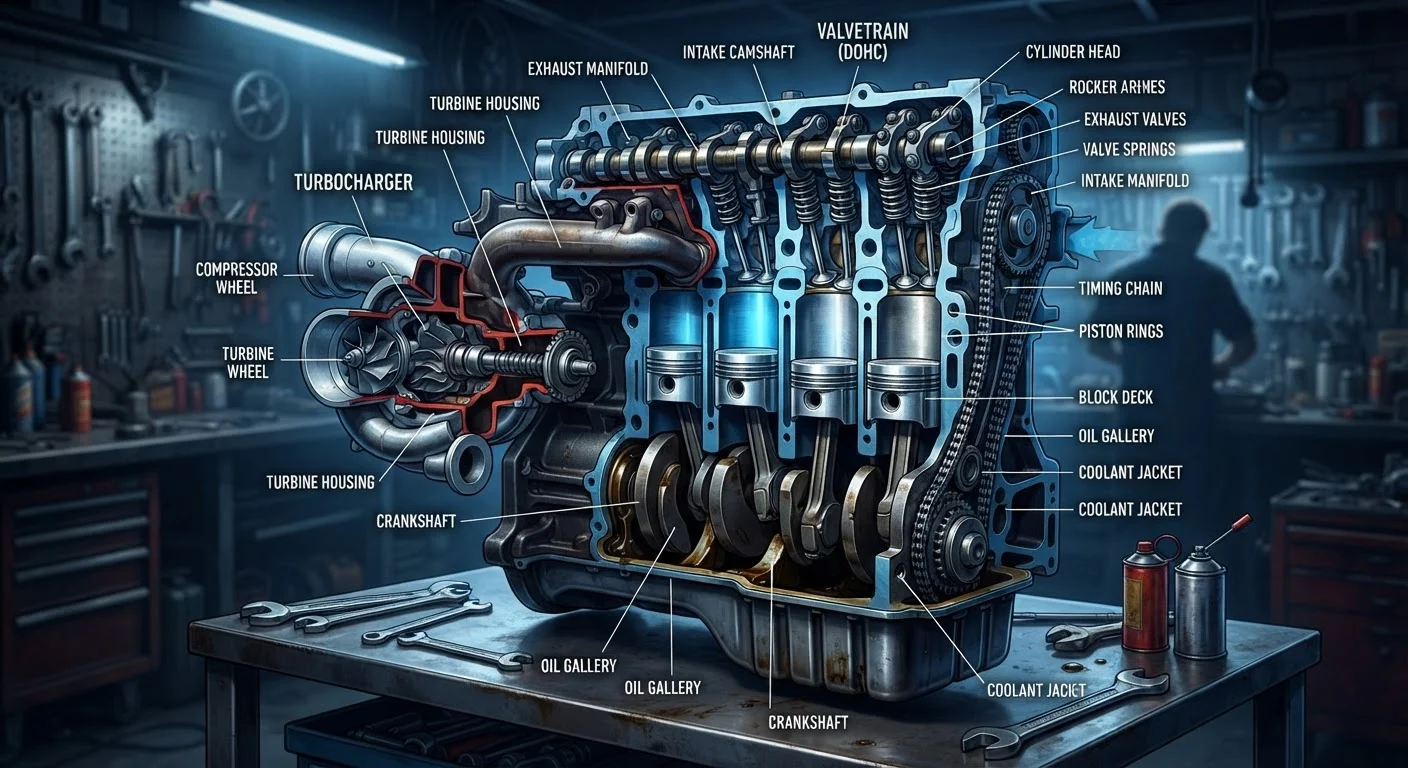
Compression Ratio: The Foundation of Power
At the heart of any performance engine lies its compression ratio - the relationship between the cylinder's total volume and its compressed volume when the piston reaches the top of its stroke. A standard passenger-car engine typically operates between 9:1 and 10.5:1. Performance engines often push 11:1 to 13:1 or higher in naturally aspirated applications.
Higher compression means the air-fuel mixture is packed more tightly before the spark plug fires. This translates directly into a more forceful combustion event, yielding greater force on the piston and, ultimately, more torque and power at the crankshaft. The tradeoff is a requirement for higher-octane fuel to prevent knock - uncontrolled pre-detonation that can destroy pistons and bearings over time.
For context on how forced induction interacts with compression, see our complete guide to turbocharging and supercharging - turbocharged engines typically run lower static compression ratios because the boost pressure effectively raises the dynamic compression in the cylinder.
Forced Induction: Amplifying the Air-Fuel Charge
Forced induction - whether via turbocharger or supercharger - is the single most impactful modification an engine can receive for raw power gain. Both systems compress intake air before it enters the combustion chamber, allowing significantly more oxygen (and therefore fuel) to be packed into each cylinder per cycle.
2x+
Power increase possible with forced induction
Engineering analyses show well-executed turbocharger installations can more than double a naturally aspirated engine's peak output from the same displacement.
11:1-13:1
Typical compression ratio in NA performance engines
Naturally aspirated performance engines commonly operate in this range, compared to 9:1-10.5:1 in standard passenger vehicles.
100+ BHP/L
Specific output benchmark for performance engines
Many modern turbocharged performance engines exceed 100 brake horsepower per liter of displacement, a figure once reserved for motorsport.
A turbocharger harvests energy from exhaust gases to spin a turbine that compresses incoming air. A supercharger is driven directly by the crankshaft, offering immediate response but consuming engine power to operate. Each approach has distinct power delivery characteristics - a distinction explored in depth in our comparison of turbocharger vs. supercharger power delivery.
The philosophical divide between forced induction and naturally aspirated tuning is real and significant. Those tradeoffs are examined thoroughly in the article Naturally Aspirated vs. Turbocharged.
Valve Timing and Airflow Efficiency
An engine breathes. Its power ceiling is ultimately determined by how efficiently it can draw in the air-fuel charge and expel exhaust gases. The valvetrain - comprising camshafts, valves, lifters, and associated hardware - controls this breathing cycle with precision.
Valve lift (how far a valve opens) and valve duration (how long it stays open) are both tuned aggressively in performance applications. A more aggressive camshaft profile keeps valves open longer, allowing more charge to enter at high RPM - but this often sacrifices low-RPM tractability.
Getting the Most from Variable Valve Timing
If your performance vehicle uses a VVT system, keeping the engine oil clean and at the correct viscosity is critical - VVT actuators are oil-pressure-driven and highly sensitive to sludge or pressure loss. Follow the manufacturer's oil change intervals strictly, and use only the specified oil grade. Neglecting this can cause sluggish VVT response and reduced performance across the RPM range.
Modern performance engines resolve this tension with Variable Valve Timing (VVT) systems - such as Honda's VTEC, BMW's VANOS, or Toyota's VVT-i - which electronically adjust camshaft phasing to optimize both low-end torque and high-RPM power. This is one reason contemporary performance engines can be both civil in traffic and explosive on track.
Airflow doesn't stop at the valves. Performance intake manifolds, larger throttle bodies, and tuned exhaust headers are engineered to reduce restriction throughout the entire air path - a concept that ties directly into how aerodynamic design shapes a car's overall capability, explored in our article on aerodynamics in high-performance vehicles.
Engine Management and the Role of the ECU
A modern high-performance engine is inseparable from its Engine Control Unit (ECU) - the digital brain that governs ignition timing, fuel injection duration, boost pressure targets, and variable valve timing maps in real time. Factory performance ECUs are calibrated with specific fueling and timing tables that reflect the engine's hardware capabilities.
Performance tuning often involves remapping these tables - a process known as an ECU tune or flash - to extract additional output from upgraded hardware. This area carries meaningful risk: improperly calibrated maps can cause detonation, excessive exhaust temperatures, or accelerated wear. Any ECU modification should be undertaken only by qualified calibrators using appropriate data logging equipment.
Understanding the engine as a complete system - from the moment the ignition fires to the power delivered at the wheels - is essential context for anyone exploring what truly defines a performance vehicle. The engine is the core, but it is one element in a broader performance equation that includes chassis, brakes, and aerodynamics.