How Each System Makes Power
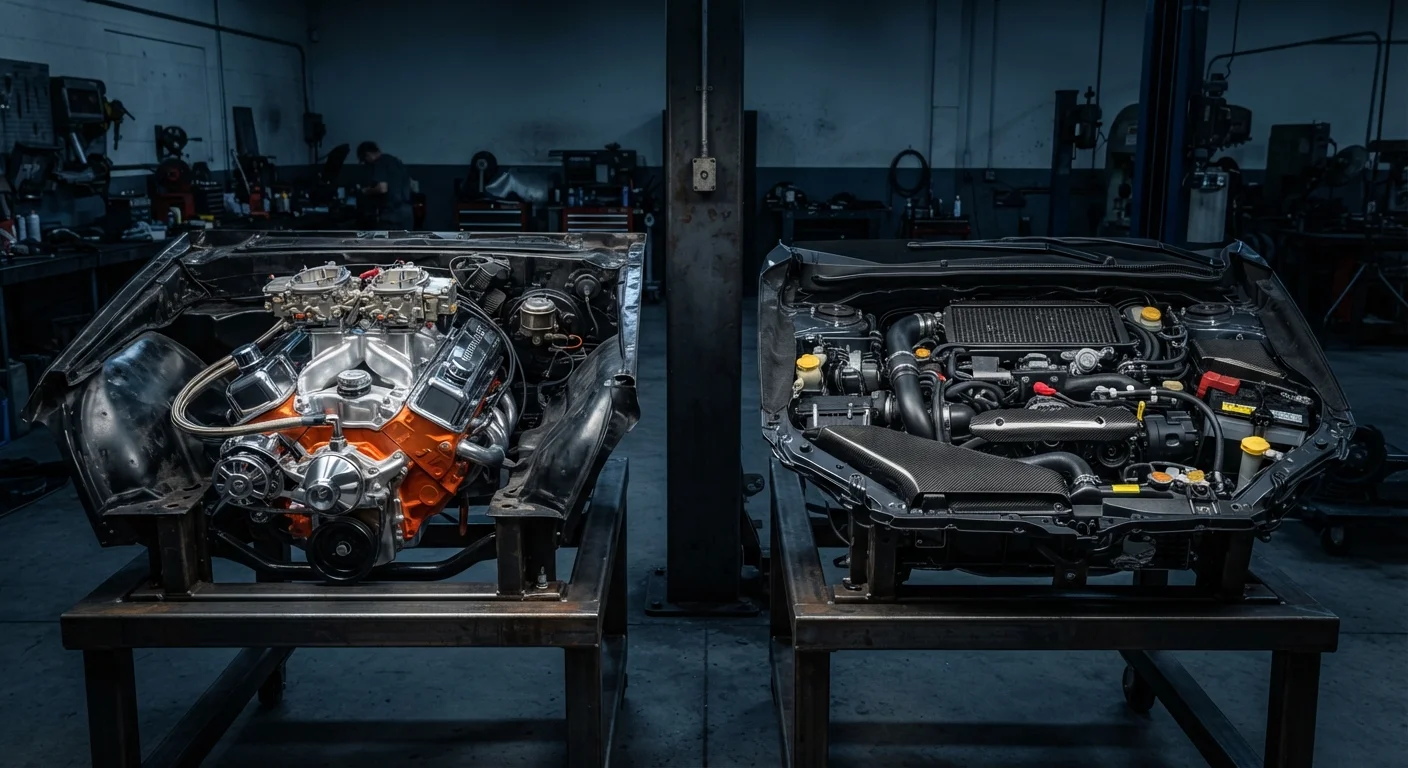
At the core of this debate is a fundamental question: how does an engine fill its cylinders with the air-fuel mixture it needs to combust? A naturally aspirated engine relies entirely on atmospheric pressure. As the piston descends on the intake stroke, it creates a low-pressure zone that draws air in through the intake tract - no assistance, no compression beforehand. The power ceiling is therefore set by displacement, compression ratio, valve timing, and how efficiently the engine breathes at high RPM. To learn more about how these elements interact, see The Anatomy of a High-Performance Engine.
A turbocharged engine bypasses that atmospheric ceiling by compressing intake air before it enters the cylinder. Exhaust gases spin a turbine, which drives a compressor wheel that forces more air - and therefore more fuel - into each combustion event. The result is dramatically more power from the same displacement. For a thorough look at the mechanics involved, How a Turbocharger Forces More Power from a Smaller Engine covers boost, lag, and intercooling in detail.
| Criterion | Naturally Aspirated | Turbocharged |
|---|---|---|
| Throttle response | Immediate, linear | Delayed by spool time |
| Peak power per litre | Lower without major mods | Significantly higher |
| Torque character | Builds progressively with RPM | Strong mid-range surge |
| Tuning ceiling | Moderate; requires hardware | Higher; boost is adjustable |
| Mechanical complexity | Lower (fewer ancillary parts) | Higher (turbo, wastegate, intercooler) |
| Heat management demands | Standard cooling sufficient | Elevated - intercooling required |
| Fuel economy at cruise | Consistent, displacement-dependent | Can be efficient at light load |
| Driving character | Transparent, high-revving | Torque-forward, surge-oriented |
Power Delivery and Driving Character
The experiential difference between these two philosophies is arguably more important than peak numbers on a dyno sheet. Naturally aspirated engines build power in a smooth, linear progression tied directly to engine speed. Step onto the throttle and the response is immediate - there is no system lag, no spool time, just a direct relationship between right foot and output. High-revving NA engines in particular - think flat-plane-crank V8s or Honda's VTEC-equipped four-cylinders - reward aggressive driving with an acoustic and tactile feedback loop that enthusiasts describe as visceral and honest.
Turbocharged engines behave differently. At low RPM, boost pressure is minimal and the engine may feel comparatively soft. As the turbocharger spools, there is a surge of torque that can feel dramatic, even abrupt on older or simpler setups. Modern variable-geometry turbos and twin-scroll designs have significantly narrowed the lag window, but the power characteristic remains distinct from a naturally aspirated curve. That fat mid-range torque, however, is enormously useful in everyday driving and on long, high-speed stretches - which is why the GT and touring car world has long favored forced induction. Key Engineering Differences Between Sports Cars and Gran Turismo Vehicles explores how these priorities shape entirely different vehicle architectures.
~30-40%
Typical power density gain from turbocharging
Engineering analyses broadly indicate turbocharged engines commonly produce 30-40% more power per litre compared to equivalent naturally aspirated configurations under optimal boost conditions.
< 1 sec
Turbo spool time on modern twin-scroll units
Advances in twin-scroll and variable-geometry turbocharger design have reduced effective spool lag to under one second in many contemporary performance applications.
9,000+ RPM
Redline capability of high-spec NA engines
Purpose-built naturally aspirated racing and performance engines - including Formula 1-derived and sports car platform units - have historically achieved redlines well above 9,000 RPM, showcasing the ceiling of atmospheric induction.
Tuning Potential and Long-Term Ownership
For performance enthusiasts who plan to modify their vehicles, the platform's tuning architecture matters as much as its stock output. Turbocharged engines have a structural advantage here: boost pressure is a variable the calibrator can adjust. With supporting fueling, a capable ECU tune, and appropriate hardware, many turbocharged platforms can see meaningful power increases that would require far more invasive work on an NA engine - cam swaps, head porting, larger displacement. That said, inflating boost without proper supporting modifications is a path to engine damage, not performance gains. The Engine Tuning Myths That Keep Costing Enthusiasts Money article addresses exactly this kind of misconception.
Naturally aspirated tuning is more involved but produces highly linear, predictable results. Intake improvements - for which Cold Air Intake vs. Short Ram Intake is a useful reference - exhaust headers, cam timing, and compression ratio all contribute incrementally. NA builds tend to require more parts expenditure per horsepower gained, but they also tend to be more durable over time when the engine is not being pushed against a boost-limited ceiling. For those considering the full spectrum of forced induction options, the complete guide to turbocharging and supercharging provides essential context before committing to a build direction.
Turbo vs. Supercharger: A Related Choice
If forced induction is the direction you're pursuing, the choice between a turbocharger and a supercharger introduces its own set of trade-offs around lag, packaging, and parasitic loss. Turbocharger vs. Supercharger: Understanding the Power Delivery Difference examines these distinctions in focused detail. Understanding both the NA-vs-turbo and turbo-vs-supercharger decisions gives you the full map of the forced induction landscape before committing to a build.