What Neck Braces Actually Do
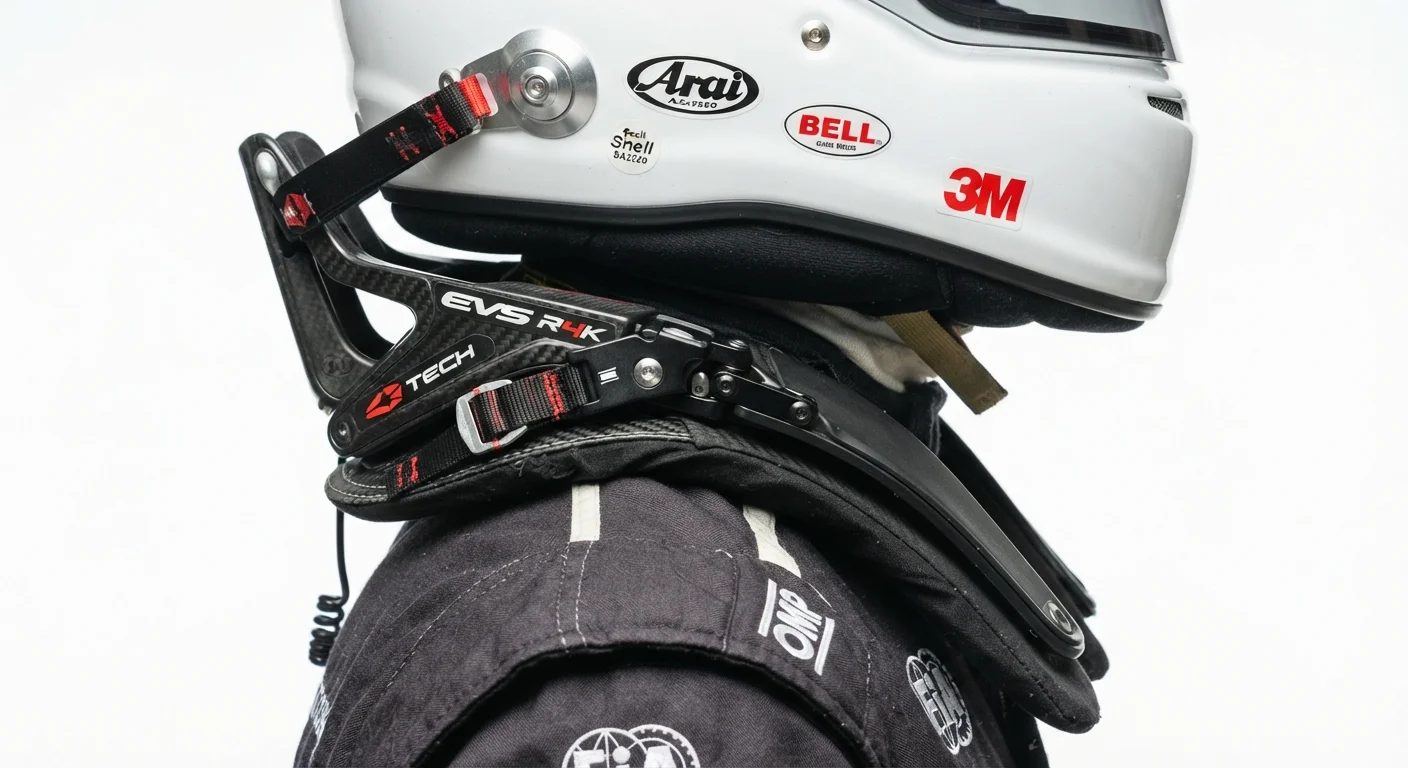
A motorsport neck brace - more precisely called a neck restraint device or collar-style neck brace - is designed to limit the range of motion of the head and neck during a crash. Unlike a HANS device (which tethers to the helmet via straps), a collar-style brace forms a rigid or semi-rigid perimeter around the base of the helmet, using the helmet's lower edge as a load-transfer surface.
In a severe impact, unconstrained head movement can generate compressive, tensile, or shear forces on the cervical spine that exceed what tissue can tolerate. Neck braces intervene by distributing those loads across the collarbone, sternum, and shoulders rather than concentrating them on the cervical vertebrae. The underlying principle - reducing the kinetic energy that the neck alone must absorb - is shared with the HANS device, though the mechanical approach differs.
See the broader context in our driver safety gear explainer for how this fits alongside helmets, harnesses, and seats.
Reduces compressive cervical spine forces in frontal impacts
By transferring load to the shoulders and chest, collar-style braces reduce the direct compressive force the cervical vertebrae absorb during frontal and near-frontal crashes - the impact axis where they perform best.
No helmet tether straps required
Unlike HANS-style devices, collar braces don't require strap attachments to the helmet, which simplifies helmet changes and reduces compatibility constraints with certain helmet models.
Effective across multiple motorsport disciplines
Collar braces are used in circuit racing, rally, off-road events, and karting, where seating positions and safety system configurations vary widely.
Well-established safety standards exist for evaluation
SFI 38.1 and FIA 8670-2016 provide standardized testing benchmarks, giving users a basis for comparing certified products on objective performance criteria.
Works within existing cockpit layouts without major modification
Unlike full neck restraint systems that may require seat or harness geometry changes, collar braces generally integrate into existing setups with fewer structural adjustments.
The Practical Limitations
No single piece of safety equipment eliminates injury risk, and neck braces carry genuine trade-offs worth understanding before purchasing.
Effectiveness depends heavily on correct fitment
An ill-fitting brace that doesn't sit flush with the helmet shell cannot transfer load properly, potentially negating its protective function entirely during an impact.
Restricts natural head movement during driving
The deliberate motion limitation that makes braces protective in crashes also reduces lateral and vertical head range during normal operation, which can affect situational awareness in some disciplines.
Must be matched to compatible helmet and harness system
Brace function is system-dependent - mismatched helmets, inadequate harnesses, or incorrect seat positioning each reduce the brace's ability to distribute crash loads as designed.
Limited protection in pure lateral or rollover impacts
Collar-style neck braces are optimized for frontal and near-frontal loading; their geometry provides less meaningful benefit in certain lateral or rotational crash modes.
Structural damage may not be visible after an impact
Composite brace materials can sustain internal damage that compromises future performance without showing obvious external cracks or deformation, requiring inspection after any significant crash.
Compatibility is the most frequently underestimated limitation. A collar-style brace must interface correctly with the lower shell of the helmet - if the helmet's profile prevents clean contact, load transfer is compromised. Similarly, brace effectiveness is closely coupled to seat design and harness configuration; a poorly restrained torso reduces the brace's ability to do its job. Our breakdown of racing harness components and ratings explains why harness geometry matters here.
Collar braces are also less effective in rollover scenarios than frontal or side impacts, and they offer no meaningful protection in some lateral loading situations. Finally, restricted head movement - intentional by design - can reduce peripheral awareness during normal driving, which is worth factoring into your discipline-specific risk calculus.
Certification Standards and Regulatory Context
Neck braces sold for motorsport use in the US are typically evaluated against SFI specification 38.1 or FIA standard 8670-2016, depending on the sanctioning body. These standards define test protocols for energy absorption and load-distribution performance under impact conditions.
Certification Is Series-Specific
SFI 38.1 and FIA 8670-2016 are not interchangeable in all contexts - some sanctioning bodies specify one standard exclusively. A brace certified to one standard may not satisfy another series' rulebook requirements even if it meets equivalent safety performance thresholds. Always confirm the applicable standard with your series' technical regulations before purchasing or competing.
It is critical to verify which standard your racing series requires. Some sanctioning bodies mandate specific certification levels; others accept either standard. Track day organizers often leave equipment choice to the participant, but this does not mean all neck restraint devices are equivalent. Consult your series rulebook and, where applicable, the organizer's safety requirements before purchasing.
For track day participants evaluating their full safety package, in-car safety equipment considerations covers complementary systems including roll structures and HANS devices.
Fitment, Helmet Compatibility, and Wear Discipline
A neck brace sized or positioned incorrectly provides a false sense of protection. Most collar-style braces are available in multiple torso sizes and front-height configurations to accommodate different body geometries. The brace should sit level on the shoulders and collarbone, with the helmet resting evenly on its upper surface - not tilted or bridging at a single contact point.
Helmet compatibility charts are published by most brace manufacturers and should be treated as a hard constraint, not a suggestion. Rounded helmet shells and those with significant flares at the base interact differently with brace geometry. Full-face helmets are generally more compatible with collar-style braces due to their extended lower shell.
2
Primary certification standards for neck braces
SFI 38.1 and FIA 8670-2016 are the principal standards against which motorsport collar neck braces are tested and certified in the US and internationally.
~70°
Typical lateral head motion reduction in brace use
Engineering specifications for certified collar braces commonly target significant reduction in extreme lateral head displacement; exact figures vary by product and test protocol.
Periodic inspection of the brace structure - particularly after any significant impact - is also important. Impact energy can compromise the internal structure of composite braces without visible external damage, reducing their effectiveness in a subsequent event.