Strap Anatomy: What Each Piece Does
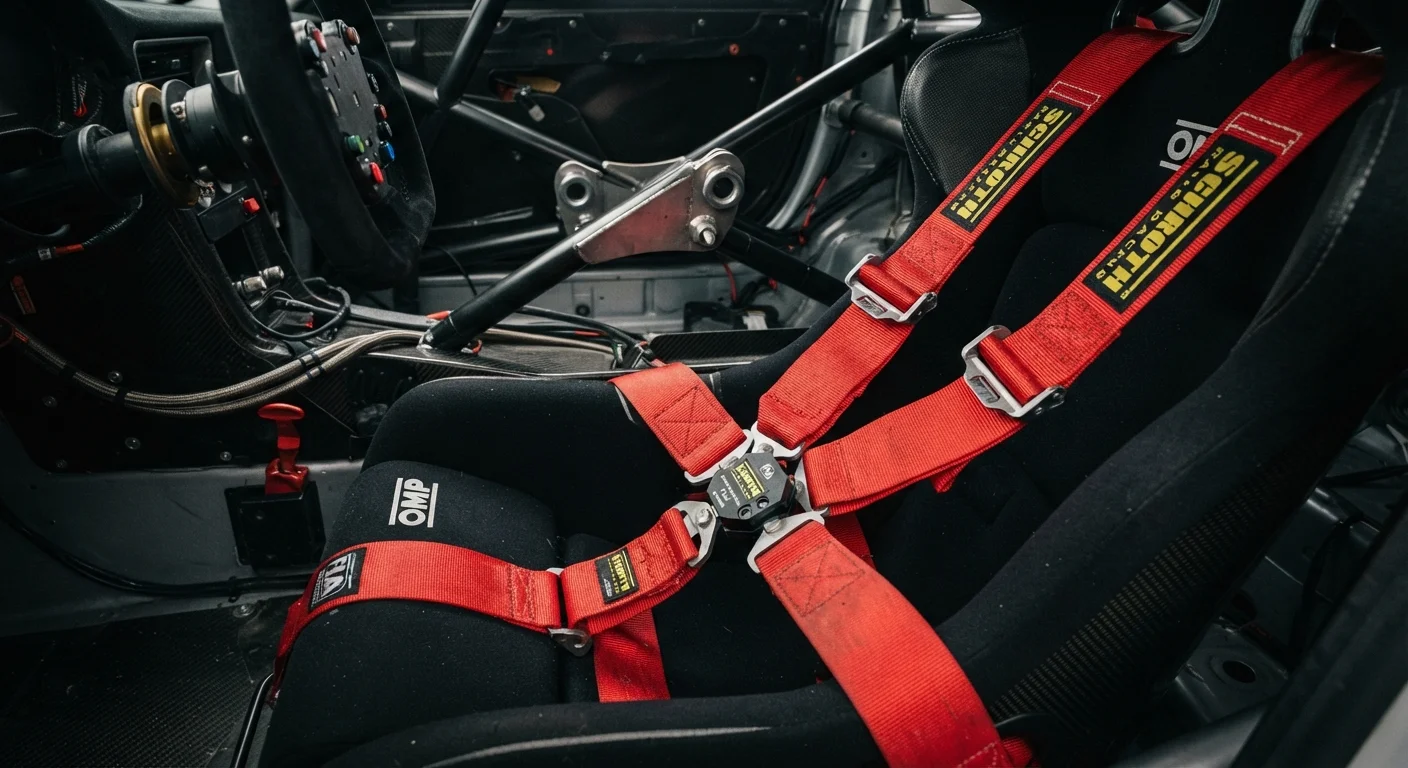
A racing harness looks complex at first glance, but each strap has a specific biomechanical job. Understanding those roles helps explain why harness configuration matters beyond just feeling secure in the seat.
Shoulder Straps
Two wide-webbing straps route over the tops of the shoulders and connect to the central buckle. In a frontal impact, they are the primary load path, transferring deceleration forces into the upper torso and sternum rather than letting the body travel forward. For this reason, their mounting angle is critical - too steep and the force vector is directed downward along the spine, which can cause vertebral compression injuries.
Lap Belt
The lap belt routes across the hip bones (the iliac crests), not the soft abdomen. This distinction matters enormously. A lap belt positioned correctly sits low and flat across the pelvis, transmitting loads into one of the body's most robust skeletal structures. A mispositioned lap belt sitting on the abdomen can cause internal injuries even in moderate impacts.
Anti-Submarine Straps (Crotch Straps)
These one or two straps run between the driver's legs and anchor to the seat or floor. Their sole purpose is to prevent submarining - the forward-and-under movement of the pelvis that causes the lap belt to ride up over the abdomen. In a 4-point harness, this protection is absent. Five- and six-point designs address it directly.
6
Maximum attachment points in a competition harness
Six-point harnesses add two crotch/anti-submarine straps to the standard four-point configuration, addressing the submarining failure mode identified in racing incident analyses.
5 years
FIA harness certification service life
FIA 8853/8854-certified harnesses are recognized as certified for five years from the manufacture date, after which they must be replaced for use in FIA-sanctioned competition.
20°
Maximum recommended shoulder strap downward angle
Most harness manufacturers and motorsport safety guidelines specify that shoulder straps should not descend more than 20 degrees below horizontal from the driver's shoulder to avoid spinal load redirection.
The Buckle
Most competition harnesses use a central release buckle - either a cam-lock or a rotary (pull-to-release) mechanism - that allows all straps to disengage simultaneously with a single motion. This is a deliberate safety feature: in a fire or rollover situation, extraction speed matters. Buckle hardware is load-rated, and that rating is part of the overall harness certification.
Certification Standards: SFI vs. FIA
Two standards govern racing harness certification in practice: SFI (SFI Foundation, based in the US) and FIA (Fédération Internationale de l'Automobile, international). Neither is inherently superior - they test for similar outcomes using different methodologies, and sanctioning bodies specify which they accept.
SFI 16.1
SFI 16.1 is the primary US harness specification. It covers webbing tensile strength, hardware pull strength, and buckle release force. Certification tags include a date quarter and year; many sanctioning bodies enforce a two-year window from that date. After expiration, the harness may still be physically intact but it is no longer recognized as certified.
FIA 8853 and 8854
FIA specifications require dynamic sled testing in addition to static strength tests, which is a more demanding protocol. FIA 8853 covers standard harnesses; FIA 8854 covers harnesses used with HANS devices. FIA-certified harnesses carry a five-year service life from manufacture date.
Street Use and Legal Considerations
Racing harnesses are not designed or certified for use in road-going vehicles. They are engineered to work within a complete safety cell - containment seat, roll cage, and neck restraint - that is absent in street cars. Using a race harness without these complementary systems in a street car can actually increase injury risk in a crash involving airbag deployment or without a proper seat structure.
Harness Compatibility with HANS Devices
FIA 8854-certified harnesses include specific shoulder strap geometry and clip anchor points designed to interface with HANS-type devices. If your sanctioning body requires or recommends a neck restraint device, verify that your harness is rated for HANS use - not all 8853 harnesses include the necessary clip hardware. See our overview of neck restraint devices for motorsport for more on that pairing.
For drivers participating in events sanctioned by SCCA, NASA, or other US organizations, check your specific rulebook - some classes accept either standard while others mandate one or the other. See our guide to in-car safety equipment for track day participants for a broader look at how harnesses fit into the overall safety system.
Installation Basics and Common Errors
A harness is only as effective as its installation. Proper mounting requires compatible hardware, correct geometry, and - in most cases - a containment seat with dedicated harness slots. Installing a racing harness into a standard factory seat is a significant mismatch: the seat's structure is not designed to work with the load paths a harness creates, and the belt geometry will likely be wrong from the outset.
Always Follow Manufacturer Torque Specs
Harness mounting hardware - eyebolts, backing plates, and bracket bolts - should be torqued to the values specified by the harness and seat manufacturers, not just tightened by feel. Under-torqued hardware can shift under load; over-torqued fasteners can crack backing plates or distort seat structures. Use a calibrated torque wrench and recheck after the first few sessions.
Mounting Points
Shoulder straps typically route through openings in the seat back and attach to the roll cage, a dedicated harness bar, or reinforced chassis points. Lap belts bolt to the seat frame or floor using Grade-8 hardware and load-spreading backing plates. Anti-submarine straps often use a dedicated eyebolt through the seat or floor pan. All mounting points must be capable of withstanding the forces specified by the harness manufacturer - improvised anchor points are a documented failure mode.
Shoulder Strap Angle
This is the most technically consequential dimension of harness installation. The straps should exit the seat back and travel rearward at no more than 20 degrees below horizontal, measured from the driver's shoulder. Steeper angles redirect crash energy into the spine. Some seats and cage designs make achieving this geometry difficult, which is a reason to plan the seat and cage as a system rather than add the harness after the fact.
For a deeper look at how fit and adjustment interact with safety performance, see our article on fitting safety gear correctly. And since harnesses are designed to work alongside neck restraint systems, pairing this knowledge with an understanding of neck brace principles for motorsport rounds out the picture.
Installation involving structural modifications to a vehicle should be performed or inspected by a qualified roll cage fabricator or safety equipment specialist. This article is for educational purposes only and is not a substitute for manufacturer installation instructions or professional guidance.