Why DIY Diagnosis Goes Wrong
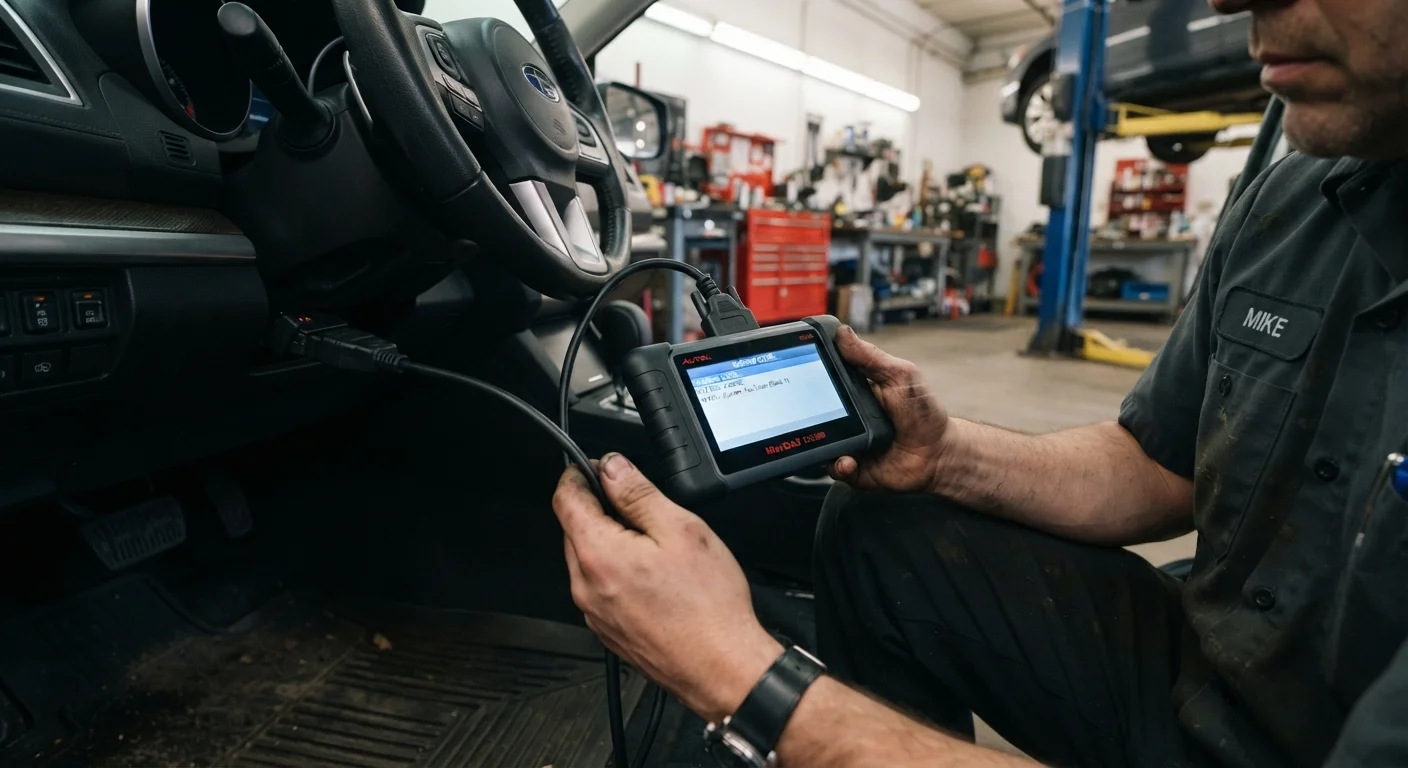
Pulling a fault code, searching the symptoms online, and ordering a part - it feels like a logical process. For many owners, it works out. But for a significant number, it results in wasted parts, unresolved problems, and trips to a shop that should have happened first. The issue isn't that owners attempt diagnosis - that's valuable - it's that several persistent myths shape how they interpret what they find.
Understanding these misconceptions doesn't mean abandoning DIY diagnosis. It means doing it more accurately. See our guide to what owners can realistically diagnose themselves for a grounded picture of where self-diagnosis succeeds and where it falls short.
Myth
A fault code tells you exactly which part to replace.
Fact
A fault code identifies a circuit or system that is out of specification - it does not name the failed component.
This is the most damaging myth in DIY diagnosis. When a scanner returns a code like P0171 (System Too Lean, Bank 1), it means the engine control module has detected a lean air-fuel mixture on one side of the engine. The cause could be a faulty mass airflow sensor, a vacuum leak, a failing fuel injector, a weak fuel pump, a dirty throttle body, or a leaking intake manifold gasket - among others.
The code is the starting point for a diagnostic process, not the conclusion. Replacing the part most commonly associated with a code - without testing or confirming it - is called parts cannon diagnosis, and it's one of the most reliably expensive mistakes an owner can make. See our walkthrough of reading and interpreting OBD-II fault codes for guidance on what to do after a code appears.
Myth
If the warning light turns off on its own, the problem is gone.
Fact
Most warning lights clear when the fault condition temporarily disappears - the underlying cause almost always remains.
Modern engine management systems monitor sensor readings continuously and will extinguish a warning light when readings return to an acceptable range. This is a feature of the system's logic, not a confirmation that a repair has occurred. A marginal oxygen sensor, for instance, may read normally when the engine is cold, triggering a fault only after it warms up - then appearing to clear when the car is parked.
Stored fault codes often remain in the ECU's memory even after the light clears. An OBD-II scanner will retrieve these pending or stored codes even when no light is active. Dismissing a self-clearing light is a common reason serious problems go unaddressed until they become failures. What your check engine light is actually telling you explains the difference between active, pending, and cleared codes.
Myth
No fault codes means nothing is wrong.
Fact
Many vehicle faults - mechanical wear, fluid leaks, belt noise, brake issues - produce no fault codes at all.
OBD-II systems monitor electronic circuits and sensor outputs. They do not detect worn brake pads, a slipping clutch, a leaking power steering rack, a failing wheel bearing, or a stretched timing chain unless these problems happen to affect a monitored circuit. Noise, vibration, handling changes, and fluid loss are diagnostic clues that require human observation, not just a scanner.
A clean scan result is genuinely useful information - it narrows the search - but it is not a clean bill of health. Treating it as one leads owners to dismiss real symptoms because they didn't produce a code. Understanding when visual inspection outperforms scanning helps clarify what each method can and cannot reveal.
Myth
Intermittent problems that come and go aren't serious enough to investigate.
Fact
Intermittent symptoms often indicate early-stage failures that will become complete failures - frequently at the worst possible moment.
An intermittent hesitation, a stall that happens once and never repeats, or a warning light that flickers briefly are all signals worth pursuing. They are hard to diagnose precisely because they don't present consistently, but that difficulty doesn't reduce their significance. A marginal crankshaft position sensor, for example, may cause only occasional stalling for weeks before it fails completely and leaves the vehicle undriveable.
Mechanics use strategies such as reviewing freeze-frame data (the sensor readings captured at the moment a code sets), monitoring live data while replicating driving conditions, and checking for wiring and connector issues to track down these faults. How mechanics approach intermittent fault diagnosis covers these techniques in detail.
Myth
You only need a scanner - a visual check is a waste of time.
Fact
Many faults that generate codes or symptoms are immediately visible on physical inspection, and a scanner cannot see them.
Before connecting any scan tool, a methodical walk-around and underhood inspection can identify cracked hoses, disconnected connectors, obvious fluid leaks, burnt wiring, or corrosion that explains the fault entirely. These checks take minutes and often make the rest of diagnosis unnecessary.
Over-reliance on electronic scanning also creates blind spots: a scanner reads what sensors report, and if a sensor is reading correctly but a mechanical component it monitors has failed, the data can appear normal. Combining both approaches - visual first, electronic to confirm - is the standard professional method, not a redundancy. Review our article on when visual inspection and scanning each work best for a structured approach.
How These Myths Lead to Real Costs
Each myth above represents a pattern of reasoning that feels sound but consistently produces bad outcomes. The part-replacement trap - buying a sensor because a code mentions it - is probably the most common and expensive. A study of DIY repair patterns consistently shows that unnecessary parts purchases cluster around misread fault codes.
~40%
DIY repairs that don't fix the original problem
Industry repair data consistently shows a substantial share of owner-attempted fixes fail to resolve the fault, often due to parts being replaced based on codes alone without further testing.
P0420
Most commonly misdiagnosed fault code
Catalytic converter efficiency codes are frequently misread as requiring immediate cat replacement, when the cause is often a failing oxygen sensor or exhaust leak upstream.
The "cleared light means fixed problem" myth is particularly risky because it can delay attention to genuinely serious issues. A coolant temperature fault that triggers briefly and then clears hasn't necessarily resolved - it may simply be waiting for the right conditions to recur. Intermittent faults are notoriously difficult to catch precisely because they don't stay visible long enough for owners to act on them.
Skipping the visual check in favor of immediately grabbing a scan tool is another common shortcut that backfires. A cracked vacuum hose, a loose ground strap, or a visibly corroded connector can cause dozens of different fault codes - and no scanner will tell you to look at the wiring harness. Visual inspections and electronic scanning each have their place, and skipping one rarely saves time overall.
Don't Clear Codes Before Diagnosis Is Complete
It can be tempting to clear fault codes after reading them, especially if a light is annoying. However, clearing codes also erases stored freeze-frame data - a snapshot of sensor readings at the moment the fault occurred - which is often the most useful information available. Clear codes only after a repair has been made and verified, not as a diagnostic step.
If you've already replaced a part and the fault persists, don't continue substituting components hoping to stumble on the answer. Systematic diagnosis - confirming a fault before acting on it - is the only reliable approach. Chasing the wrong fault costs time and money in ways that compound quickly.